
SAFE SPORT REQUIREMENTS for GYMNAST at REGIONALS and NATIONALS
FROM USA GYMNASTICS
The U.S. Center for Safe Sport has created a new requirement that all athletes, age 18 or older, must complete the U110 to be in the field of play. The course is free and must be completed prior to March 23, 2019. This is a mandate from the USOC for all National Governing Bodies, not just USA Gymnastics.
Please see below the message that was sent to the membership Monday.
USA Gymnastics will not begin auditing athlete membership records for compliance until April 23, 2019. This is after L9/10 Regionals but before E/W and JO Nationals. I DO NOT want to tell an athlete who qualifies to any post season Championship meets that she cannot compete in that competition. Please help me remind these athletes that this needs to be completed asap. I certainly don’t expect them to do this before this weekend’s competitions but definitely before the championship meets roll around.
Please share this messaging to any clubs, coaches or athlete that may reach out to you with any question or concerns or direct them to contact the Member Services Department directly at 800.345.4719 or via email atmembership@usagym.org.
| Every athlete receiving this email is impacted by the U.S. Center for SafeSport’s recent update to its education policy, in accordance with federal law, regarding USA Gymnastics athlete members who are 18 years of age or older. The U.S. Center for SafeSport mandates the SafeSport training requirements for all national governing bodies, including USA Gymnastics. The center requires all adult professional members of USA Gymnastics to complete the U110: SafeSport Course. The Center’s policy changes and the specific structure of USA Gymnastics requires that adult athlete members now must also complete this training. Effective immediately, all USA Gymnastics adult (18+) athlete members are required to complete the U110: SafeSport Course. The U.S. Center for SafeSport’s deadline for athlete compliance is March 23, 2019. The course is free and takes approximately 90 minutes to complete. USA Gymnastics has developed step-by-step instructions to help you to access and take the course. Click here for the instructions. Victims/survivors of any type of abuse may qualify, on a case-by-case basis, for an exemption from this education and training policy. Athletes may make their requests directly with the U.S. Center for SafeSport at ngbservices@safesport.org. The Center’s goal is to increase awareness of athlete safety, not only with you as an athlete member of USA Gymnastics, but also athletes in all amateur sports and affiliated organizations. The U.S. Center for SafeSport course is an important educational tool toward building a strong community effort for safety. Increasing awareness with you, our athletes, is a critical step in protecting you and the people around you. If you need assistance in registering for the course, please contact the Member Services Department at 800.345.4719 or via email at membership@usagym.org. We thank you in advance for completing the course by the deadline of March 23, 2019, and we hope this course will be a beneficial part of your continued safe sport education. |
We Must Allow Our Children To Fail
We Must Allow Our Children to Fail
Our job as coaches and parents is to prevent traumatic head injuries or that possibly badly broken limb but at the same time we must allow for skinned knees and scraped palms.
If we protect them from everything we do not prepare them for anything.
I am not one of those parents who laments the downfall of society because we do not spank our kids and make them learn cursive writing. The norms of society changes with each generation. I look back at what was an acceptable coaching practice when I first started coaching and I wonder, “what were we thinking?”. Common practices in the gym today will be looked at with scorn in a decade.
The only constant in life is change.
and failure.
If it wasn’t for failure we would never learn. I do not think we should set our children or our gymnasts up for failure. But we have to let kids figure somethings out themselves.
The recent college admissions scandal may seem like an extreme case that only pertains to wealthy elites with the means to bribe people to get their children into top universities. But it touches on the pressured feelings almost all parents and students feel today. It also highlights the way many parents are cheating their kids out of an important life lesson: how to fail and bounce back. This is not a parent networking and calling a friend or colleague to give a child a second look. This isn’t a parent paying for a tutor or SAT prep courses. This is parents bribing their child’s way into a school. *
Where does it end? Will a parent bribe their child’s way into their first job? Into public office? This is the natural destination for a generation of children who have never been allowed to fail or even struggle. Not in schools, not in sports, not on the playground. The current attitude is that a child is successful based on their talent. If they struggle it is not because they are not as talented- it is because the system is rigged or that a teacher or coach didn’t do their job. **
The concept of “helicopter parents” who hover over all aspects of their kids’ lives has been around for a while, but over the past year, there have been more headlines about “lawn mower parents,” who mow down every obstacle or difficulty their children may have to face.
It’s natural for parents to want to protect their children from disappointment, but doing so can ultimately lower their self-esteem and set them up for more difficulty in the future.
As coaches and parents we have to give the children the information they need. Do not hold anything back. Allow them to make some decisions and accept the consequences.
The Importance Of Failure
In an interview with Huffington Post, Kim Metcalfe, a retired professor of early childhood education and psychology and author of Let’s Build ExtraOrdinary Youth Together said, “Parents who give permission for kids to fail are building social and emotional skills and qualities that last a lifetime ― persistence, positive self-image, self-confidence, self-control, problem-solving, self-sufficiency, focus and patience,” But allowing your child to fail almost seems to go against nature, noted Jessica Lahey, a teacher, journalist and author of The Gift of Failure: How the Best Parents Learn to Let Go So Their Children Can Succeed.
She said that parents feel bombarded by frightening headlines along the lines of “it’s impossible to get into college today” or “the next generation of kids is unlikely to do better economically than their parents.”
“When faced with those sorts of scary scenarios, we tend to go into ‘protective parent mode,’ which is evolutionarily rational,” Lahey explained. “But we’re reacting to things that aren’t actually threats. It’s not a threat that our child can’t get into Harvard. It’s not a threat that our kid is not the top-scoring player on the soccer team. It’s something that’s beneficial for them to have to experience.”
Because parents have the instinct to protect their children from failure and disappointment, it’s necessary to take a step back and understand what real threats are versus what’s actually just part of growing up.
“Failure is part of life, and if our children don’t have the opportunity to fail or make mistakes, they’ll never realize they can bounce back. That’s what resilience is all about,” said Michele Borba, an educational psychologist and author of UnSelfie: Why Empathetic Kids Succeed in Our All-About-Me World. “Your child doesn’t learn to bounce back because you told them they could but because they experienced it. Then when the problems get really huge, they’ve got that gumption inside to realize, ‘Hey I can do this!’”
One of the best ways to help a child build his or her sense of self-esteem is to separate your own self-worth as a parent from your children’s accomplishments.
Teach Failure And Resilience Every Day
The Power Of Brainstorming
Borba recommends making brainstorming part of kids’ day-to-day experience to help them practice coming up with solutions to problems.
“When your child makes a mistake, don’t berate the child for the mistake but make it into a question of ‘What are you going to learn from it?’ ‘What’s one way you could do that differently?’ or ‘OK, let’s figure out what to do next,’”
Kids Need To See Their Parents Struggle
Sharing stories of past failures and how you moved on can be beneficial for your children, but what’s even more helpful is keeping your kids in the loop as you face adversity in the present.
Life is not perfect. We all struggle. That is normal. We need to teach our children how to get through adversity. When to try it alone and when to seek help.
*when a parent donated a few million so the school can build a lab, a building or fund a scholarship and then their child gets in, at least others can enjoy the product of their legal bribe.
** I do believe for some that the system is rigged and not necessarily fair. A non political non socio economic example would be baseball. I live in the North East of the USA. An area that sees 4-5 months of cold/snow where playing outside is severely limited. A thousand miles to the south playing baseball year round is possible. A prospective baseball player living there has more time to play the game. More time for organized or unorganized practice time, more time to perfect basic elements. (conversely there are not a lot of down hill skiers from Florida).
After writing this yesterday I came across an article in INC Magazine. WANT TO RAISE SUCCESSFUL YOUNG ADULTS? STOP LAWNMOWER PARENTING.
Real Growth Begins At The END Of Your Comfort Zone
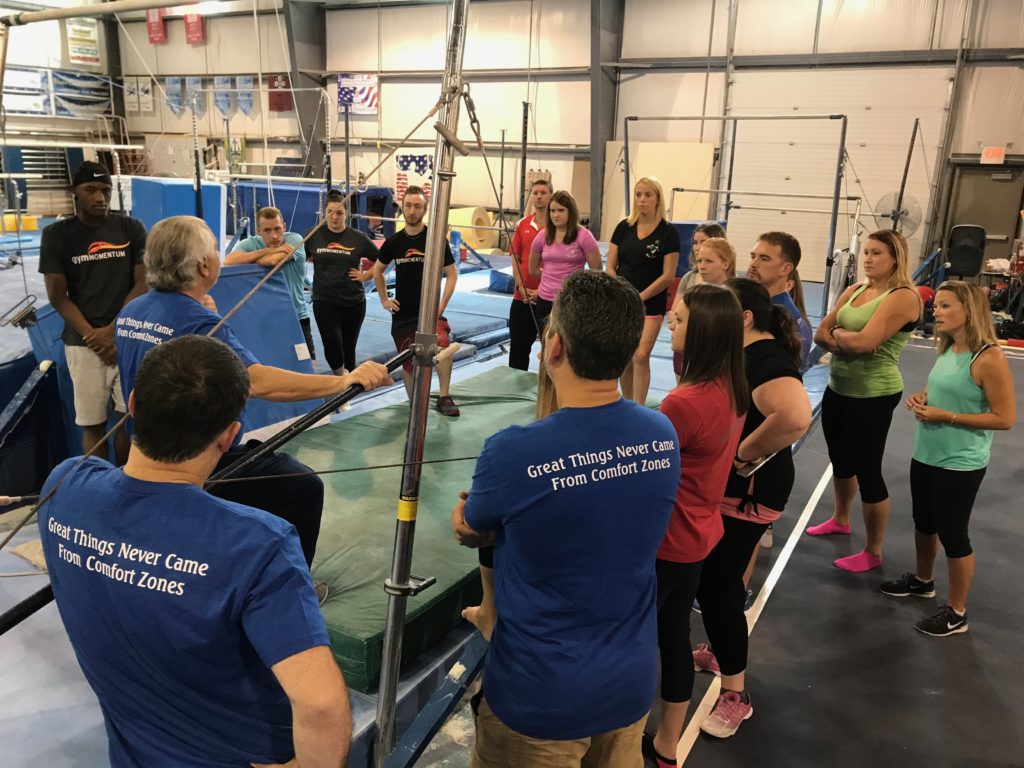
At GYM MOMENTUM TRAINING CAMP we believe that only in a state of discomfort can you grow and achieve your greatest potential.
As a gymnast or a coach in order to get better you need to get out of your comfort zone. If you find yourself in a place where everything is “OK” or everything is “good” , you are probably stuck NOT BEING AWESOME. I have seen many coaches and gymnasts flounder and be miserable because they are simply in a comfortable spot. Things are easy and they are not improving.
Breaking a habit, trying a new skill or technique, making new connections, are not going to be easy, but it’s worth it. It’s exhausting but rewarding.
Calvin Coolidge said “All growth depends upon activity. There is no development physically or intellectually without effort, and effort means work.”
Go where the demands are high. Go where the pressure is to perform.
Dr. Elizabeth Lombardo, Psychologist and author of “Better Than Perfect”, says people who regularly seek out fresh experiences tend to be more creative and emotionally resilient than those who remain stuck in a routine.
“Breaking your own mold can only make you stronger and more confident to reach higher levels in your professional and personal life,” she says.
To grow as a gymnast or coach you need to embrace the discomfort. The transition will be uncomfortable and scary, but daring greatly can push you further than you can imagine. Stretch yourself. You might just like what’s possible.
Discomfort is a catalyst for growth. It makes you yearn for something more. It forces you to change, stretch, and adapt.
The secret to success lies in the very thing you’re avoiding. Those things that seem to break you down and humble your spirit.
Seek out discomfort. Be deliberate about doing things that push your limits magnificently. Difficulty helps you to grow.
If you want long-term success, stop avoiding what’s hard.
If you’re truly pushing yourself to improve — in any capacity whatsoever — you are uncomfortable.
When you are challenged, you are asked to become more than you were. That means creating new perspectives, acquiring new skills and pushing boundaries.
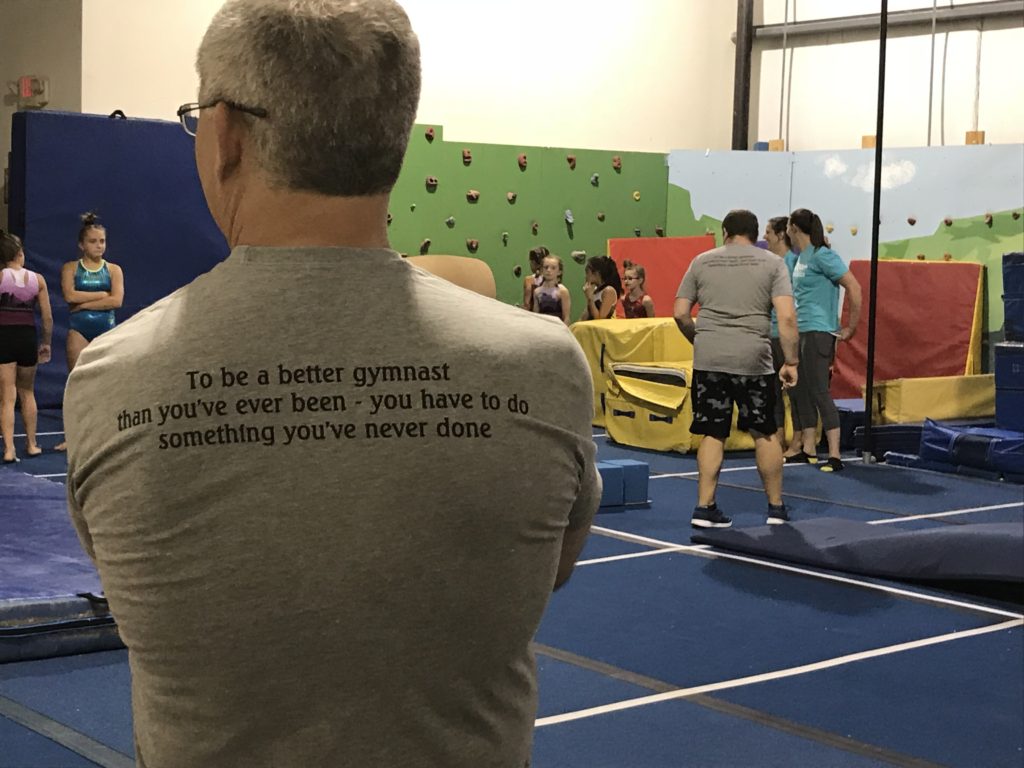
Being challenged in life is inevitable, being defeated is optional, says Roger Crawford.
Don’t fight the discomfort. It’s what you feel when you are growing.
A little push beyond your safe bubble is exactly what you need to grow.
Finding fulfillment in your gymnastics career might just entail stepping outside of your comfort zone once a day, once a week, or even once a month.
Choose what works for you and enjoy the stretch.
If you are serious about improving your future self, get used to being uncomfortable. Comfort can ruin your life. Only in a state of discomfort can you continually grow and achieve your greatest potential.
Gymnasts and Coaches must each build a healthy balance of comfort and adventure.
12 Lessons You Learn OR End Up Regretting
TRAVIS BRADBERRYMARCH 15, 2019
Being busy does not equal being productive.
Sticking your neck out and taking charge of your career is no trivial matter. Whether that’s switching careers, going back to school, or walking away from a j-o-b to start your own business, it takes a lot of guts.
But guts will only get you so far. Once you build up the nerve and make the leap, you’re no more than 5% of the way there. You still have to succeed in your new endeavor, and trying to succeed is when your worst fears (the ones that made you hesitate in the first place) will come true.
I’m going to assume you’re like me and don’t have a brilliant mentor, a rich uncle, or some other person who is going to show you the ropes and explain each step you need to take to take charge of your career.
You see, it’s been almost 20 years since I last had a boss. I went from working in a surf shop to striking out on my own, eventually starting TalentSmart (with a partner) before I’d finished grad school.
When I set out on my own, I had all the gumption and appetite for risk that I needed to take charge of my career. At the time I thought that was all I needed to succeed.
It wasn’t. I also needed guidance. Without it, I learned some difficult (and often painful) lessons along the way.
I’d like to share some of my biggest lessons learned with you so that they can help you as you take charge of your career (in whatever form that takes). As I look back on these lessons, I realize that they’re really great reminders for us all.
1. Confidence must come first

Successful people often exude confidence — it’s obvious that they believe in themselves and what they’re doing. It isn’t their success that makes them confident, however. The confidence was there first.
Think about it:
- Doubt breeds doubt.Why would anyone believe in you, your ideas, or your abilities if you didn’t believe in them yourself?
- It takes confidence to reach for new challenges. People who are fearful or insecure tend to stay within their comfort zones. But comfort zones rarely expand on their own. That’s why people who lack confidence get stuck in dead-end jobs and let valuable opportunities pass them by.
- Unconfident people often feel at the mercy of external circumstances.Successful people aren’t deterred by obstacles, which is how they rise up in the first place.
Confidence is a crucial building block in a successful career, and embracing it fully will take you places you never thought possible. No one is stopping you from what you want to accomplish but yourself. It’s time to remove any barriers created by self-doubt.
2. You’re living the life that you’ve created
You are not a victim of circumstance. No one can force you to make decisions and take actions that run contrary to your values and aspirations. The circumstances you’re living in today are your own — you created them.
Likewise, your future is entirely up to you. If you’re feeling stuck, it’s probably because you’re afraid to take the risks necessary to achieve your goals and live your dreams.
When it’s time to take action, remember that it’s always better to be at the bottom of the ladder you want to climb than at the top of one you don’t.
3. Being busy does not equal being productive
Look at everyone around you. They all seem so busy — running from meeting to meeting and firing off emails. Yet how many of them are really producing, really succeeding at a high level?
Success doesn’t come from movement and activity. It comes from focus — from ensuring that your time is used efficiently and productively. You get the same number of hours in the day as everyone else. Use yours wisely. After all, you’re the product of your output, not your effort. Make certain your efforts are dedicated to tasks that get results.
4. You’re only as good as those you associate with

You should strive to surround yourself with people who inspire you, people who make you want to be better. And you probably do. But what about the people who drag you down? Why do you allow them to be a part of your life?
Anyone who makes you feel worthless, anxious, or uninspired is wasting your time and, quite possibly, making you more like them. Life is too short to associate with people like this. Cut them loose.
5. Squash your negative self-talk
When you’re taking charge of your career, you won’t always have a cheerleader in your corner. This magnifies the effects of self-doubt. The more you ruminate on negative thoughts, the more power you give them. Most of our negative thoughts are just that — thoughts, not facts
When you find yourself believing the negative and pessimistic things your inner voice says, it’s time to stop and write them down. Literally stop what you’re doing and write down what you’re thinking.
Once you’ve taken a moment to slow down the negative momentum of your thoughts, you will be more rational and clear-headed in evaluating their veracity.
6. Avoid asking “What if?”
“What if?” statements throw fuel on the fire of stress and worry, which are detrimental to reaching your goals. Things can go in a million different directions, and the more time you spend worrying about the possibilities, the less time you’ll spend taking action and staying productive. Asking “what if?” will only take you to a place you don’t want — or need — to go. Of course, scenario planning is a necessary and effective planning technique. The key distinction here is to recognize the difference between worry and strategic thinking about your future.
7. Schedule exercise and sleep
I can’t say enough about the importance of quality sleep. When you sleep your brain removes toxic proteins from its neurons that are by-products of neural activity when you’re awake. Unfortunately, your brain can remove them adequately only while you’re asleep.
So when you don’t get enough sleep, the toxic proteins remain in your brain cells, wreaking havoc by impairing your ability to think — something no amount of caffeine can fix.
Your self-control, attention, and memory are all reduced when you don’t get enough — or the right kind — of sleep. Sleep deprivation raises stress hormone levels on its own, even without a stressor present, which are a major productivity killer.
Ambition often makes you feel as if you must sacrifice sleep to stay productive, but sleep deprivation diminishes your productivity so much throughout the day that you’re better off sleeping.
A study conducted at the Eastern Ontario Research Institute found that people who exercised twice a week for 10 weeks felt more competent socially, academically, and athletically. They also rated their body image and self-esteem higher.
Best of all, rather than the physical changes in their bodies being responsible for the uptick in confidence, it was the immediate, endorphin-fueled positivity from exercise that made all the difference. Schedule your exercise to make certain it happens, or the days will just slip away.
8. Seek out small victories
Small victories can seem unimportant when you’re really after something big, but small victories build new androgen receptors in the areas of the brain responsible for reward and motivation.
This increase in androgen receptors increases the influence of testosterone, which further increases your confidence and your eagerness to tackle future challenges. When you have a series of small victories, the boost in your confidence can last for months.
9. Don’t say “yes” unless you really want to
Research conducted at the University of California in Berkeley shows that the more difficulty that you have saying no, the more likely you are to experience stress, burnout, and even depression, all of which make it difficult to take charge of your career.
Saying no is indeed a major challenge for many people. “No” is a powerful word that you should not be afraid to wield.
When it’s time to say no, avoid phrases like “I don’t think I can” or “I’m not certain.” Saying no to a new commitment honors your existing commitments and gives you the opportunity to successfully fulfill them.
10. Don’t seek perfection
Don’t set perfection as your target. It doesn’t exist. Human beings, by our very nature, are fallible.
When perfection is your goal, you’re always left with a nagging sense of failure that makes you want to give up or reduce your effort. You end up spending your time lamenting what you failed to accomplish and what you should have done differently instead of moving forward excited about what you’ve achieved and what you will accomplish in the future.
11. Focus on solutions
Where you focus your attention determines your emotional state. When you fixate on the problems that you’re facing, you create and prolong negative emotions which hinder your ability to reach your goals.
When you focus on the actions you’ll take to better yourself and your circumstances, you create a sense of personal efficacy that produces positive emotions and improves performance.
12. Forgive yourself
When you slip up, it is critical that you forgive yourself and move on. Don’t ignore how the mistake makes you feel; just don’t wallow in it. Instead, shift your attention to what you’re going to do to improve yourself in the future.
Failure can erode your self-confidence and make it hard to believe you’ll achieve a better outcome in the future. Most of the time, failure results from taking risks and trying to achieve something that isn’t easy.
Success lies in your ability to rise in the face of failure, and you can’t do this when you’re living in the past. Anything worth achieving is going to require you to take some risks, and you can’t allow failure to stop you from believing in your ability to succeed.
When you live in the past, that is exactly what happens, and your past becomes your present, preventing you from moving forward.
Bringing it all together
I hope these lessons are as useful to you as they have been to me over the years. As I write them, I’m reminded of their power and my desire to use them every day.
Travis Bradberry is the coauthor of Emotional Intelligence 2.0 and the cofounder of TalentSmart.
This article originally appeared on LinkedIn.
Gymnastics—The “Mother” of All Sports
Gymnastics—The “Mother” of All Sports by Piet Könnicke © Betty Shepherd Once again the world watched spellbound as the Olympic gymnasts performed ever-more-daring feats on the beam, the trampoline and parallel bars. From Beijing, the performances of international stars like Shawn Johnson and Daria Bijak gave youngsters around the globe new reason to dream and say to themselves: “To be able to fly through the air, to do a somersault, would be cool!” And this is a wonderful thought for youngsters to have!
Source: Gymnastics—The “Mother” of All Sports » Take The Magic Step®
Gymnastics—The “Mother” of All Sports

© Betty Shepherd
Once again the world watched spellbound as the Olympic gymnasts performed ever-more-daring feats on the beam, the trampoline and parallel bars. From Beijing, the performances of international stars like Shawn Johnson and Daria Bijak gave youngsters around the globe new reason to dream and say to themselves: “To be able to fly through the air, to do a somersault, would be cool!”
And this is a wonderful thought for youngsters to have! Because you don’t have to be an Olympian to benefit from gymnastics. There’s a reason why it’s called “the mother of all sports.” Simple gymnastic exercises form the basics of many other sporting activities and can create coordination and muscle memory that will last a lifetime. We hope this article-aimed as much at youths as at adults-will inform both groups of readers to the lifetime benefits of early gymnastics.
Children jumping on a trampoline will sooner or later dare to do a somersault or to jump up from a seating position into a standing one. Most children who see a tree limb or a beam will be tempted to balance on it. And the monkey bars on a playground will lure children to climb or to hang from them. In a very natural way these simple gymnastic exercises create a muscle movement pattern and at the same time arouse the child’s ambition to try and master new movements.
Consider adults who want to learn skiing, snowboarding, surfing or skating. They have less risk of falls, injuries and sore muscles if they’ve done gymnastics as a child. Our brain stores movement patterns in so-called engrams which the nervous system can access continuously during our development.
With the learning of gymnastic skills comes the acquisition of general motor skills which are inherent in many other sports. If these basic movement patterns are not acquired at an early age, all other learning processes will be much harder. As early as pre-school, children are ready for gymnastics. There will always be room at home or in the garden for forward and backward rolls, hand or head stands, cartwheels and pull-ups. Trying to reach your toes with your fingertips is a simple gymnastic exercise which can be easily performed-with quickly measurable success. From that beginning until the age of 10 to 12 years, all the important gymnastics movement patterns can be learnt and perfected more easily and can form the basis for almost every other sport.
Climbing, Rolling, Jumping
The benefits of gymnastics are enormous: The sport increases the ability to balance, it also develops good posture. It contributes to the child’s general strength and stability during his or her physical development and promotes agility, flexibility and ability to respond. Above all, however, children gain an awareness of their body in a fundamental way found in no other sport.
In gymnastics, the body is constantly changing its direction and pace. In the process, the interaction of inner and outer forces and the spatial orientation enhance coordination skills as well as the ability to concentrate. Movements such as climbing, hanging, rolling, jumping, dangling, and “flying”-which come naturally to most children-are gymnastic elements that aid in the acquisition of motor and cognitive skills. They incorporate the so-called ‘crossover’ across-the-body axis and support the cooperation of the left and the right sides of the brain. The left side is responsible for analytic thinking, language and logical processes while the right side influences holistic thinking, creativity, spatial orientation, visual imagination and emotions.
Children can be easily inspired to become active and to take part in sports. But for children living in a city, exercise patterns have changed due to urbanization, heavy traffic, constricted living space and tempting television programs and video games. Open spaces for physical activity and opportunities to run, jump, climb, slide, seesaw or swing are sometimes very limited. Therefore it is even more important that urban parents make an effort to find sports and exercise facilities for their children. (*Please see note below.) It should not be too difficult to find a certified gymnastics club or recreational gymnastics group in your area. There you should be able to find a great range of equipment: benches, ropes, wall bars, climbing bars as well as still rings, parallel and uneven bars, balance beams, vaulting horses, trampolines and high bars. If a child displays extraordinary talent, parents should be supportive and consider letting him or her join a club with more advanced opportunities
Success through Cooperation
Gymnastics is an individual sport. However, you train and experience the sport with others. By exercising together children learn gymnastics in a playful manner. Failure and disappointment are quickly forgotten in a group and success is achievable more easily in a common effort. Children learn that helping each other leads to successful completion of an exercise and that even difficult gymnastic elements can be accomplished together.
Assisting others is of fundamental importance in gymnastics-no matter at what level. Children gradually learn to support and trust each other. (Nevertheless children should always be supervised by an adult when exercising).
Common Roots and History
Few sports boast the long tradition of gymnastics. In America and Germany, gymnastics history is closely linked through common roots. As long ago as 1793, Johann Friedrich Gutsmuths published the book “Gymnastics for Youth” in Germany which was later translated into several other languages. Friedrich Ludwig Jahn (1778 – 1852), who is still considered Germany’s “Father of Gymnastics,” became even more well-known. The major gymnastics event he founded is still being held annually and-with thousands of participants-remains enormously popular. It was Jahn who developed the parallel bars, the beam and the rings as gymnastic apparatus. His reputation spread to America and Harvard College tried unsuccessfully to lure him to the United States. Instead the American gymnastics pioneer, Charles Follen, took over at Harvard in 1825. The American gymnastics movement gained further momentum through German immigrants who relocated to America after the German Revolution in 1848/49. Amongst them there were many gymnasts who had been politically active in Germany, who emigrated after the failure of the revolution and who influenced the development of gymnastics in their new home country significantly. Thanks to all these visionaries, gymnastics is now widely available to all of us-both parents and youngsters.
* Take The Magic Step wants all parents to make sure that they find a qualified instructor. Make sure that your instructor has a Safety Certification from USA Gymnastics which is the sole national governing body for the sport of gymnastics in the United States. Ask your instructor for other USAG qualifications as well.
Take The Magic Step staff writer Piet Könnicke is a freelance journalist based in Potsdam, Germany, father of an 11-year-old son, and a lifelong runner.
At Least You Know Who You Are Dealing With
One of the most challenging aspects of coaching gymnastics is that we are working with an ever changing person. When the gymnast says, “it just feels different today,” they are telling the truth. It is different today. They have possibly gotten taller. Their muscles may be tight making them feel slow. They may have added strength or are well rested making them feel fast. Any one of these is going to contribute to things feeling different.
Mentally they could have had a tough day at school. They could have had an argument with a parent or sibling just before getting to the gym. They could also be well rested and in the zone.
How do you tell?
I have always told my gymnasts there will be MAKE IT HAPPEN days and LET IT HAPPEN days. The secret for success is knowing what day you are having.
The gymnasts I coached often joked that they could tell my mood by what colors I was wearing. If I was wearing all black, it was because I was in a bad mood.
I almost didn’t have the heart to tell them I was colorblind and I simply determined what to wear by what was on top of the “ clean pile.”
It would be great to know a gymnasts mental and physical state prior to starting practice. I always try to ask about school, home or how they slept before practice. Nothing formal. Just a conversation. “Hey- how was school today?” or “Did you have a good night?” It helps me coach.
When I travel for clinics, I have the added issue of not knowing the gymnasts and often not speaking the language very well.
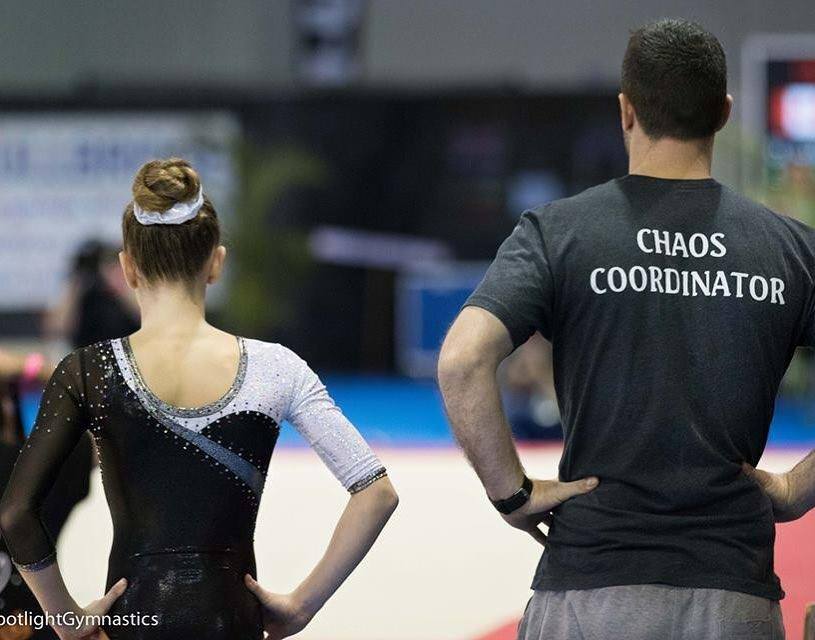
Recently in Civitavecchia, Italy one of the gymnasts wore a shirt that helped me know exactly what I was dealing with!

In truth, this young lady had a great sense of humor and worked extremely hard.

What shirts would you like to see gymnasts wear to help you coach?
You can tweet your answer @gym_momentum or post to Gym Momentum’s Facebook page.
Funniest shirt a gymnast wore in your gym will win a Chaos Coordinator T-shirt!
A letter to the new CEO of USA Gymnastics
A letter to the new CEO of USAG;
I have heard that a new CEO has been chosen and that they are in the vetting and negotiating process. USAG has NOT been on a winning streak recently and I am hoping that we are going to turn this around.
Dear Madam (or Sir); February 13, 2019
The federation has faced a pretty rough few months and there are still rocky roads ahead. Although the growth of registered athletes, despite the recent scandal looks good. It is a reflection of where gymnastics was 6 years ago. The overall feeling inside and outside the gymnastics community is hard to read. I believe that the professional community of coaches and club owners has never felt more vulnerable. It is as if the whole country is waiting for the other shoe to drop. On the whole, I think we can safely assume we’ve weathered the current storm. However, while we can all be grateful for the recent signs of an upturn in our performance, I suspect the next year or two will hold many challenges.
Indeed, the stabilization of our situation offers only a brief reprieve, if any at all. Many of the clubs in the country are still on fragile ground. We operate in an industry that still has many needs. The needs of the gymnasts, parents, coaches, and club owners. The need to perform exceptionally well at international competitions, the need to continue to develop new talent in all the disciplines and build a place where they can train successful and safely. The need to market each discipline. The need to secure sponsors and Television contracts. All this AND we going to be embroiled in lawsuits for at least the immediate future.
It is my feeling that the gymnastics community needs a leader we can rally behind. Someone who can give us hope that we will get through this together. If the professional community doesn’t believe you (or in you) I do not feel that USAG will be long for this world.
In short, you’ll have your hands full indefinitely.
The pressure of achieving results: Meeting targets of any kind can cause immense pressure. As CEO, you will be constantly conscious of these targets…in fact, they will almost consume you.
Solution: Set realistic targets for yourself, for people in the office and for our teams. Assess what’s doable and what’s not. Have a core group of people you can rely on but involve everyone in the plans from day one, so that they are on the same page, and aware of what needs to be done. You will need to deploy a diverse set of people with different competencies to achieve the targets… Successful gymnastics clubs always have individuals with complementary competencies and skills, rather than similar ones, not only does that make a well rounded program in the gym but they are also then able to view and solve problems with a different approach. You will need to get people “on the ground” involved. It can be a motivating force moving toward a shared vision, and not just a gold medal or number
The pressure of always being right: As CEO you will be constantly looked upon as a role model, someone who will not err or fumble, someone who is fair and looks at a problem from different angles. This pressure will often put you in doubt — doubt about the direction the federation is moving in, the decisions you’re taking, and your own capabilities and worth as a leader. ‘To be or not to be’ was not just a dilemma for Hamlet…it’s a dilemma every coach goes through. You may even feel reluctant to continue in your position…
Solution: Realize that all the burden of responsibility is not your own. As CEO, you are largely a facilitator, and you should focus instead on growing your teams, rather than doing everything yourself. It is not essential for you to know and direct on every detail of every aspect … All you need to do is focus on the vision set out, and then nurture great teams to execute them. The more you empower those around you, the less stress you will feel.
Grow a circle of advisors who you can reach out to when in doubt. These should be your confidantes…those you can pour your heart out to, and share your problems with. Take ideas and solutions from them and find strength from their support.
Many people have called for USAG to become more Transparent. What is Transparency? Can you have it without accountability? Too often, leaders don’t know what accountability looks like, much less how to implement accountability in an organization. In order to set the team at USAG on the path to greater accountability and greater results there are a few things that I have found have helped me in my businesses.
Set clear expectations.
Achieving results requires clarity around expectations and outcomes–so it’s on you as a leader to affirm (and reaffirm) that everyone understands what they need to do to achieve success.
Be realistic about what people in the office or out in the field can handle. Avoid overburdening them just to get the results you want, when you want them.
Measure and report progress.
Doc Massimo told me that all my goals as an athlete and as a coach should be clear and measurable. If I can’t measure them, they shouldn’t be a goal. You will need to be transparent and open when measuring and reporting progress. The board may need to be reminded that a change in priorities may mean a change in the Key Results in the short term that will define success for the organization in the long term.
Give and receive feedback.
Keeping the feedback loop open is crucial to great leadership. In my gyms I do not want “Yes men”. I need people around me who can give and take feedback. I have a policy of “catch them doing something right”. It’s easy to fall into the trap of giving feedback only when something goes wrong, but that conditions employees to associate feedback with failure or punishment. And always ask for feedback as often as you give it.
Encourage risk taking.
Collaboration and innovation is fostered in an environment where risk-taking is encouraged–even when a project or action isn’t guaranteed to succeed. I have written many articles on Failure being a prerequisite for success. In too many organizations, the fear of punishment strongly deters risk-taking. Sometimes the only way to achieve success is to take risks along the way. Build a culture of trust, collaboration, and transparency by letting those in the National office or in the field take risks and learn from failures. Encourage people to engage in creative problem-solving so they can learn what it feels like to overcome obstacles together.
Inspire gymnastics professionals to take ownership.
Accountability is all about ownership. Right now I think about 80% of the coaches out there want the National office to swoop in and fix all the problems. When the office does make a decision all they do is complain. There needs to be accountability through out the gymnastics community. A professional who skirts their responsibilities, expecting others pick up the slack, does little to encourage a proactive, dynamic culture. Everyone must be focused by ensuring that everyone is on board with the federations objectives.
These are just a few of my ideas to help you keep your balance and beat the pressures you will face daily as CEO. Of course there will be many more, as the leadership role is vast…
Today’s times are rightly described as VUCA — volatile, uncertain, complex and ambiguous. These factors will play havoc in the life of the leader too.
But as CEO, if you decide to face these situations with calm and equanimity you will be an inspiration to many.
Tony Retrosi
Want to Raise Successful Kids? Science Says Teach Them Any 1 of These 7 Things. Or better yet, help your kids learn them all.
I recently read this in INC Magazine. Definitely something to share at your gym.
How can you teach your kids to be successful — and more important, live happy and fulfilled lives?
1. Teach them to seek small wins first.
According to research, gaining agreement has an effect — even if only over the short term.
Teach your kids that, instead of jumping to the end of their argument, they should start with statements or premises they know their audience will agree with. Teach them to build a foundation for further agreement.
A body in motion tends to remain in motion, and that also applies to a head that nods in agreement.
2. Teach them to focus on positive outcomes.
While it’s tempting to use scare tactics, positive-outcome statements tend to be more persuasive. (Researchers hypothesize that most people respond negatively to feeling bullied into changing a behavior.)
So if your kids are trying to create a change, tell them to focus on sharing the positives of that change. They want to take their audience to a better place, not tell their audience what to avoid.
3. Teach them to dare to take a stand.
You would assume data and reasoning always win the day, right? Nope. Research shows humans prefer cockiness to expertise. We naturally assume confidence equates with skill.
Even the most skeptical people tend to be at least partly persuaded by a confident speaker. In fact, we prefer advice from a confident source, even to the point that we will forgive a poor track record.
So teach your kids to be bold. Teach them to stop saying “I think” or “I believe.” Teach them to stop adding qualifiers to their speech. Tell them, “If you think something will work, just say it will work. If you believe something will work, just say it will work.”
Teach your kids to stand behind their opinions — even if they are just opinions — and to let their enthusiasm show. People will naturally gravitate to their side.
4. Teach them to understand the way others prefer to process information.
A fellow supervisor used to frustrate the crap out of me. (Read the next paragraph to see how that swearing thing works.)
I was young and enthusiastic and would burst into his office with an awesome idea, lay out all my facts and figures, wait breathlessly for him to agree with me — and he would disagree.
Every time.
Finally — it took way longer than it should have — I realized that he wasn’t the problem. My approach was the problem.
Not to go all Myers-Briggs on you, but he was an “I.” He instinctively wanted time to think. He liked to process. By demanding an immediate answer, I put him on the defensive, which led him to fall back on the safe choice: Saying “no.”
So I tried a different approach. “I have an idea that I think makes sense,” I said, “but I feel sure there are things I’m missing. If I run it by you, could you think about it for a day or two and then tell me what you think?”
He loved that. One, I implicitly showed I valued his wisdom and experience. Two, I implicitly showed I didn’t just want him to agree. I really did wanted his opinion.
And most important, I gave him time to process my idea his way.
Teach your kids not to push for instant agreement when an individual’s information-processing preference makes that unlikely.
And teach them not to ask for thought and reflection if their audience loves to make quick decisions.
5. Teach them not to be afraid to show a little emotion.
Cursing for no reason is just cursing. But say a team needs to pull together immediately pull together.
Tossing in an occasional — and heartfelt — curse word can actually help instill a sense of urgency because it shows you care. (And of course it never hurts when a leader lets a little frustration or anger show, too.)
In short, teach your kids to be themselves. Authenticity is always more persuasive. If your teenager feels strongly enough to slip in a mild curse word, he or she should feel free (in the right setting, of course). Research shows they’re likely to be a little more persuasive.
(And don’t tell me your teenagers never curse. Didn’t you?)
6. Teach them to share the bad with the good.
According to University of Illinois professor Daniel O’Keefe, sharing an opposing viewpoint or two is more persuasive than sticking solely to your argument.
Why? Very few ideas or proposals are perfect. Your audience knows that. They know there are other perspectives and potential outcomes.
So teach your kids to meet objections head on. Tell them to talk about the things their audience may already be considering. Teach them to discuss potential negatives and show how they will mitigate or overcome those problems.
Teach your kids to talk about the other side of the argument — and then do their best to show why they’re still right.
7. Teach them to not just say they’re right. Teach them to be right.
Persuasive people understand how to frame and deliver their messages, but most important, they embrace the fact that the message is what matters most.
Teach your kids to be clear, concise, and to the point. Teach them to win the day because their data, reasoning, and conclusions are beyond reproach.
What’s true for your kids applies to all of us: The art of persuasion should always be the icing on a logical cake.
Intention
in·ten·tion \in-ˈten(t)-shən\
: the thing that you plan to do or achieve : an aim or purpose
: a determination to act in a certain way : resolve
This time of year many people make NEW YEARS RESOLUTIONS. They set goals for the year in business, in life and in the gym. Goals are great but a goal must start with intention. The problem with just setting goals is that goals generally do not allow for failure and in failure there are many lessons to learn.
In the gym, it is vital for both coaches and gymnasts to have INTENTION in their training. You must train with a purpose. Training is the path which leads to success. If your have no purpose to your training, it is easy to get lost.
The past few years I have done many, many clinics at many gyms through out North America and into Iceland and Europe. When I walk in the first thing I ask is, “What is the goal? What are we going to do?”
I can always tell a program that has a purpose. They are confident in the process and progression. The gymnasts know what they are doing and where they are going.
– Does your team have intention? Or are you wandering around?
Gymnasts MUST have intention as well. When they get up on a Beam, or get ready to Vault or Bars or Tumble- What do they INTEND to do?
They may wobble or fall but then they make a correction.