VAULT
BARS
FLOOR
TWISTING- Teach It Right The First Time
In GYMNASTICS, time is not our friend. There are constant reminders through out warm up and competitions. Looking at time as a whole, it works against us. In college recruitment, in skills, on a path to elite. tic, tic, tic. Time only moves in one direction.
Reality is that technology makes you impatient. It used to take months to get across North America. Now it is a pretty easy flight. Did the continent get smaller? No- we got faster. If you wrote to someone in Europe from USA it could take as much as a month for the letter to arrive. Today it takes a fraction of a second for an e-mail to make it anywhere in the world (or even up to the freaking space station!).
In the gym, we view skills as “easy” because they are performed frequently. The double back on floor does not even raise an eyebrow unless is is tremendously HIGH or frighteningly LOW. Women must have been competing it for ever! Nope. Nellie Kim of the former USSR competed it at the Montreal Olympics in 1976 (An Olympics I was at as a 10yr old spectator). It was competed at other competitions (but not internationally) back in 1972. The Layout Yurchenko, also known as the “Level 9 compulsory vault” was first competed in 1982. In the grand scheme of things, these are pretty new skills. Are these skills done more frequently now because they are easier? Maybe yes, maybe no. Technology has made advancements in that Floors have gotten more springy and the vault table replaced the old horse. The innovations of numerous training aids like the Tumbl Trak and pits have allowed more attempts. Technically the skills have the same physical demands.
Looking at practices:
In a 45 minute rotation
At vault a gymnast, if they are VERY efficient, is going to take maybe 10 turns. Maybe 6 will be vaults that they are planning on competing.
Total time of work: 35 seconds. Counting return stations I will be generous and say 2 minutes.
At bars an efficient gymnast may do 5 routines plus a couple of parts.
Total time of work: 3.5 – 4.5 minutes.
At beam, 5-10 routines plus parts.
Total time of work: 12 minutes average .
At floor, 2 or 3 routines, plus extra passes and dance.
Total time of work: 7-9 minutes.
Warm up, conditioning and flexibility: Total time of work:
MAYBE 27 minutes (assuming the warm up run is about 12 minutes and flexibility is about 10 minutes)
In a 4 hour work out total time of work: MAYBE 50 minutes.
It gets WORSE when you think about competitions.
At a competition a gymnast is doing minimal amount of work. The focus is on quality, not quantity.
Vault: Total time of work: Maybe 30 seconds. Time of work in competition: 7 seconds
Bars: Total time of work: 2 minutes. Time of work in competition: 15-30 seconds
Beam: Total time of work: 3 minutes. Time of work in competition: 1.5 minutes
Floor: Total time of work: 2 minutes. Time of work in competition: 1.5 minutes
IF you were to compete EVERY weekend (not a good idea) a gymnast is spending on average :
3 hours on vault (8-10 minutes of work) for 7 seconds of competition.
3 hours on bars (16 minutes of work) for 30 seconds of competition
3 hours on beam (40 minutes of work) for 90 seconds of competition
3 hours on floor (28 minutes of work) for 90 seconds of competition.
We have a LOT of time that we spend in a practice NOT working. Are your gymnasts focused on what they did and the correction they need to make or are they thinking about what they are going to have for dinner?
In most gyms there is VERY little about what you can do to increase efficiency physically. Is there anything you can do to keep the gymnasts engaged mentally?
Time is NOT going to be your friend in the gym. You need to make sure you have a plan and a back up plan. Look not just at the big picture but also each event and side station.
I’d love to hear your ideas.
Press Handstand.
This by NO MEANS is an original piece of work. It is a compilation of the drills and ideas of myself, Steve Arkel, Jacobo Giron, Jason Mortimer, Don McPherson, John Min,, James Parent, Quinn Shannon, Brandi Smith-Young, and John Wojtchuk
As we go into TOPS Testing this weekend lets give some thought into one of the tested Physical Ability Elements at TOPS, Developmental Camps and National Team Camps.
I had done a few clinics and training camps this fall and in 2 gyms they did NO press handstands. I couldn’t figure out why. When I asked they said that they were difficult to spot and that they didn’t view them as necessary. Maybe I was missing something so I sent out an e-mail to some colleagues whom I have a great deal of respect for. I wanted to get their thoughts, opinions and progressions.
The importance of the Press- Why it is necessary and tested.
“No rope climbs= no gymnastics
No press handstands= no gymnastics
Not doing both= no gymnasts”
Don McPhersonVERY simple, press and cast handstand on bars. Good shape in press good shape for bars. Teach lean on shoulders and get the butt up before the feet. If you can’t get your butt over your head in a press how can you get your butt over your head on bars?
Jacobo GironI do them religiously, need them for Tops, and the benefits are quite apparent. My strongest athletes especially on bars are my press masters. I work them everyday and spot too plus lots of supplementary drills to strengthen and stretch the proper areas. There is a video post from Worlds now with athletes doing presses repeatedly for two minutes. My first time at National camp back in 2001, Dr. Sands stressed the importance of presses and how the USA improvement correlated with presses. Interesting then and a proponent always. My two cents.
John Min
Do they expect their athletes to cast to a handstand one day? Stalders? Tkachev?
I would say press handstands would be beneficial for the following skills:
• Cast Handstands
• Shoulder strength for opening up in a clearhip/toe on
• Compression for Stalders
• Tkachev
• Safety in general mechanics of skills as you have to do each piece of the spine in a row. Trying to skip a vertebrae while “rolling up” into the handstand will lead to injury.
James ParentPresses are a must for gymnast!
They teach the athlete stacking/body alignment in an upper body loaded position and how to balance the body and spine inverted. When done correctly the moving in and out of shaping, finding spine neutral, actively and coordinating opening from thoracic extension and scapular upward rotation promote the shaping necessary to peak any skill. It is important athletes can actively get into spine neutral and with end ranges of scapular upward rotation and elevation while breathing utilizing the central stability system to achieve motor control and strength to transfer forces later in everything from vault to tumbling, to series on beam to truly pushing away from the bar to swing bars and not muscle bars. Press handstand are foundation for many progressions.
Brandi Smith-YoungDevelopment of general core strength and balance, development of HS position, body control during vertical movements, teaching to control balance while on hands and moving through different body shapes
Directly related to Cast straddle up AND STRAIGHT BODY HS (Look at the movement of the arms opening) on bars, all stalder or endo skills, toe shoot skills, a beam mount/skill, some possible choreography on floor
John Wojtchuk
Progressions and drills.
Prerequisite Skills: good balanced HS, good straddle “L” hold
(It may be argued a “toe – touch press” should be here also but I consider it a drill. – JW)
General Preparation:
Strength: Straight arm raise w. weight (also from laying down position on chest on a raised panel mats – lift dumbells from hanging straight down to horizontal (body is now straight as if a HS position); holding s straddle “L” position
Flexibility: Good shoulder flex (for HS), good “pancake” on floor, good pike compression stretch (floor and standing)
A different way of thinking about it would be to use gravity to help rather than hinder. The kinetic chain can learn backwards as well as forwards. Rather than pressing up to a handstand. a gymnast can start in handstand and press down. An athlete , especially a young one, will tend to push if working in reverse rather than working up bending the arms trying to lower the head and shoulders in order to get the hips in balance. This method works well on numerous skills to include cast handstand and Kip just to name a few. Some pressing drills reversed against the wall work well. Working with your seat (instead of shoulders) against the wall gets the desired lean forward and balance through the shoulders in order to get the hips over-the-top.
Drills:
Common Errors:
There are many benefits of doing the press in different places as well.
1: press on a low rail
2: press sideways on beam
3: press longways on beam (English)
4: press on end of vault board
5: press on P Bars
6: press on rings
7: press on pommel horse w/pommels
Mix it up and alternate days. Do 5 repetitions of 4 of the above with 60 second holds after 5th one and alternate which every week.
In 1976 my coach offered a bunch of us an opportunity to go at watch the Olympics in Montreal. There were about 10 of us in a motel room. We took the Metro every day over to the Olympic Park to watch gymnastics.
It was great to be able to go back up there. Taking the Metro to the Olympic Park the first day certainly gave me a feeling of de ja vu.
As has been widely reported- There were a lot of falls. That is pretty normal for the year after the Olympics. What I found troubling was the amount of injuries that occurred on both the Men’s and Women’s side. Speaking to many of the c0aches and competitors they were NOT happy with the schedule. Not enough time to adjust from travel and not enough time to adjust to the bright lights on the podium.
Big winners over all- Morgan Hurd (the Harry Potter loving NEW World Champion) on the Women’s side and Ruoteng Xiao for the Men.
Biggest Loser- Gym Nova the equipment company. The floor broke on Day One of Men’s preliminaries and an entire rotation had to compete again. (First time there was a 9th person in Men’s FX finals due the the break in floor). A Beam that very few people seemed to be able to stay on.
Craziest new skill – “The Flying Dutchman” Epke Zonderland missed a hand on is Kovacs and managed to HANG ON!
https://www.youtube.com/watch?v=6TZucAeUx-g
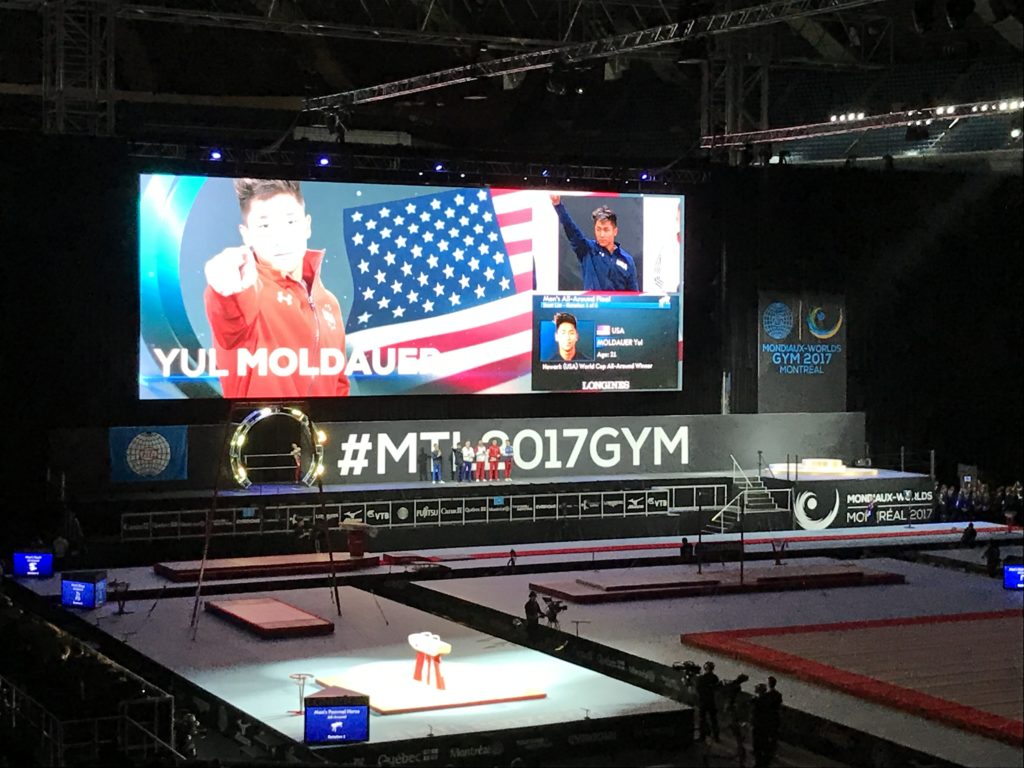
Most Pleasant Surprise. Yul Moldauer (USA). Super clean (I believe he had the Highest E scores of the entire championships). Good difficulty. Finishing 7th AA and medaling on FX. I loved his excitement as he came off equipment.
Now that the qualifications at the 2017 Montreal World Championships are finished, let’s crunch a few numbers.
Source: International Gymnast Magazine Online – Crunching the Numbers in Montreal
Now that the qualifications at the 2017 Montreal World Championships are finished, let’s crunch a few numbers.
Before we do, let’s note that at the individual worlds in 2013, there were 80 women who tried to qualify to the all-around, and 81 men. In 2009 there were 83 women and 74 men.
Women’s competition: Among the 75 women attempting to qualify to the all-around final, there were 16 execution scores of 9.0 or higher, and all were on vault. The E-scores of those all-arounders across all four events ranged from 1.466 to 9.300. On balance beam, there was only one E-score score of 8.0 or above (8.133). Among the specialists, there was one 9+ E-score on uneven bars, a 9.033, and a few more on vault.
The difference in total score from the leader, Mai Murakami (55.933) and last place, Milca Leon(33.431), was 22.502.
Men’s competition: Among the 59 men attempting to qualify to the all-around final, there were 24 execution scores of 9.0 or higher, and all but one was on vault. A 9.233 was awarded on parallel bars. The E-scores on all six events ranged from 3.766 to 9.633. Among the specialists, there were two 9+ scores on rings, a 9.10 and 9.033, a 9.033 on p-bars and several more on vault.
The difference in total score from the leader, Manrique Larduet (86.699), and last place, Ahmed Mosa(61.398), was 25.301.
Suffice to say, gymnastics is really hard under the open-ended Code of Points, which, by its design, entices gymnasts to attempt their hardest skills. If you can’t score a 9.0 on any apparatus but vault, you might as well throw your most difficult tricks since the D-score is immune to deduction. The natural evolution of the sport was suddenly put into overdrive because of the open-ended Code.
The result of that trend was on full display during the qualifications in Montreal, where there were more falls than Niagara and a multitude of injuries. This Code has simply made the sport too difficult for the majority of countries.
We can only hope that the FIG takes notice, and also takes the necessary steps to make gymnastics more beautiful than it is right now.
Numbers don’t lie.
Source: Nine Original Women’s Elements Submitted At 2017 World Championships | FloGymnastics
Seven original elements yet to be performed in major international competition in Women’s Gymnastics stand to be named after gymnasts at the 2017 Artistic Gymnastics World Championships in Montreal, Canada.
If a gymnast who has submitted a skill to be named for her completes the new element without a major deduction at the World Championships, the element will be named after that gymnast in the International Gymnastics Federation (FIG) women’s code of points.
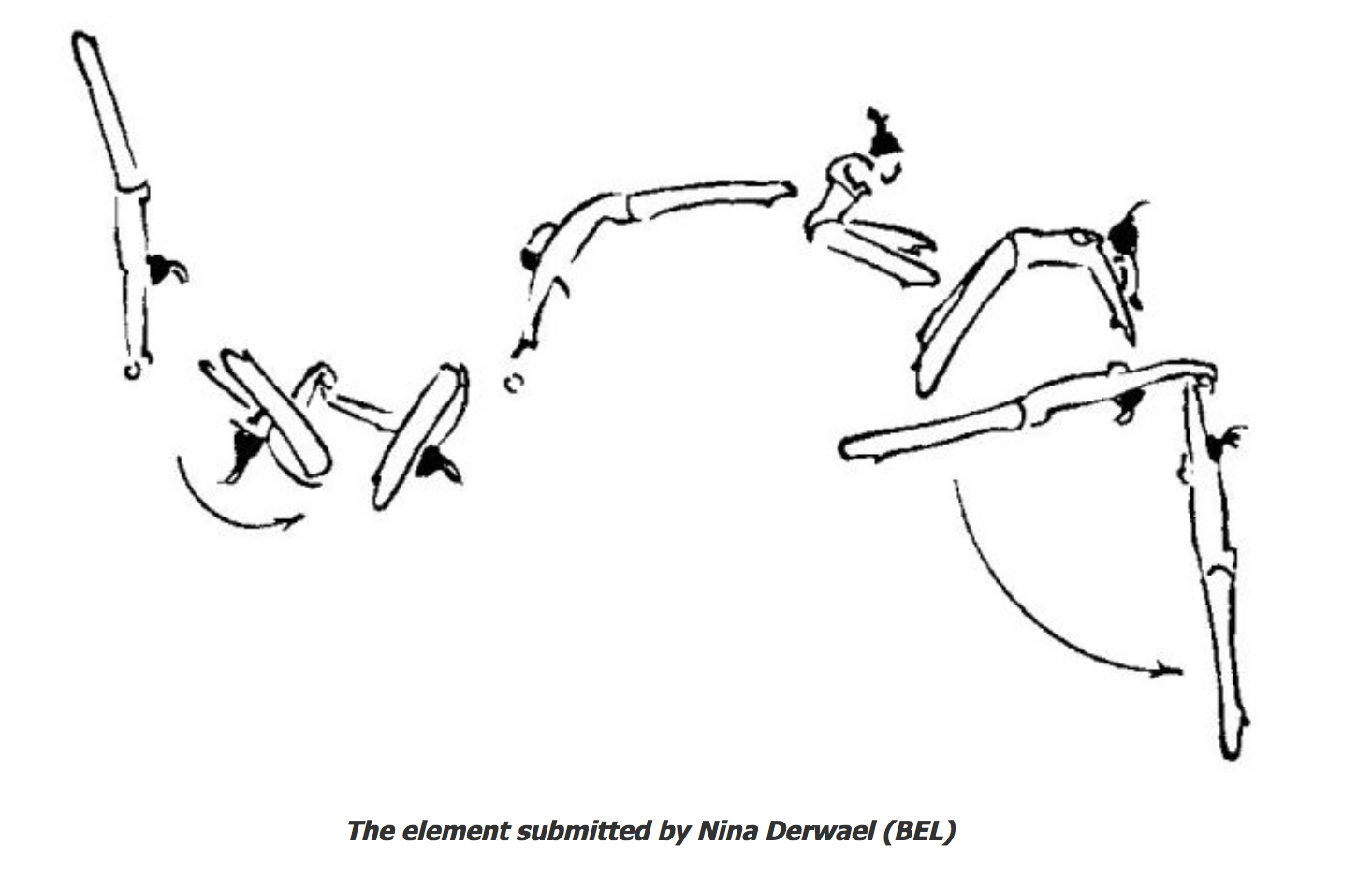
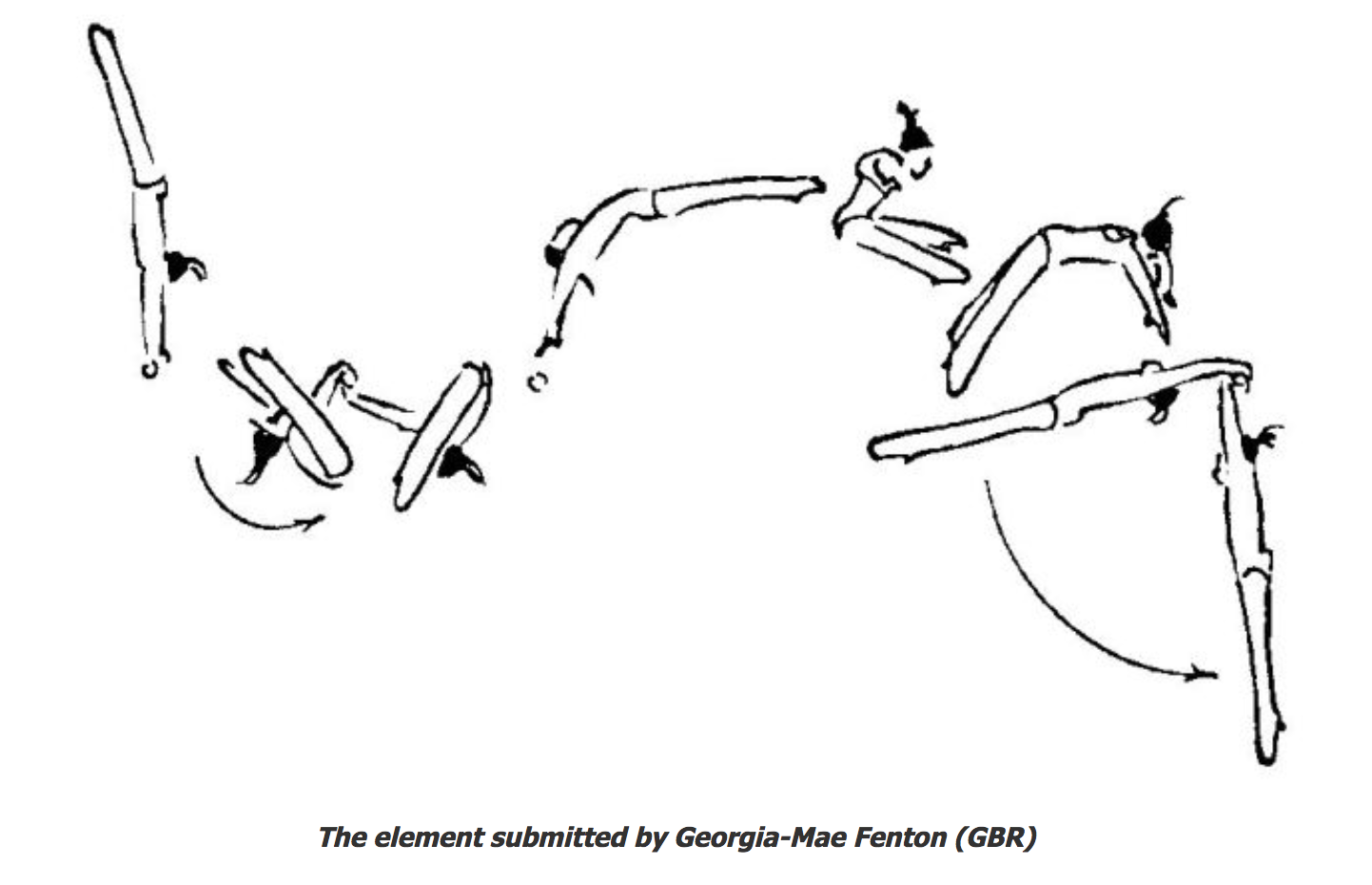
According to the FIG, If Nina Derwael and Georgia-Mae Fenton, who submitted the same skill on bars, both complete it successfully, the element will be named after both athletes.
The new skills were submitted by federations and evaluated prior to the start of the world championships by the FIG Women’s Technical Committee. In order to have an element named in the men’s code of points, a female gymnast must successfully perform a submitted skill at least once in world or Olympic competition.
Full press release via FIG here.
Here are the new elements under consideration:
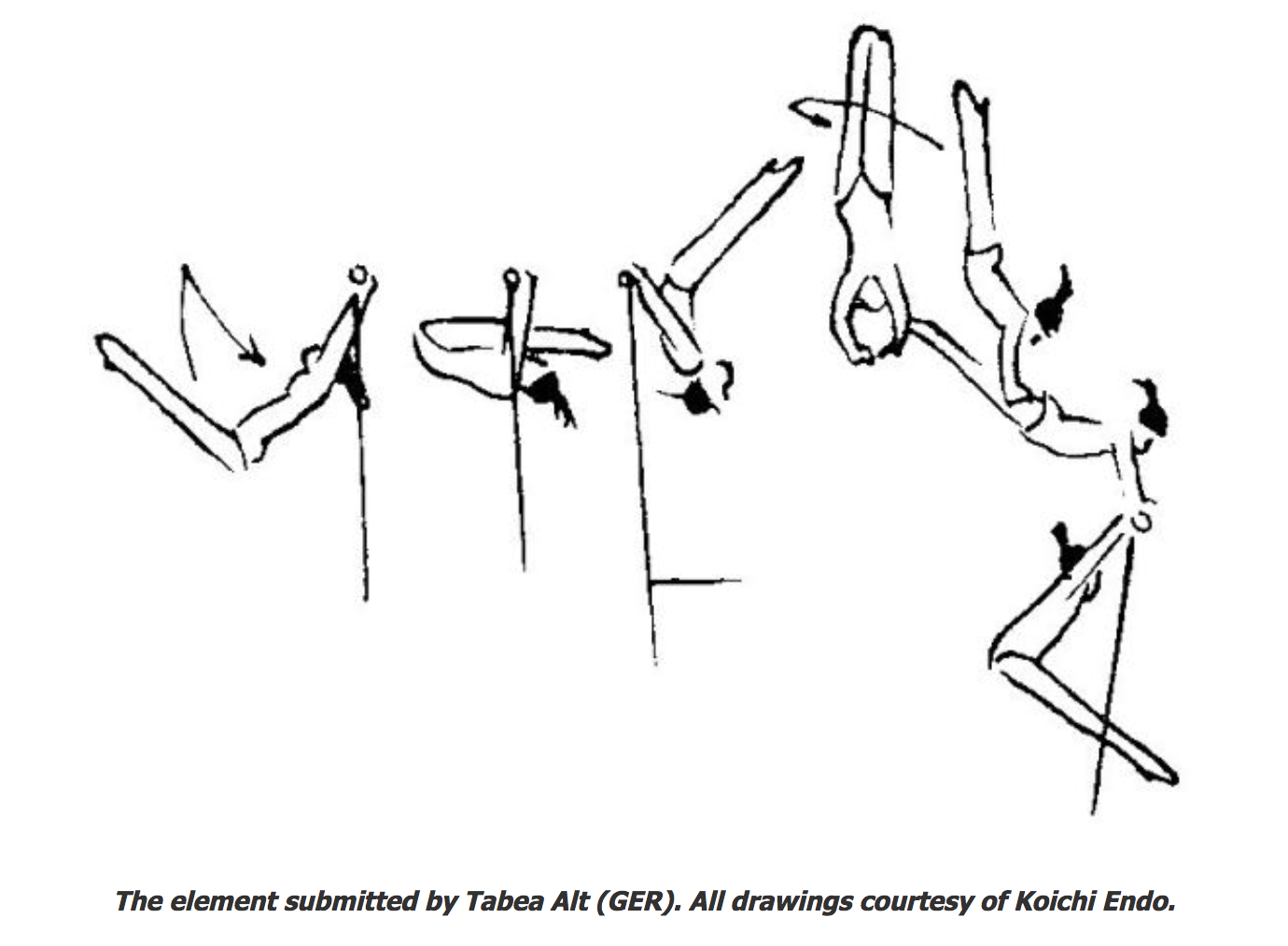
Submitted by: Tabea Alt, GER
Apparatus: Uneven Bars
Element description: Stoop through on high bar, dislocate and release with half (180 degree) turn in flight between the bars to catch low bar in hang
Element value: C

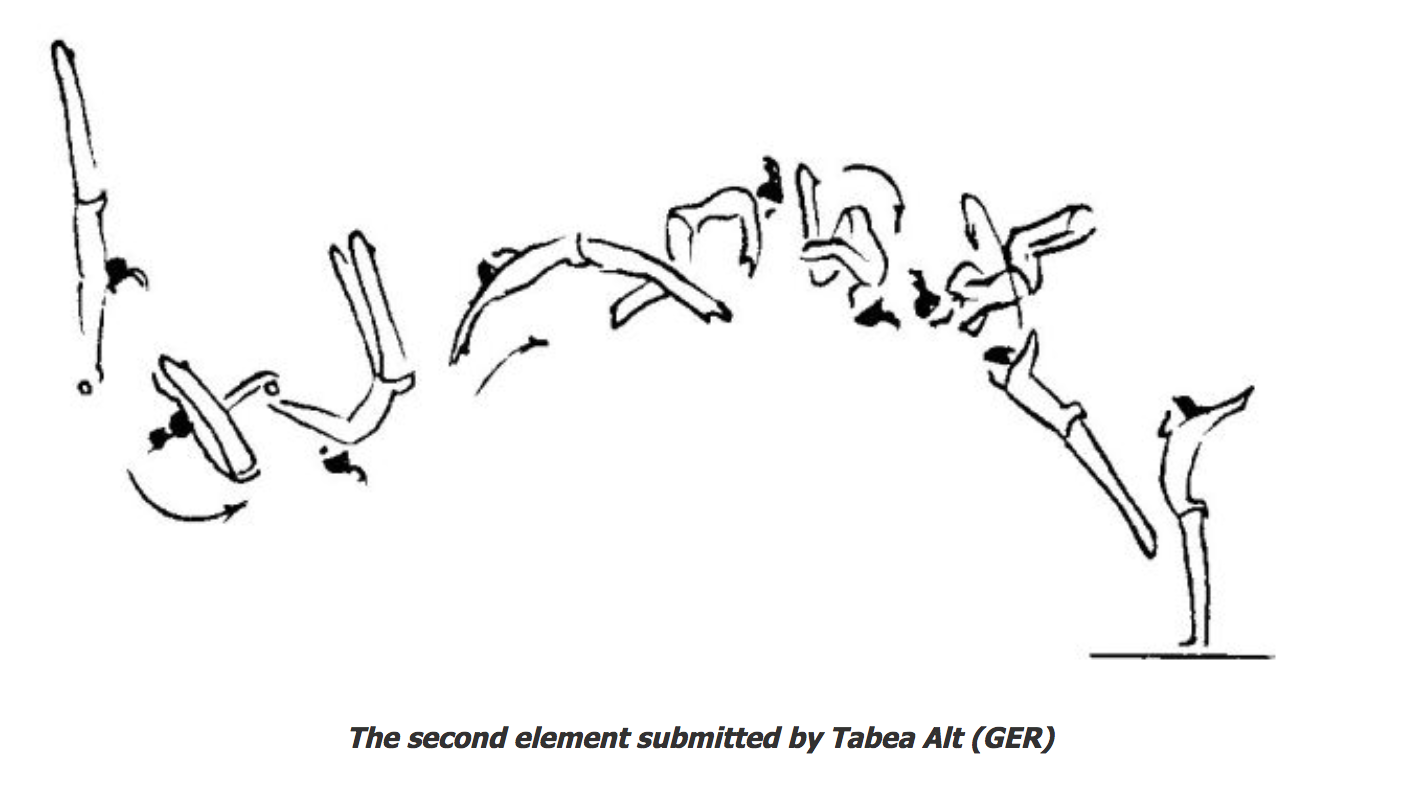
Submitted by: Tabea Alt, GER
Apparatus: Uneven Bars
Element description: Dismount: Clear straddle underswing with forward tuck salto with half (180 degree) turn
Element value: C

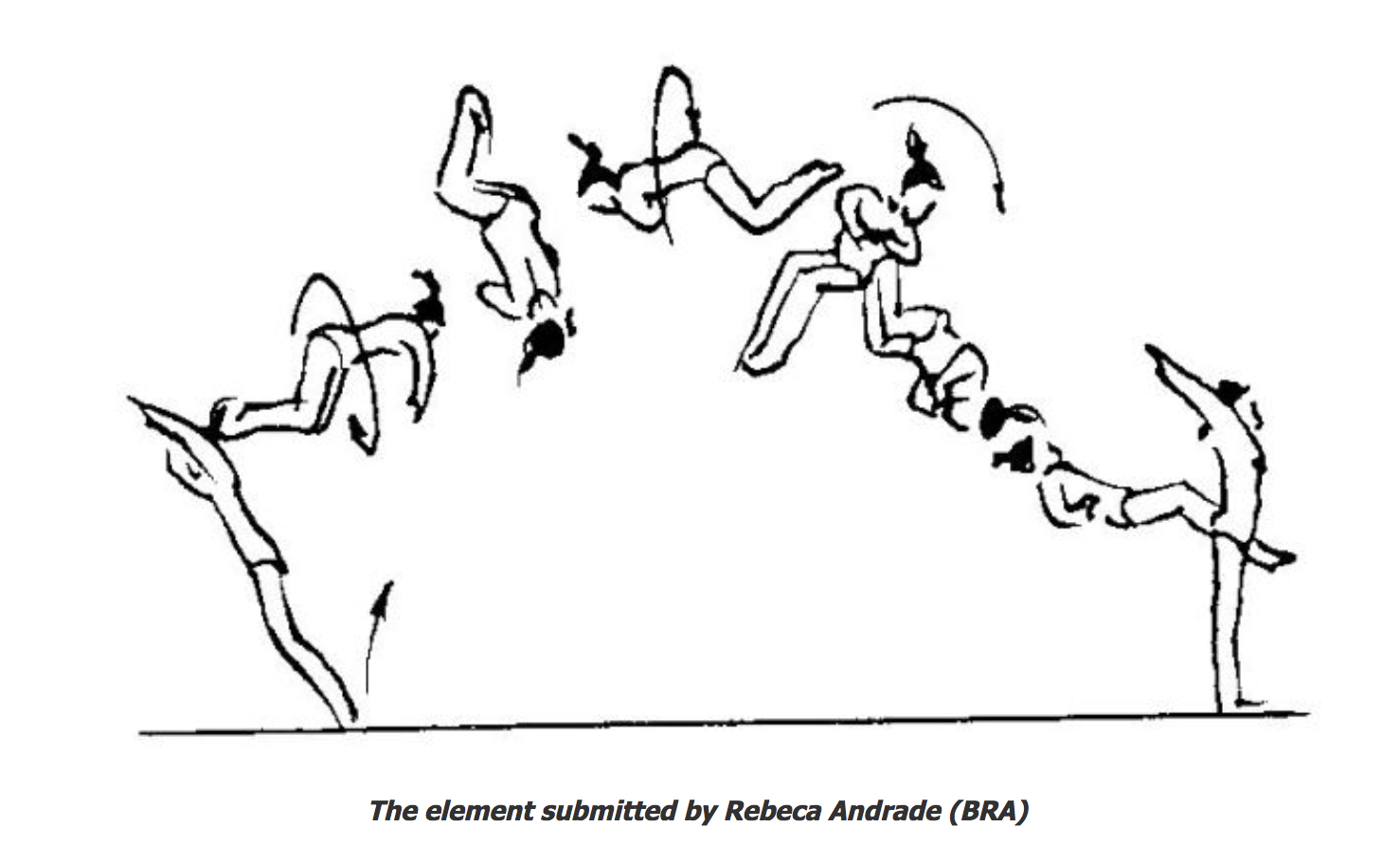
Submitted by: Rebeca Andrade, BRA
Apparatus: Floor Exercise
Element description: Double backward salto in tuck position with one and a half (540 degree) twist
Element value: G

Submitted by: Nina Derwael, BEL
Apparatus: Uneven Bars
Element description: Backward stalder with counter straddle reverse hecht over the high bar with half (180 degree) turn to hang in mixed L-grip
Element value: F

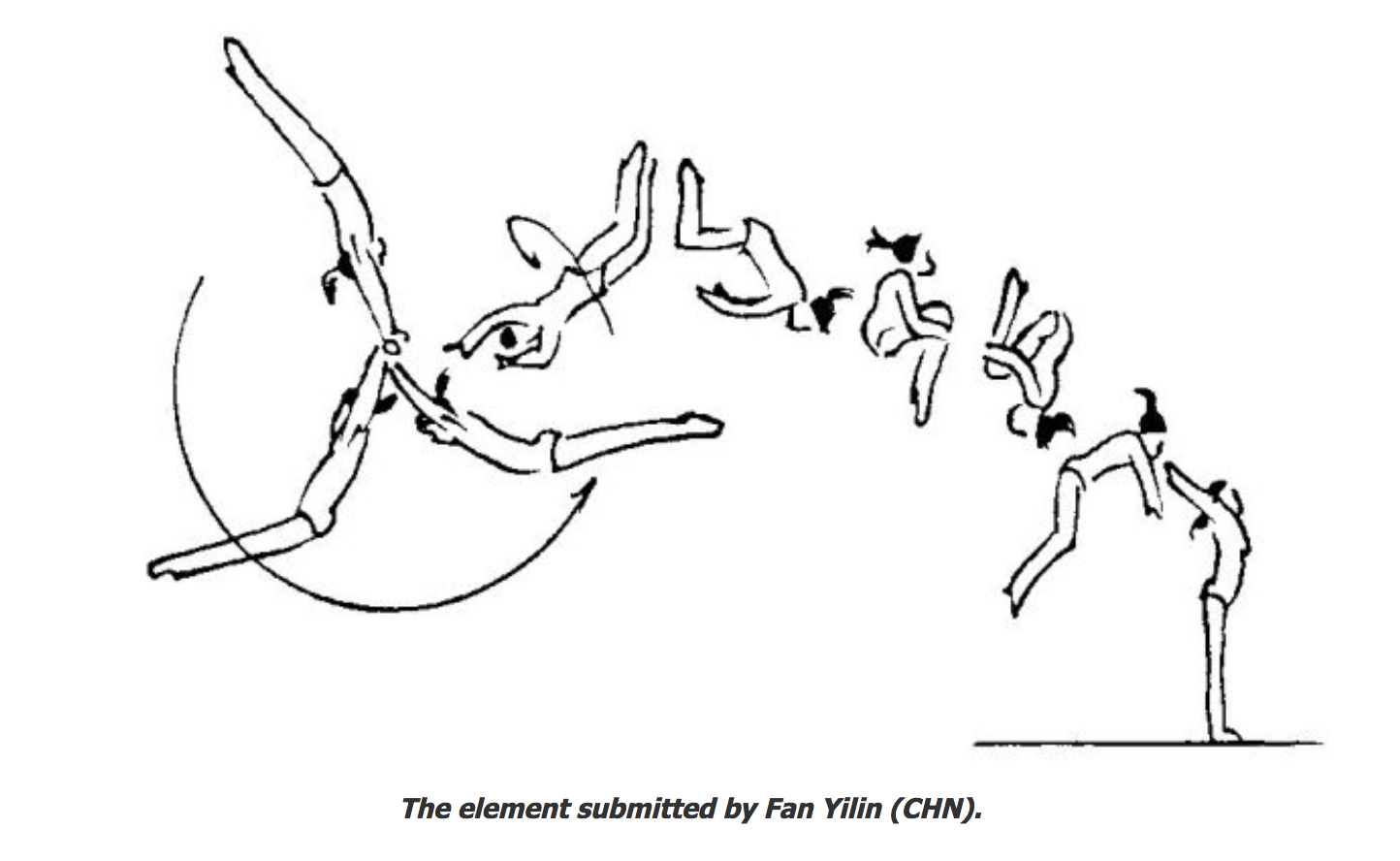
Submitted by: Fan Yilin, CHN
Apparatus: Uneven Bars
Element description: Dismount: From L-grip, swing backward, half (180 degree) turn to double salto backward tucked
Element value: D

Submitted by: Georgia-Mae Fenton, GBR
Apparatus: Uneven Bars
Element description: Backward stalder with counter straddle to reverse hecht over the high bar with half (180 degree) turn to hang in mixed L-grip
Element value: F

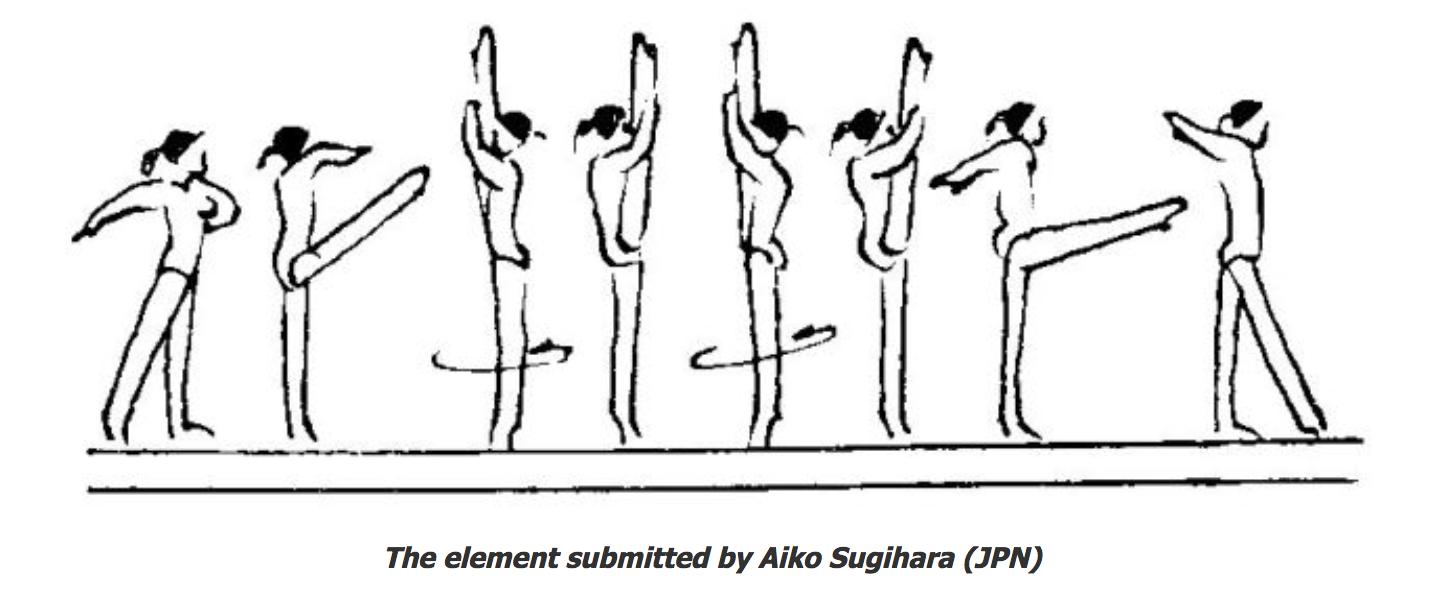
Submitted by: Aiko Sugihara, JPN
Apparatus: Balance Beam
Element description: Double (720 degree) turn with free leg held at 180 degree split throughout the turn
Element value: E

Submitted by: Aiko Sugihara, JPN
Apparatus: Balance Beam
Element description: Two and a half (900 degree) turn with free leg held at 180 degree split throughout the turn
Element value: E
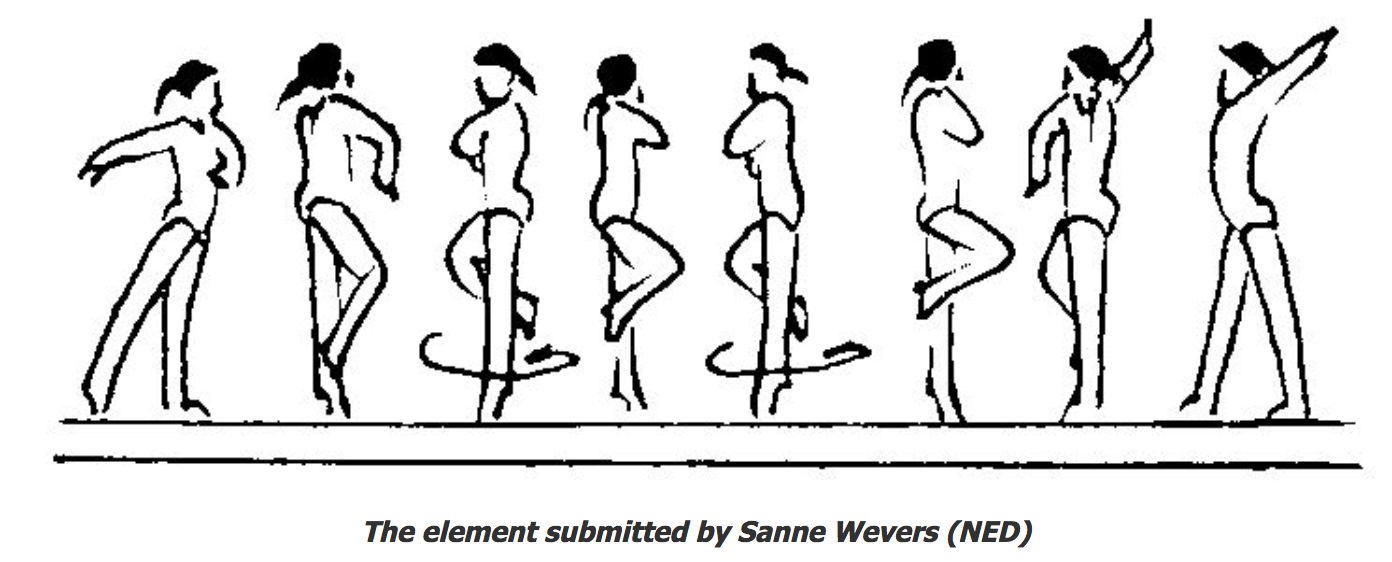
Submitted by: Sanne Wevers, NED
Apparatus: Balance Beam
Element description: Two and a half (900 degree) turn with free leg position optional
Element value: D

Source: Seven Original Men’s Elements Submitted At 2017 World Championships | FloGymnastics
Seven original elements yet to be performed in major international competition in Men’s Gymnastics stand to be named after gymnasts at the 2017 Artistic Gymnastics World Championships.
If a gymnast who has submitted a skill to be named for him completes the new element without a major deduction during the competition in Montreal, the element willl bear the name of that gymnast in the men’s FIG Code of Points.
The new skills were submitted by federations and evaluated prior to the start of the World Championships by the FIG Men’s Technical Committee.
In order to have an element named in the men’s Code of Points, a male gymnast must successfully perform a submitted skill at least once in World or Olympic competition, or at another registered FIG competition where a Men’s Technical Committee member officially participates.
Here are the new elements under consideration:
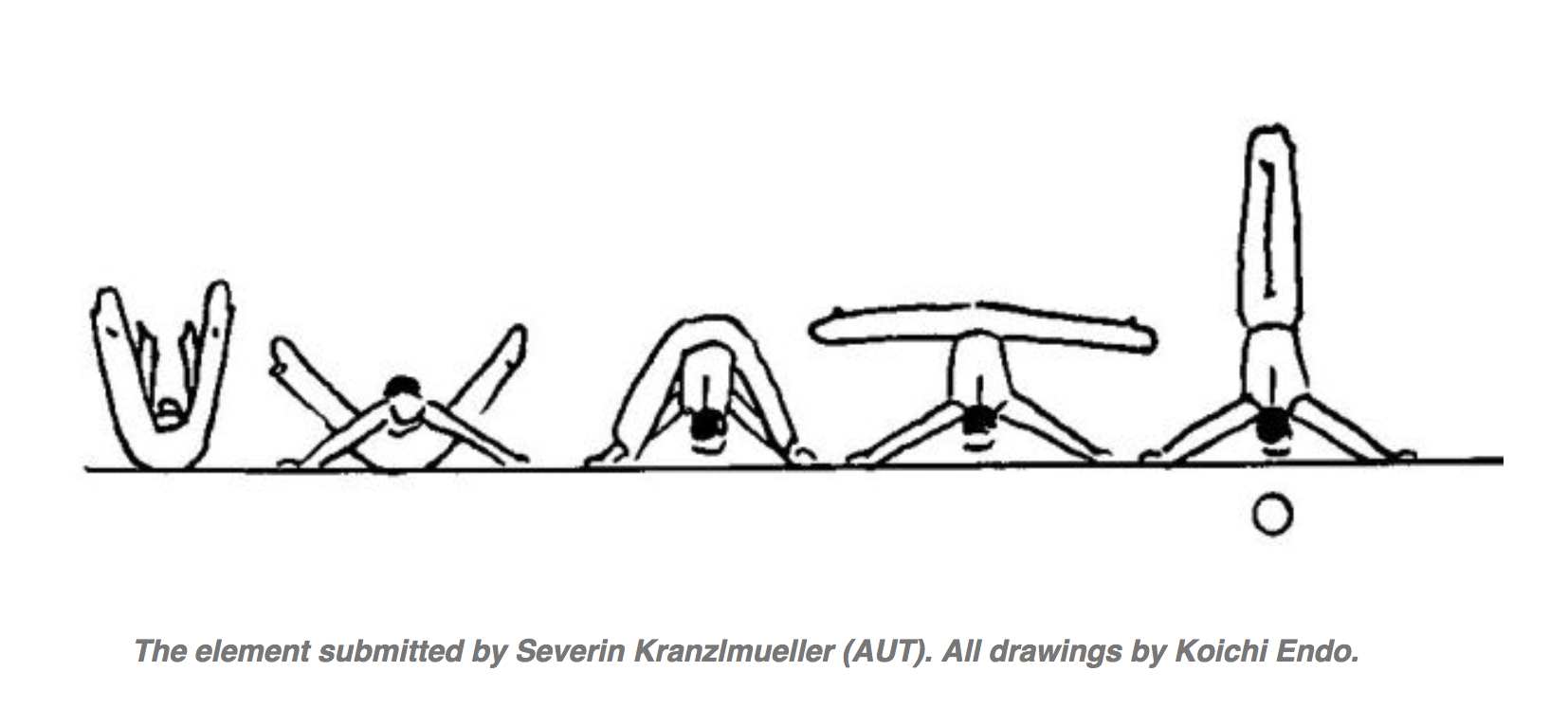
Submitted by: Severin Kranzlmueller, AUT
Apparatus: Floor Exercise
Element description: Endo roll to Japanese handstand
Element value: C

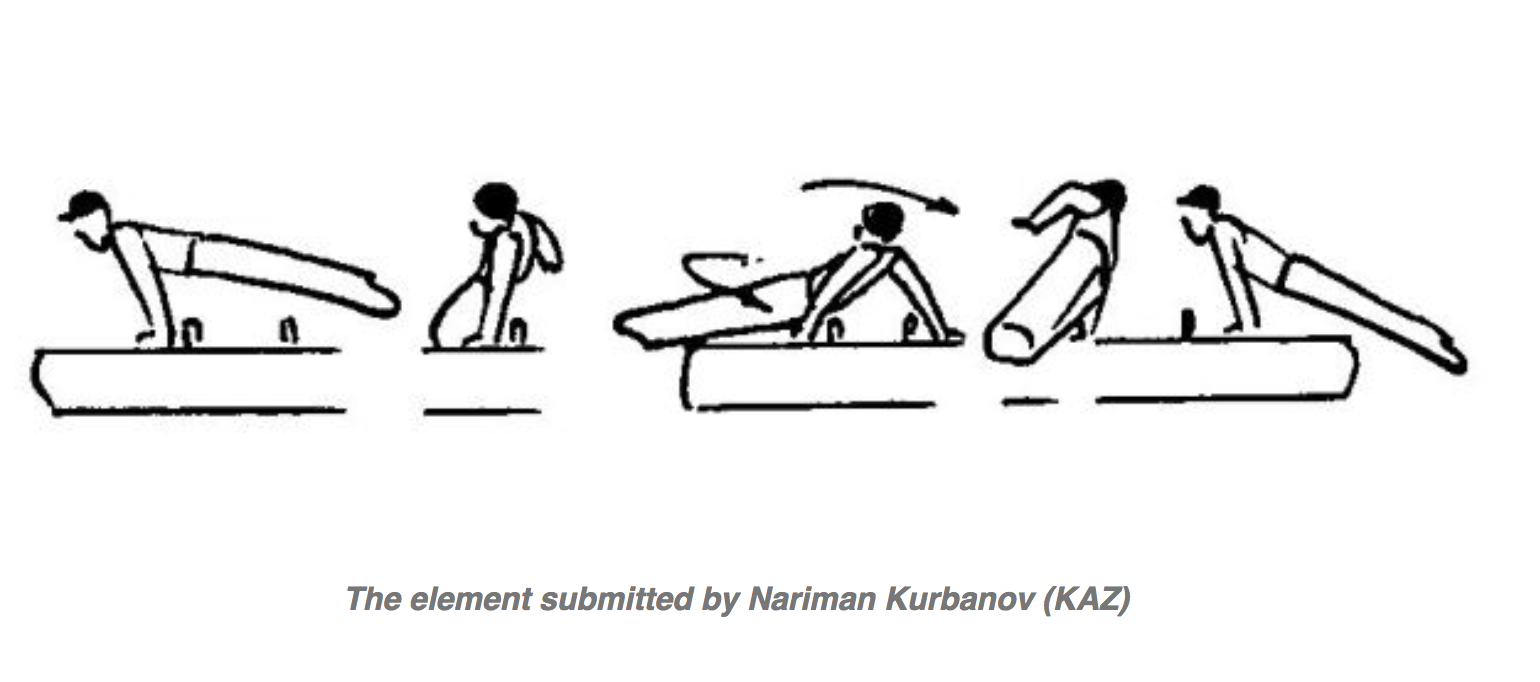
Submitted by: Nariman Kurbanov, KAZ
Apparatus: Pommel Horse
Element description: Travel backward in cross support over both pommels
Element value: E

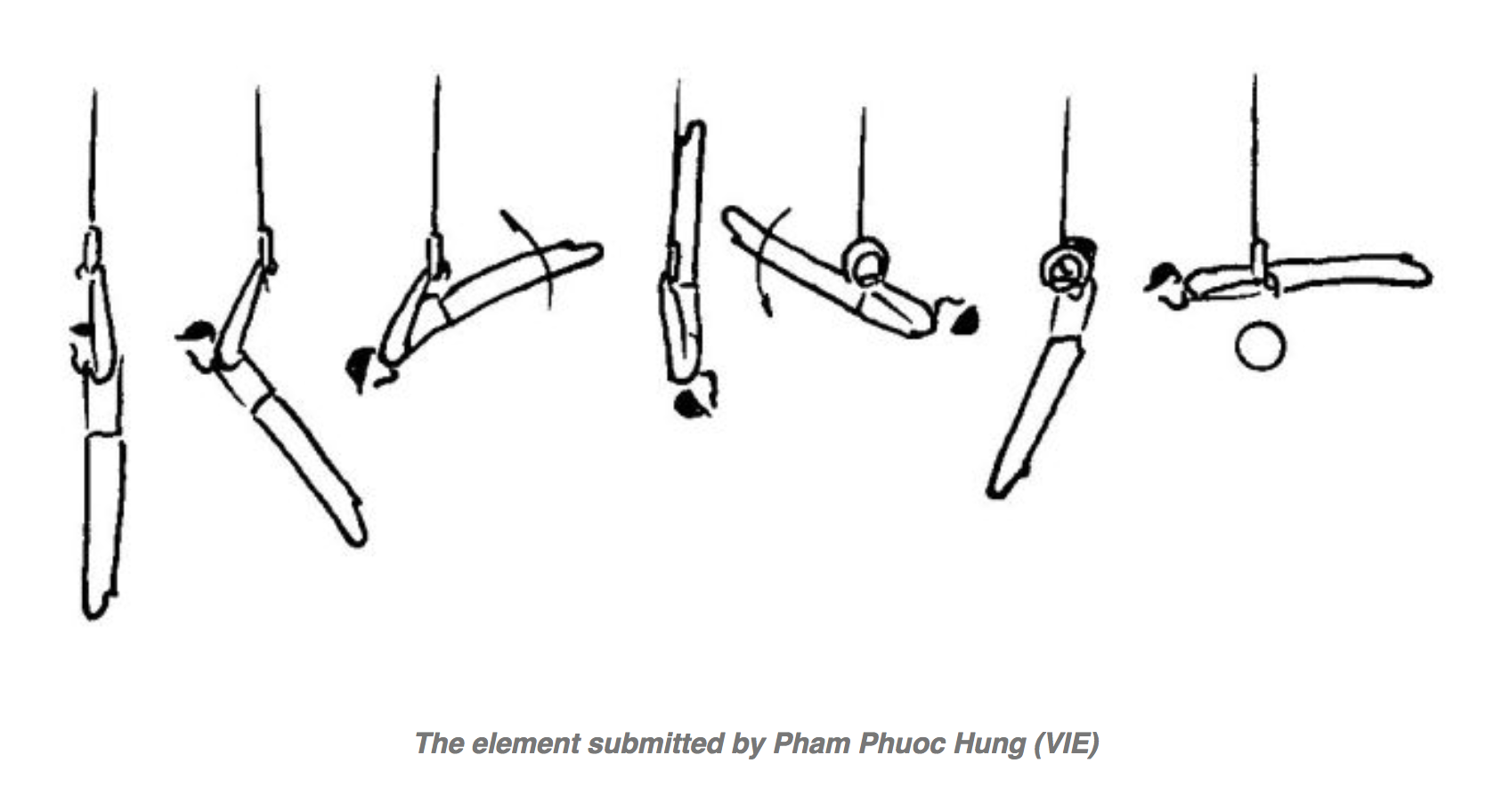
Submitted by: Pham Phuoc Hung, VIE
Apparatus: Still Rings
Element description: Slow roll forward with straight body and arms through cross to swallow (two seconds).
Element value: E

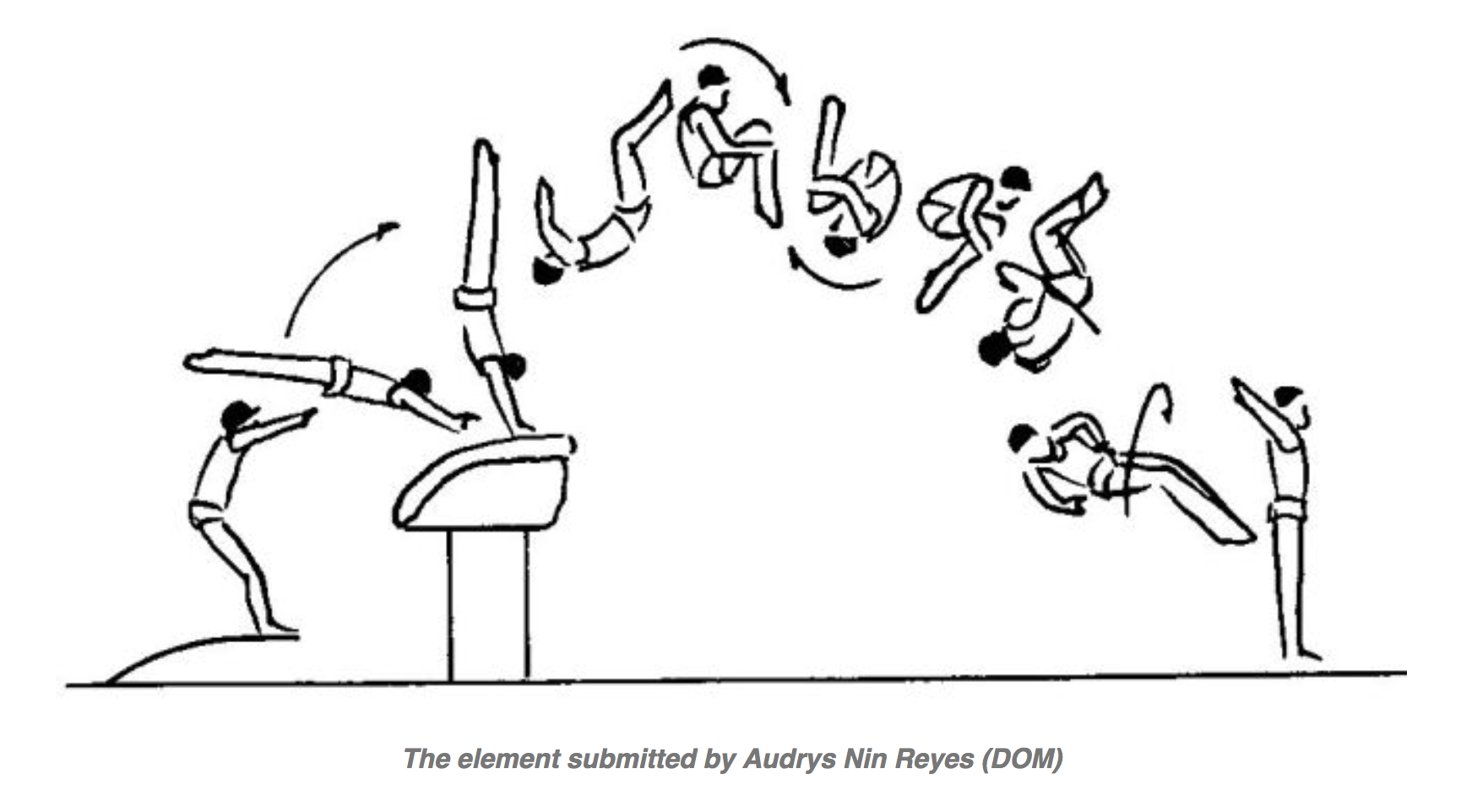
Submitted by: Audrys Nin Reyes, DOM
Apparatus: Vault
Element description: Roche with a 1/1 turn
Element value: 6.0

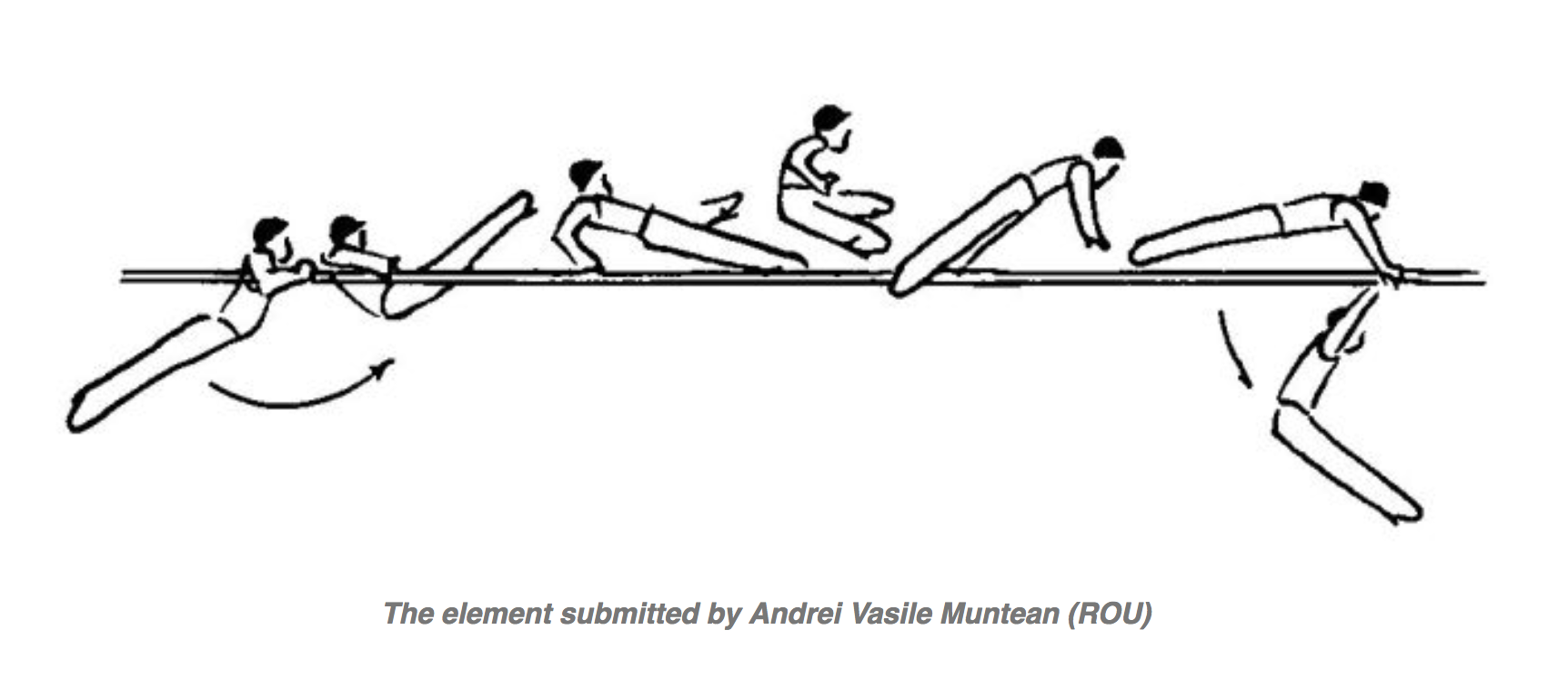
Submitted by: Andrei Vasile Muntean, ROU
Apparatus: Parallel Bars
Element description: Front uprise and straddle cut backward to hang
Element value: C

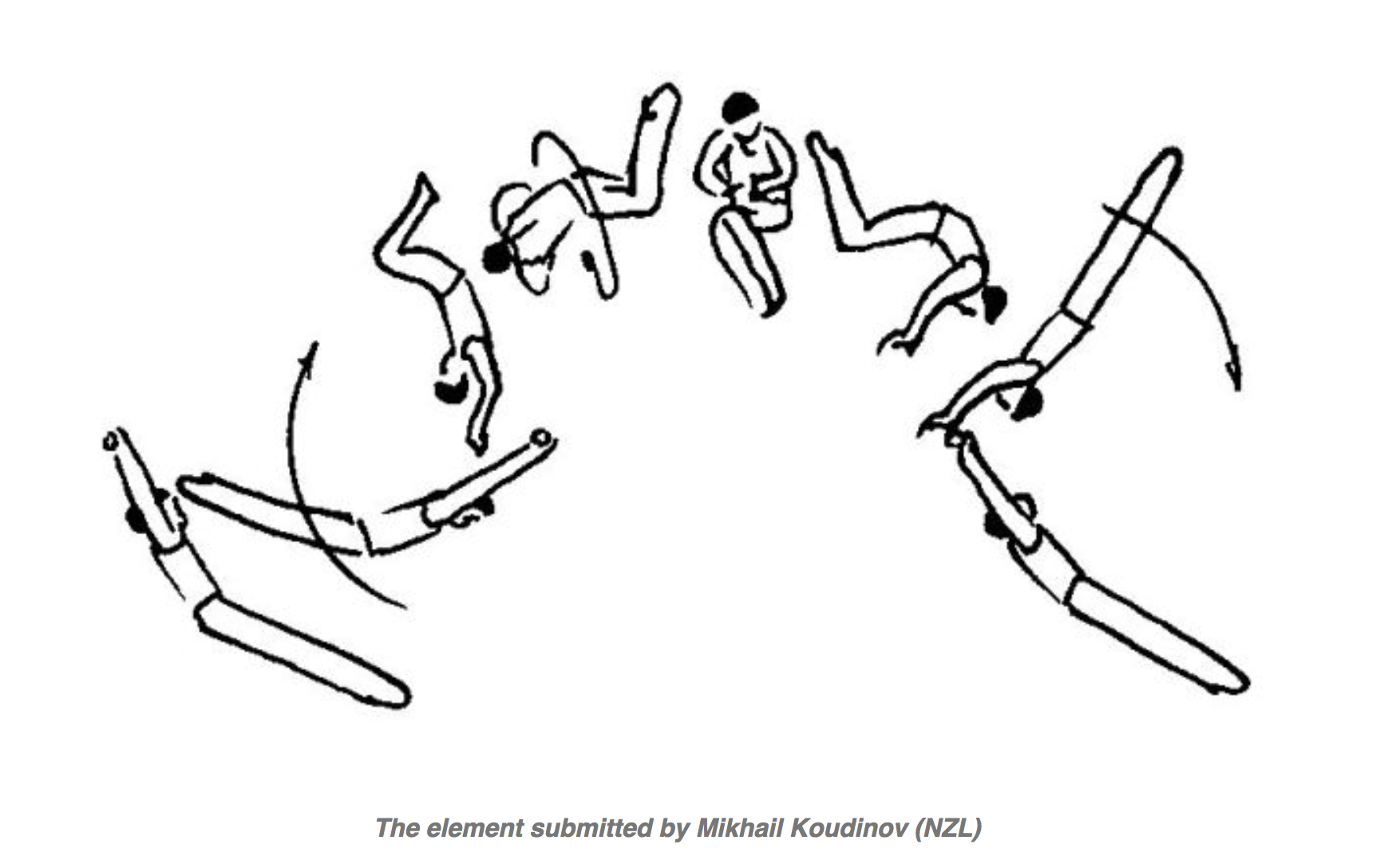
Submitted by: Mikhail Koudinov, NZL
Apparatus: Horizontal Bar
Element description: Gaylord with a 1/1 turn
Element value: G

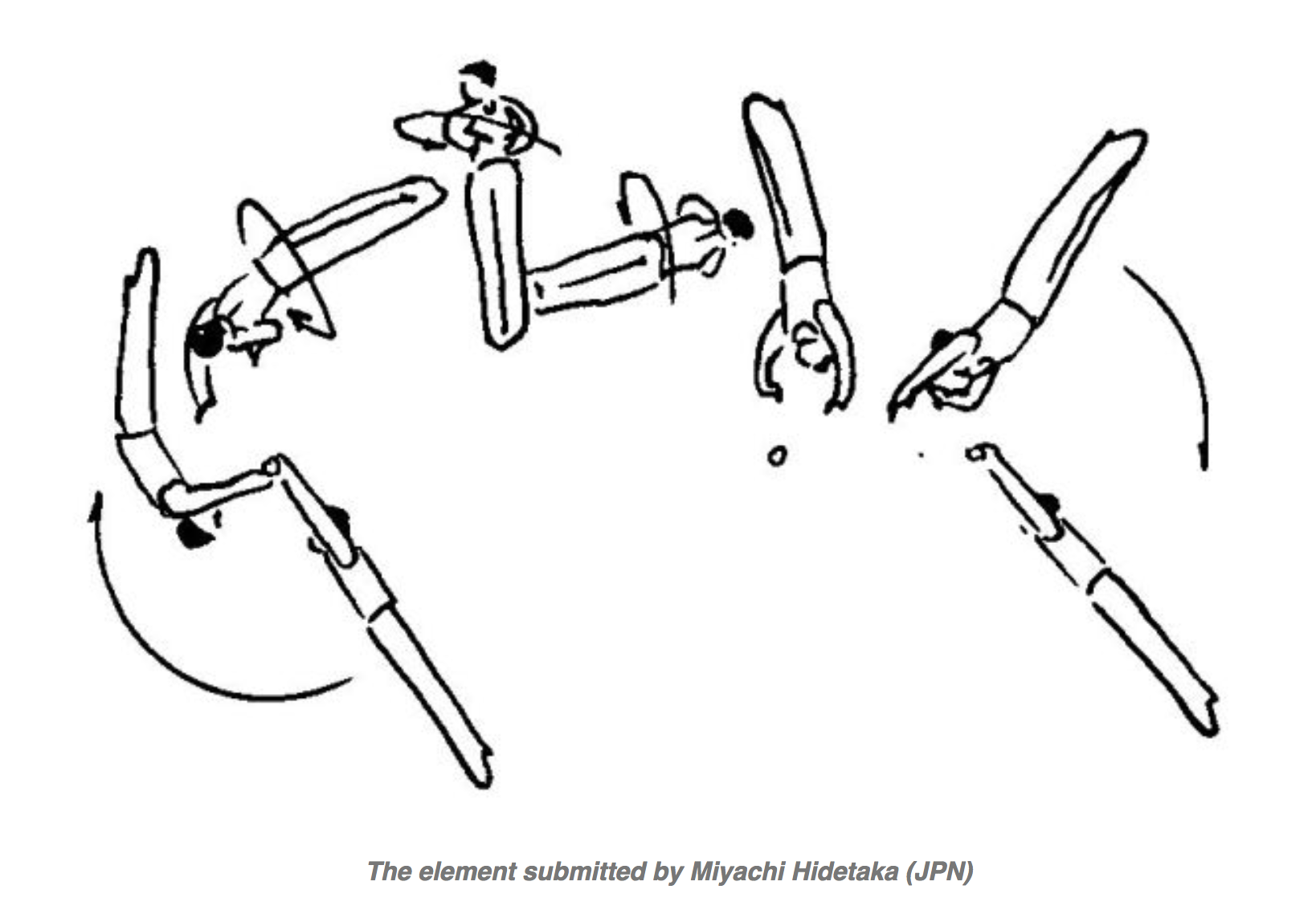
Submitted by: Hidetaka Miyachi, JPN
Apparatus: Horizontal Bar
Element description: Kovacs stretched with 2/1 turn
Element value: I

(originally published by USA Gymnastics)
Moldauer, Naddour, Whittenburg advance to men’s finals at 2017 World Championships
Yul Moldauer of Arvada, Colo./University of Oklahoma, will compete in the men’s all-around final after placing seventh in the qualification rankings at the 2017 World Championships at the Olympic Stadium in Montreal, Que., Canada. Alex Naddour of Queen Creek, Ariz./USA Youth Fitness Center, and Donnell Whittenburg of Baltimore, Md./U.S. Olympic Training Center, also will compete in event finals. The U.S. women compete in Subdivision 5, the last women’s qualification round, on Wednesday, Oct. 4, at 7 p.m. USA Gymnastics is providing live webcasts of the U.S. competitive sessions and all finals at usagymwords.com.
The U.S. men competing in the event finals are listed below. Ranking in the qualification standings is included in parentheses, but scores do not carry forward to the finals. The top eight, with a maximum of two per country, advanced to the individual event finals, with the top 24 qualifying for the all-around final.
Naddour and Whittenburg are the first and second reserve athletes for still rings. Eddie Penev of Rochester, N.Y./U.S. Olympic Training Center, is the second reserve athlete for vault. Whittenburg is also the second reserve athlete for the parallel bars. Marvin Kimble of Milwaukee, Wis./Salto Gymnastics Center, is the second reserve athlete for the horizontal bar. Sam Mikulak of Newport Coast, Calif./U.S. Olympic Training Center, also competed for the U.S. Team.
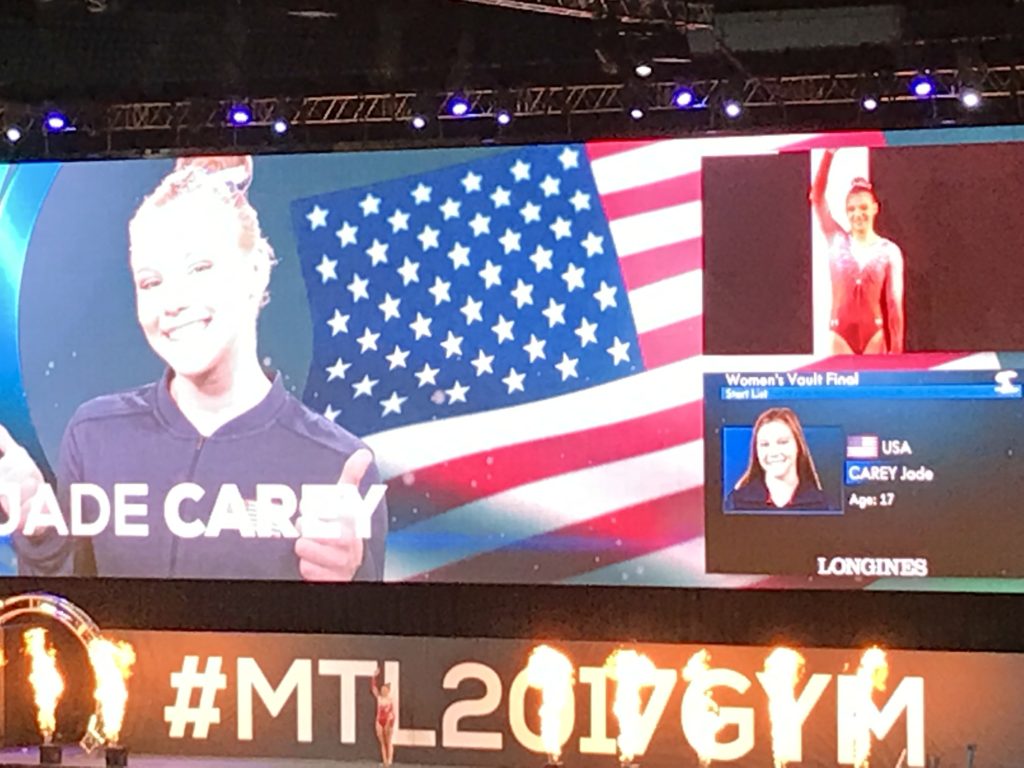
The 2017 U.S. Women’s Team, who will compete on Oct. 4 in the qualification round, features Jade Carey, Phoenix, Ariz./Oasis Gymnastics; Morgan Hurd, Middletown, Del./First State Gymnastics; Ashton Locklear, Hamlet, N.C./Everest Gymnastics; and Ragan Smith, Lewisville, Texas/Texas Dreams Gymnastics. Jordan Chiles of Vancouver, Wash./Naydenov Gymnastics, is the non-traveling replacement athlete.
Athletes advance to the event finals at this year’s World Championships, an individual World Championships, based on performances during the qualification rounds, with a max of two per country. Women qualification rounds wrap up on Oct. 4. Athletes are vying for World titles for the men’s and women’s all-around and individual events.
Event schedule
The remaining World Championships’ competition schedule is as follows. The qualification rounds with U.S. athletes are in boldface.
Qualification rounds
Oct. 4 – Women: 1:30 p.m. ET, Subdivision 3; 4 p.m. ET, Subdivision 4; 7 p.m. ET, Subdivision 5*.
All-Around finals
Oct. 5 – 7 p.m. ET, men’s all-around final
Oct. 6 –7 p.m. ET, women’s all-around final
Individual event finals
Oct. 7 – men’s floor exercise, pommel horse, still rings; women’s vault, uneven bars, 1 p.m. ET.
Oct. 8 – men’s vault, parallel bars, horizontal bar; women’s balance beam, floor exercise; closing ceremony, 1 p.m. ET.
Ways to follow the action
Here’s a quick overview of the various ways to watch and follow the U.S. Team’s performances at the 2017 World Championships in Montreal. For more information on the World Championships, please go to USAGymWorlds.com.
Oct. 4 1:30 p.m. ET – Women’s Qualification Round, Sub. 3 (NED, ROU)
7 p.m. ET – Women’s Qualification Round, Sub. 5 (USA, CHN, JPN)
Oct. 5 7 p.m. ET – Men’s All-Around Finals
Oct. 6 7 p.m. ET – Women’s All-Around Finals
Oct. 7 1 p.m. ET – Event Finals, Day 1
Oct. 8 1 p.m. ET – Event Finals, Day 2
I got a text this morning that no one wants to get. Informing me that a colleague had apparently been murdered. Chris Grover has come to a number of Gym Momentum Training Camps and Clinics. In fact, I am pretty sure, he was at the first one we ever held and attended this last summer with 20+ gymnasts.
Right now I am shocked. Words cannot express what I am feeling. My heart breaks for his children. My heart breaks for the gymnasts he worked with. We will all mourn in our own way. Right now I want to focus on how to help the gymnasts get through this.
After describing such sad events, all you can think is- This is something that no child should have to go through.
I’m sure you’ve heard a variation of this throughout your life. Maybe you’ve even said something similar to the following:
The truth is, if you live long enough, you’re most likely going to experience some significantly stressful event: a loved one will die. You’ll get sick. Someone will mistreat you. The list goes on.
How do we convince an 8-year-old gymnast that it’s safe to return to the gym after such a tragedy? The news story is going to dominate the area for weeks and will in some way change every child at the gym.
Our 24/7 news culture — in conjunction with easily accessible iPads, cell phones, and televisions — provides a window to events that both children and adults grapple to understand. And when bad things happen it is very natural and healthy for children to bring up questions at home or in the gym
When terrible events happen, children, like the rest of us, need to wrap their minds around it. They’re seeing images and hearing stories that are hard to absorb.
Decisions about what to say, and what not to say, should be guided by a child’s developmental age. Among his tips for parents and educators:
What should you not say? The guiding principle is to talk to kids in ways they understand, while being careful to not provide too much detail to a younger child.
When children can understand why, when they can make a scary event coherent, they are better able to trust again. Spend some time thinking — and talk to other coaches and educators you trust — about how to talk to your gymnasts in a way that will help them understand and make sense of events that may otherwise feel unpredictable and overwhelming.
It is obvious that as gymnastics professionals we need to do something to help the gymnasts. I am open to any ideas.
Peace,
Tony
For me there is no better job in life than Coaching Gymnastics. It’s fun, fast paced and always changing. Excelling at a fast-paced job can be challenging — especially when you feel like you’re not being respected enough by the gymnasts and your coworkers.
But how do you earn the respect of those you work with? And how do you deal with public displays of disrespect?
Remember that respect is a two-way street
If you want to know why you might not be getting the respect you want, stop and think: are you doing anything to disrespect others?
Some of the top offenders include interrupting others while they’re speaking, refusing to admit your mistakes and criticizing others publicly.
“Interrupting others while they’re speaking … is the ultimate sign of disrespect. So stop doing it. Immediately. Bite your tongue and spend your time listening to understand, not to reply,” business consultant Lisa Quast writes in Forbes, “While you can add your two cents after hearing the other person out, it’s better to give them the floor and actively try to understand their perspective instead of talking over them.” Gymnasts need to have input as well. Yes- they can run on and on with stories. Give them a time to speak. If it is not relevant (or you feel it is a 20 minute story!) let them know that they can talk to you and the group about it later.
Another red flag? Refusing to admit your mistakes — or worse, blaming them on others — is a surefire way to make people lose respect for you. I was doing a clinic at a gym and individually each coach spoke to me about the short comings from the previous season and each coach blamed it on the other. “We would have done better at States if it wasn’t for Beam…” If you pretend that you’ve never done anything wrong and then find ways to excuse your failures or blame them on others, you’ll lose the respect of everyone. Failure is only failure when you don’t learn anything from it, and you can’t learn anything when you pretend that you never actually failed.
Other big offenders:
In Dale Carnegie’s seminal book, “How to Make Friends and Influence People,” he writes of a tyrant boss who eventually became willing to learn how to change his ways.
“For years he had driven and criticized and condemned his employees without stint or discretion. Kindness, words of appreciation and encouragement were alien to his lips,” Carnegie explains in the book, “After studying the principles discussed in this book, this employer sharply altered his philosophy of life. His organization is now inspired by a new loyalty, a new enthusiasm, a new spirit of teamwork.”
After all, no one wants to deal with a bully at work.
Be humble, but not insecure
There’s a difference between being grounded and groveling.
If you are constantly putting yourself down in an effort to appear humble, you might run the risk of losing the respect of others, who could mistake your self-effacement for insecurity. Be willing to admit your flaws, but do not focus on them. You should have some self-depreciation, but it should be paired with self-confidence. People generally will not respect another coach who appears insecure and continuously mentions their shortcomings. Show your human side but maintain a sense of bravado and self-assurance. If you’re constantly talking about what you don’t understand or what you’re not good at, people might start to believe you.
Displaying confidence can go a long way.
Let your work speak for itself, and take pride in your accomplishments. Others will see your enthusiasm and respond positively.
Avoid sending mixed messages
Empty promises are a respect-killer in the workplace. If your coworkers can’t count on you to follow through, they’re going to eventually stop listening. “What you actually do matters much more than what you say you’re going to do. Anyone can talk a big game or over-promise, but the actual follow-through is what creates lasting success,” writes web designer and bestselling author Paul Jarvis.
Don’t micromanage
Hovering — literally or metaphorically— is not effective.
Effective delegation is an important part of becoming a good leader. You must understand that your co-coaches are looking to develop their skills, so when you delegate, give them an important task to accomplish. Then stand back and let them figure out how to do it. When you tell them how to do the task, they feel mistrusted and perhaps worthless. It is difficult to trust a leader who can’t let go. That does not mean that you do not offer guidance (and they must take your input). You are in charge because you’ve been down this road before. You know where the potholes are BUT they may teach you a better way.