“The very symbol of the sport, the handstand, is indeed one of the most important fundamental elements in gymnastics. Although often viewed as an individual skill, the handstand shape is repeatedly seen in every event, every exercise, and virtually every movement sequence.” Dr Gerald S. George, Ph.D. “Championship Gymnastics. Biomechanical Techniques For Shaping Winners” 2010 [Read more…]
NCAA Gymnastics for Beginners | The Balance Beam Situation
PUBLIC SERVICE ANNOUNCEMENT: You can now also listen to me read this post to you on GymCastic! NCAA Gymnastics for Beginners Move along, haggard old jaded NCAA fans. Nothing for you to see here. In…
Source: NCAA Gymnastics for Beginners | The Balance Beam Situation
Move along, haggard old jaded NCAA fans. Nothing for you to see here. Instead, take this time to write a polemic against the aerial-to-back-handspring acro series on beam.
If, however, you watch elite gymnastics and have finally become fed up with nothing interesting happening 11.975 months out of the year—or you were introduced to the WEARETHEFINALFIVEAHHH during the Olympics and thought, “This sport is a ludicrous sparkleburger that seems to be based entirely on critically assigning numerical ratings to people’s every action, so it’s my life and I’m in love now”—then settle in. NCAA gymnastics is here to soar to your rescue, here to save you from a wretched winter of non-gymnastics discontent by bringing its beautiful qualities like an actual season with weekly meets, stuck dismounts, and legitimately close and exciting team competitions. (I know, right?!?!?!)
So, welcome. Make yourself comfortable. And by that, I mean stay quiet and do exactly as you’re told.
But it’s only fair that I warn you. NCAA gymnastics will change you. By the time you’ve watched a full season, the phrase “like a jank-ass rudi dismount” will be your go-to burn, you’ll be telling toddlers that they really need to display more calm confidence, and you’ll be greeting new acquaintances with pieces of paper reading “9.825” to inform them that they’re just OK.
So, let’s begin. You’re in for a treat.
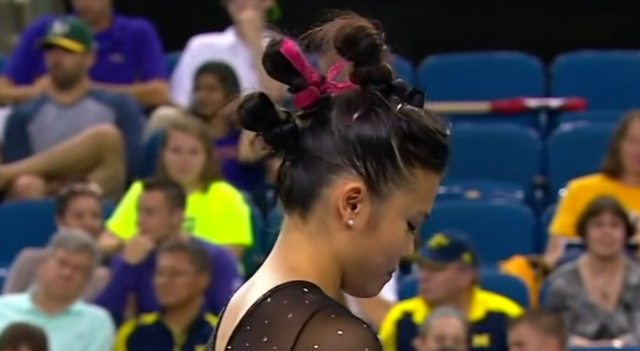
Item #1 is, of course, Ivana Hong’s triceratops hair. Just know this. If you can’t get behind the idea of Ivana Hong triceratops hair, then you are too far gone to be saved and NCAA gymnastics will never happen for you.
But now that we’ve got that out of the way, let’s begin for real.
What…is this thing?
I’m glad you asked. This thing is a big old vat of beautiful insanity called NCAA gymnastics.
Here’s what happens: Once they reach the age of 18 or 19, your favorite elite gymnasts are forced to heave themselves out of their hospital beds, start having a personality, and go to a real school for the first time (harrowing). There, they will join many of the top Level 10 gymnasts in the country to compete on a series of university gymnastics/competitive-temporary-tattoos-on-the-face teams.
They get to do this on a full scholarship because athletes are more important than scientists. Also because, in the 1970s, the US government realized that women exist and told the NCAA that women must be allowed to leave the birthing hut and throw a ball sometimes, even if you can’t necessarily exploit their athletic achievements to make millions of dollars of your own while pretending like you’re doing them a favor in the process. Or something.
These teams spend four months each year competing against other schools—under a code of points that most closely resembles elite competitions of the early 1990s—in the hope of screaming, chanting, sticking, hugging, teamworking, and life-lessoning their way to the annual national championship.
How does the season work?
Beginning the first Friday in January and ending in the middle of April, the NCAA gymnastics season takes over all of your weekends and whole life (as if you had one…) and sees the nation’s 82 teams compete against each other approximately once a week, usually in dual meets against one other school, though occasionally in tri- or quad-meets as well. The main point of dual meets is to make fun of the people who write “duel meets,” as though Florida has challenged Alabama to pistols at high noon.
Also, can Florida please challenge Alabama to pistols at high noon?
With the number of big-reputation, competitive teams going up against each other each weekend, it’s basically like every Friday night is the worlds team final.
At the end of March, the top 36 teams in the country are allowed to continue on to the regional championships, from which 12 teams advance to the national semifinals, from which 6 teams advance to the Super Six Team Final, where the national champion is crowned.
What about individual titles?
HOW DARE YOU, SHUT YOUR FILTHY MOUTH. It’s all about the team. In NCAA, any acknowledgement of individual goals or the desire to win an individual title—or any honest assessment of your own individual gymnastic abilities—is tantamount to treason and will see you drawn and quartered in the town square. On an NCAA team, you are the closest group of sisters, and no sister is more sisterly than any other sister. SISTERS.
Maggie Nichols already gets it. Like an old pro. She just wants to help the team anywhere she might possibly maybe be able to contribute, you guys.
[Whispering] There actually are national all-around and event titles awarded based on performance in the national semifinals, but ssssh. You’re not allowed to talk about them because you might seem selfish or come across like you think you’re more important than the team manager. [/Whispering]
What are the teams?
NCAA gymnastics is infinitely more entertaining if you have a specific team to root for. And, consequently, rival teams to root against. (You’re allowed to do that, like a real sport, just don’t tell the gymternet.)
Before January, I highly recommend picking a team and then getting instantly and aggressively obsessed with it for little reason other than it’s fun. Pick any team. There are no wrong choices. That’s obviously a lie, but I don’t want to discourage you right away.
The most common (and crudest) ways of picking a team are 1) by simple geographical proximity to yourself or 2) by which team’s former elites you like the most.
For reference, here are the former elites (with the awareness that I left out some people who were junior elite for one second) currently on some of the top teams:
Oklahoma – Maggie Nichols, Brenna Dowell, McKenzie Wofford
LSU – Lexie Priessman, Sarah Finnegan, Ruby Harrold (GBR), Erin Macadaeg, Shae Zamardi (CAN)
Alabama – Maddie Desch, Amanda Jetter, Mackenzie Brannan, Ari Guerra, Kiana Winston
Florida – Amelia Hundley, Rachel Gowey, Kennedy Baker, Grace McLaughlin, Ericha Fassbender, Claire Boyce, Maegan Chant (CAN)
UCLA – Kyla Ross, Madison Kocian, Katelyn Ohashi, Felicia Hano, Macy Toronjo, Peng Peng Lee (CAN), Mikaela Gerber (CAN), Hallie Mossett, Stella Savvidou (CYP)
Stanford – Elizabeth Price, Dare Maxwell, Rachel Daum, Kaylee Cole (BOL), Aleeza Yu (CAN)
Georgia – Sabrina Vega, Natalie Vaculik (CAN), Vivi Babalis (CAN), Jordyn Pedersen (CAN)
Utah – MyKayla Skinner, Missy Reinstadtler, Shannon McNatt
Auburn – Abby Milliet
Cal – Toni-Ann Williams (JAM), Jessica Howe
Michigan – Brianna Brown, Talia Chiarelli (CAN), Polina Shchennikova
Oregon State – Maddie Gardiner (CAN), Sabrina Gill (CAN), Silvia Colussi-Pelaez (ESP)
A more advanced way of picking a side is actually watching the different teams and then deciding which style, mood, history, level of dominance/underdogginess, and attitude connects with you the most, but that sounds far too reasonable.
Or, you can just read my season previews here throughout October-December to see which team sounds like it strikes your fancy.
Or just base it on which coach seems the most like a cartoon drag queen like the rest of us did.
How do the meets go?
On each event, six gymnasts compete for each team with the five highest scores counting. At the end of four events, the team with the highest score wins. You know, like a gymnastics competition.
Please note that winning a meet is entirely meaningless (apart from Super Six). Qualification to the regional championships is based on scores, not wins, so the focus is on getting a high team score more than beating an opponent. Still, winning things is fun. Or so I’m told.
How do I watch?
Because NCAA gymnastics is amazing and super popular, TV coverage on the SEC Network, Pac-12 Network, and Big Ten Network has grown dramatically in recent years, meaning the majority of major meets are now broadcast live on TV or streamed through those networks’ online platforms with commentary predominately from people who aren’t terrible. Oklahoma meets are also randomly available sometimes on weird channel numbers, and a great proportion of the smaller teams will have online streams, sometimes even free.
If you don’t have a TV subscription and login ID for the SEC, Pac-12, and Big Ten channels, then you can also build a magical screen out of clouds and dreams and just imagine what facial expression Miss Val is making right then. It’s like the same.
Why is there a lowercase l next to that egg?
Common misconception. That’s not an l next to an egg. It’s actually a 10, which is a score that you can still get in women’s college gymnastics.
WHAT? Then, wait…how does the scoring system work?
That’s an excellent question. I’ll let you know when we find out.
I’m only kind of kidding.
NCAA gymnastics uses a modified version of the JO code of points, only with softer deductions and more overall judging subjectivity and crack smoking. Particularly the crack. I cannot overemphasize how critical crack smoking is to the judging process in NCAA women’s gymnastics.
These days, you will see about one or two 10s awarded each weekend, and for the strongest gymnasts/teams, a score of 9.900-9.950 is considered excellent, 9.850 is fine/solid, 9.825 is OK, and anything lower than that is unlikely to be satisfying or good enough. Once you head into the teams ranked 20-40, 9.850 is considered a much stronger score, and they’re usually happy to count anything 9.750 or above.
For the overall meet scores, the best teams will be expecting to hit 197 regularly. That’s the rule of thumb for a strong score. Anything in the 196s, especially earlier in the season, is not disastrous. Anything in the 195s is.
One of the beauties of NCAA gymnastics, and what makes it ideal for new or non-gymnerd fans, however, is that you don’t have to know anything about the intricacies of the scoring system to understand what’s going on. You can safely assume most routines you see will start from 10.0 (except for Yurchenko fulls on vault which are now 9.950), and the deductions taken from 10.0 are minimal and reserved primarily for the most obvious errors (steps, wobbles, short handstands, etc). That’s why we get scores in the 9.8s and 9.9s. And also why you actually have to be able to hit your skills and have them look good. NCAA gymnastics replaces difficulty with mastery and as a result keeps many teams in contention for wins.
At the top of the rankings, there will be about 8 or 9 teams within a few tenths of each other with a realistic shot to do damage in the postseason, and at last year’s team final, the top four teams were ultimately separated by just three tenths. Small mistakes matter. Wobbles are everything. You don’t know who is going to win before the championship starts.
But what if I actually want to know more about the scoring system?
I’m also here for you. As in Level 10, NCAA routines that meet the element requirements (minimum 3 As, 3 Bs, 2 Cs) automatically start from 9.500, with five tenths of bonus available to be earned in order to get up to that 10.0 start value.
Bonus can be earned by skill difficulty—with D skills garnering 0.1 bonus and E skills garnering 0.2 (E is the highest skill value)—and by connection bonus. A maximum of 0.4 bonus can be earned from either category, so to get a full 10.0 start, some of the bonus must be from skill difficulty and some must be from connections.
The connection bonuses are as follows:
BARS
C+C (both skills include flight or 1/2 turn) – 0.1
C+D – 0.1
D+D – 0.2
BEAM
Dance/mixed
A+D – 0.1
B+C – 0.1
B+D – 0.2
C+C – 0.2
Acro
B+D – 0.2
C+C – 0.2
B+B+C – 0.1
B+B+D – 0.2
B+C+C – 0.2
Turns
C+A – 0.1
(Three-element series on the beam itself that include a C element get an extra 0.1 series bonus.)
(The layout stepout is considered C for the purposes of awarding connection value but a D for the purposes of difficulty. Because…remember that thing I said about crack?)
FLOOR
Dance/mixed
C+C – 0.1
B+D – 0.1
D salto + A dance – 0.1
C salto + A dance + A salto – 0.1
C+D – 0.2
Acro direct
A+C – 0.1
B+B (different elements) – 0.1
B+C – 0.2
A+D – 0.2
Acro indirect
A+A+C – 0.1
C+C – 0.1
A+D – 0.1
C+D – 0.2
Many elements (though far from all) share difficulty values with elite, but there are some important exceptions. Of note, bars dismounts like the double layout and full-twisting double back are Es in NCAA, which makes it very easy for NCAA gymnasts with those dismounts to get their 0.5 in bonus.
For execution deductions, take a look at the judges’ cheat sheet included here and then ignore all of that information because 1% of those deductions actually get taken.
NCAA rules — Judges’ cheat sheet
But what if I’m put off by the level of enthusiasm and screaming?
This is normal. There’s a lot of screaming and smiling and cheering and entirely unfounded joy in NCAA gymnastics, and it can be extraordinarily upsetting to those who have not gone through a process of exposure therapy to adapt to this strange world in which RBF and sass-eye are not the primary form of communication.
The important thing to remember is that you can always make fun of it. And should forever.
There is a place for sarcasm, disapproval, honesty, and side-eye in NCAA gymnastics as well. I think it’s here.
What are…10 hands?
10 hands (alternatively 10HANDS) is a phenomenon in NCAA gymnastics in which a gymnast will perform a languid beige drape of a routine and her coach and teammates will attempt to trick the judges into thinking it was rainbows by holding up all 10 fingers and shouting, “10! 10! 10!” It is horrible and works sometimes.
As a member of the NCAA gymnastics community, it is now your responsibility to quash it at every turn.
Why are people in NCAA gymnastics constantly trying to tell me that it’s better than elite?
Because in the upcoming war between the worlds, you must pick a side. And our side has a lot more stiletto heels to be used as weapons.
What else should I do?
EVERYTHING.
Play fantasy gymnastics
It doesn’t matter if you don’t know anything and just pick the names of a few gymnasts that you’ve heard of. You’ll probably still do better than us experts who are always like, “I’m going to pick this obscure Lindenwood gymnast because based on my research…oh, she’s dead.” It’s probably the best way to get yourself excited about the sport, especially teams and gymnasts you wouldn’t care about otherwise.
Scour the rankings
A great way to learn about the teams to follow, scores, gymnasts, and what expectations you should have for the upcoming season is by running through the rankings and meet results from previous years and getting lost in a wikipedia-style information hole.
Watch These Routines as a starter
https://www.youtube.com/watch?v=4e0gPtPtuas
https://www.youtube.com/watch?v=efttzj5VtXE
https://www.youtube.com/watch?v=cpLVOIHc7CU
https://www.youtube.com/watch?v=8TlR51SuTuA
Balance Beam Situation– A MUST READ
Fédération Internationale de Gymnastique – View FigNews
“Challenge!” – New Year’s Greetings from Morinari Watanabe03/01/2017
“It’s a great pleasure and honor to send you my greetings for the New Year as President of the FIG.First of all, let me wish you a happy and prosperous year ahead, with a lot of success in Gymnastics and beyond.I would like also to pay tribute to my predecessor Bruno Grandi for all that he achieved during the past 20 years.For my part, I am from Japan, the Land of the Rising Sun.I would like to throw new sunshine on the gymnastics family.To this end, I would like to propose “Challenge” as the slogan of the 2017 gymnastics family.I am determined to rise to the challenge of forming a new FIG and I would like you to join me in accepting new challenges in 2017.Please take on a new challenge that is different from what you did last year.There are 148 FIG member Federations.I am sure that those 148 challenges will lead the world Gymnastics community to further its development.I would like to close my new year’s greetings by wishing you every success in your new challenges.” Morinari Watanabe, FIG PresidentRelated keywordsFIG President, Morinari Watanabe, wishes
Source: Fédération Internationale de Gymnastique – View FigNews
Adult Gymnastics Camp at Atlantic Gymnastics
My gym in Portsmouth, New Hampshire will once again be hosting an Adult Gymnastics Camp for men and women. We have been lucky enough to host a few of these in the past. I love the energy, humor and work ethic that the adults bring to camp.
This camp was featured on Chronicle and in many articles and the Gymcastic podcast.
Many of the adults are used to coaching themselves in open gym situations so this is a very unique situation for them to have an organized gym and coaches.
The camp will be staffed by
–James Parent Vice President of TumblTrak
–Brian Kormann, Owner and Head Coach Yellowjackets gymnastics
–Liz Verhey, guest coach
–Gina Paulhus, AAU Ladies Division Level 8 National Champion, Certified Personal Trainer
–and ME! Tony Retrosi.
The camp brings in gymnasts of ALL levels from beginners who are looking for ways to get in shape/ stay in shape to former college gymnasts. IS ADULT CAMP FOR YOU?
Make the Adult Camp part of your New Years Resolution.
WHEN: Jan. 28-30, 2017
WHERE: 150 Gosling Rd. Portsmouth NH (Atlantic Gymnastics)
COST: Gymnasts ages 18+
$225 per athlete (covers training ONLY)
Teams of 3 or more
$175 per athlete (IGOT3)
PRELIMINARY SCHEDULE
*Saturday, Jan. 28 2:00 Doors open/forms/swag
2:30 – 6:30 training
7:30 dinner @ The Friendly Toast
Sunday, Jan. 29 9:00 – 12:00 training
12:30 Lunch
2:30 – 3:30pm clinic upstairs in gym
3:30 – 6:30pm open gym
7:30pm Dinner
– Monday, Jan. 30 9:00 – 12:00 training
12:00 – 1:00 pictures and awards
QUESTIONS? gina @ homeexercisecoach.com
Toe on Handstand Progression
Bars has become more about in-bar skills. Clear hip, Stalders and Toe on Handstands.
Jason Mortimer from BOUNCE GYMNASTICS in Michigan put together a good video of some basic drills.
Incorporate these into your stations now and be prepared for next year.
Thank You Jason for sharing!
What Kids Worry and Fear at Different Ages @ Deborah MacNamara, PhD
In the gym we see kids of all ages. Each stage of learning and development we see different fears and anxieties. I stumbled upon this article while doing some research from some of my lectures. Too much information to edit. Think of the gymnasts you work with whether they are in a parent/tot class or on team. This article should help.
Tony
Kids have worries – from monsters to natural disasters. They can appear at random or may be triggered by everyday events. Their increasing awareness of the world, who is in it, and being able to anticipate bad things happening, can all increase their alarm.
Many of children’s fears can be existential, meaning they are indicative of a child’s growth and development as a separate being. Separation is the most impactful of all experiences and stirs up the emotional center of the brain and can create feelings of fear. As a child becomes increasingly independent, they are less dependent upon their caretakers which may foster some worry. As a child ages, this fear is often transformed into different themes but shares this common root issue.
Worries and fears that ebb and flow are part of the human condition, in fact, a lot of the brain’s energy is spent on evaluating incoming information for threats and sending out signals to the body. We don’t always know when we are afraid and have an emotional unconscious that operates outside of our conscious awareness. Joseph LeDoux, one of the world’s leading neuroscientists who studies anxiety, has shown that it is possible to be full of fear yet rendered speechless.
Common Fears and Worries
The following list contains some of the common fears and worries children may express at different ages. Many of these things are related to developmental changes and immaturity. Sometimes children may not able to articulate what their fears are and strategies for helping kids with higher levels of anxiety can be found in Helping the Anxious Teen or Child Find Rest and When the Worry Bugs are in Your Tummy.
0 to 6 months – Babies can show signs of fear at loud noises given they are unexpected and surprising. The loss of physical, visual, and auditory contact with their adults can also lead to alarm because the parts of the brain responsible for object permanence are not fully developed. When they lose contact with someone, they don’t know that this person will return as they lack an understanding that objects are permanent in time and space.
7 to 12 months – A child at this age can show signs of understanding that objects are permanent as well as causality. They realize that their adults can reappear and that they do have some influence on the actions of others, for example, when they cry someone will come to pick them up. At this age, it is common for them to display stranger protest which indicates their brain has developed enough to lock onto one person as a primary caretaker. This can result in playing shy with people they are not in contact with on a regular basis as well as showing preference for being in the company of their primary attachments. They are still often frightened by loud noises as well as objects that suddenly appear or loom over them.
1 year – Separation from parents is a common source of alarm and fear at this age and continues until 6 years of age. A young child is still highly dependent on adults for caretaking, therefore; they can be alarmed when distant from them. They can also be frightened if they get hurt, as well as loud sounds such as toilets flushing.
2 years – Young children at this age often exhibit some fear or animals as well as large objects. Their smaller size as well as lack of understanding about these things likely increases their alarm level. They may also state they are afraid of dark rooms with separation at night becoming increasingly challenging. Young children often feel most comfortable with structure and routine so changes in their environment can be potential source of concern for them.
3 to 4 years – With the increasing development of their brains, a young child’s imagination and capacity to anticipate bad things happening to them or others can increase. Their dreams may become more vivid with monsters appearing as well as other scary things. They can be afraid of animals, masks, the dark, and can seek comfort in the middle of the night when worried. There can be a heightened level of separation from parents because of their increasing independence, as evident in their exclamations of “I do it myself” and “No, I do!”
5 to 6 years – At this age a child may voice fears of being hurt physically as well as of ‘bad people’. Their play may reflect these themes as they start to imagine bad things happening that are not based in reality. They may voice concerns over ghosts and witches or other supernatural beings. Thunder and lightning may also stir them up too. Sleeping or staying on their own can still be provocative as they are just coming to the end of their development as a separate self.
7 to 8 years – Common fears include being left alone and can lead to wanting company, even if they are playing by themself. They may talk about death and worry about things that could harm them, for example, car accidents to plane crashes. They may still struggle with fears of the dark, as an extension of their growth as a separate being.
9 to 12 years – The ‘tween’ they may express worries related to school performance including a fear of tests and exams. They may have concerns with their physical appearance as well as being injured, and death. As they become more of a separate and social being, they can consider and compare who they are against others which can create some alarm. They may state their discomfort that they are growing up and don’t want to while other kids seem eager to leave childhood behind. It is important to note that the more peer oriented a child is, the more anxiety they may experience at this age as they turn to their peers for understanding who they are, When Peers Matter More than Parents.
Adolescence – For the teenager, personal relationships can be a source of confusion, worry, and fears. As they venture forth as a social being they still need to be anchored to caretakers at home to help them make sense of school issues including their friendships. They may voice fears over political issues given their increasing awareness of the world and movement towards adulthood. Some teens show signs of increasing superstition in an attempt to reduce some of the fears they have at this age too. Anticipating the future and what it holds for them can become a source of worry, along with natural disasters, and other themes related to growing up.
Strategies for Dealing with Worries
For the young child their fear is often alleviated through connection with caring adults who provide safety and reassurance. As a child ages, their increasing maturity will mean they will need to find both courage and tears to face their fears. This growth can be cultivated with the help of adults they trust and can count on.
Connection – When kids are worried, the best sources of support will come from their closest attachments. Listening to a child’s worries, acknowledging how they are feeling and coming alongside them can help to lessen their fears. Coming alongside means to listen with full attention and to reflect what you have heard instead of problem solving or negating what they have said. If a child’s level of fears and worries are more persistent and chronic, then taking steps to tackle anxiety may be appropriate.
Play with fear – One of the ways a child’s alarm system develops is by interacting with the world around them. While they may be startled, or show signs of fear, being able to play at this experience can help to diffuse its intensity. As a child plays their brain can integrate the signals as fear is less likely to hijack their emotional systems. Traditional games that can help include hide and seek, peek a boo, board games, to stories that include risk and fear.
Courage and Bravery – Children under the age of 5 to 7 are unable to exhibit courage because of the lack of integration in their prefrontal cortex. They are only able to feel one intense emotion at a time, so their fear can overwhelm them and when pushed, they can become frustrated, resistant, or attack. When a child is 6 or younger, it may be better to use a relationship with someone they trust to walk them into things that might be new or scary. It is important not to let their fears take the lead in terms of deciding what they should or should not do. For kids who are older, helping them to express what bothers them is helpful. When they can find their words for what scares them, they are better able to articulate their desires that will help them be courageous in the face of what alarms them.
Tears – Fears can also be alleviated by helping a child express their sadness about the things that worry them. For example, they may talk about a friend who doesn’t always play with them to not wanting to grow up. Sometimes the only thing left to do is to cry or feel one’s disappointment in the face of one’s fears. This will result in a release of the fear as well as some resiliency in the face of one’s worries.
The brain is a sophisticated alarm system that is meant to be activated when separation is anticipated or real. As a child ages, the shape and form of their fears and worries can change in reflection of their increasing development. The role of adults in their life is to cultivate deep connections with them, listen and acknowledge that they are afraid, help them be cautious, find their tears, or be moved to courage as the ultimate answer to their alarm.
Source: What Kids Worry and Fear at Different Ages @ Deborah MacNamara, PhD
The Psychology of HOPE
For the month of December I have been posting,
“The Season of Hope” on my other blog, Tony Retrosi.
I had a number of colleagues comment on it so I have reworked it for Gym Momentum.
Talent, skill, ability—whatever you want to call it—will not get you there. Sure, it helps. But a wealth of psychological research over the past few decades show loud and clear that it’s the psychological vehicles that really get you there. You can have the best engine in the world, but if you can’t be bothered to drive it, you won’t get anywhere. We have all seen uber- talented gymnast who never amount to anything.
Many have proposed lots of different reasons for this. Call it Grit, Conscientiousness, self-efficacy, optimism, passion, inspiration, etc. They are all important. One reason, however, is particularly undervalued and underappreciated in psychology and society.
That’s hope.
Hope often gets a bad rap. For some, it conjures up images of a blissfully naïve chump pushing up against a wall with a big smile, or Don Quixote tilting against windmills. In the gym I used to think of the kid who shows up at the meet believing they will do fine despite a horrible week of practice. That’s a shame and I feel guilty about it. Cutting-edge science shows that hope, at least as defined by psychologists, matters a lot.
Hope is not a brand new concept in psychology. In 1991, the eminent positive psychologist Charles R. Snyder and his colleagues came up with Hope Theory. According to their theory, hope consists of agency and pathways. The person who has hope has the will and determination that goals will be achieved, and a set of different strategies at their disposal to reach their goals.
Put simply: hope involves the will to get there, and different ways to get there.
Why is hope important? Gymnastics is difficult. There are many obstacles. Having goals is not enough. One has to believe that they can accomplish their goals, amidst all the inevitable twists and turns of life. Hope allows people to approach problems with a mindset and strategy-set suitable to success, thereby increasing the chances they will actually accomplish their goals.
Those lacking hope, tend to adopt mastery goals. People with mastery goals choose easy tasks that don’t offer a challenge or opportunity for growth. When they fail, they quit. People with mastery goals act helpless, and feel a lack of control over their environment. They don’t believe in their capacity to obtain the kind of future they want. They have no hope.
It seems that performance can be enhanced in the short term by reminding people that they have the motivation and the means to pursue a goal. This “situational hope” could potentially be useful in the future as a means of short-term intervention to enhance performance. By reminding people before tests or situations in which performance and achievement are required that they have the will and the ways to do well, possible potential can be better utilized.
In general, athletes had higher levels of hope than non-athletes. I have seen that among my gymnasts, the state of having hope predicted outcomes beyond training, self-esteem, confidence, and mood.
I like to think that current ability is the best predictor of future success. Important psychological studies show that ability is important, but it’s the vehicles that actually get people where they want to go. Oftentimes, the vehicles even help you build up that ability you never thought you had. And hope—with its will and ways—is one of the most important vehicles of them all.
View the original article here.
Going back to my original frustration of the gymnast who I feel is unprepared but she shows up and thinks she is going to be fine. As frustrating as it is- isn’t that better than the kid who has a great week of training and shows up to the meet thinking she’s going to crash and burn?
As coaches we spend hours and hours preparing the body. Spend some time on their mind. See the HOPE in their eyes as they start the practice. See the Hope and Smiles on their faces when they finish. Watch them walk into a competition believing they are going to accomplish their goals.
Post Competition Review: Training for The Next Comp. | Get Psyched!
Preparing for competition is filled with many, many emotions. The team will be nervous, excited, scared, and at times anxious. The first competition of the season is when coaches and athletes reall…
Source: Post Competition Review: Training for The Next Comp. | Get Psyched!
Post Competition Review: Training for The Next Comp.
December 5, 2016
Preparing for competition is filled with many, many emotions. The team will be nervous, excited, scared, and at times anxious. The first competition of the season is when coaches and athletes really start to understand where they stand amongst the other competition, they learn how their athletes will perform under pressure, and they can see where they are and where they want to be.
When the competition is over, coaches and athletes are either on a huge high from the euphoria of everything turning out the way they wanted or they are left feeling numb after an undesired outcome. No matter what the outcome, the next day at practice means getting back to the grind and going back to work.
Competitions aren’t the destination, they are little tests along the sporting journey. Each competition is an opportunity for the athlete and the coach to see if their training is on the right path. It is an opportunity to see what is working, what isn’t working, and what can they need to adjust.
After every competition, review what went well and what can be adjusted for the next time. Then create a plan on how to adjust training. Use the Post-Competition Review Worksheet after every comp.
Remember these tips:
What was the purpose of the competition? Did you have Physical and Mental Goals?
What did you learn from the competition? Not every lesson will be easy to learn, but every lesson will be important for future success.
Successes and failures do not represent who you are. You are not a better person when you win, and you are not a worse person when you lose.
Keep Competition and Practice focused on Process and learning.
Performances should NEVER be punished!!!!
Keep sports in perspective.
If you want your athlete to feel comfortable and aggressive, create an environment where they free to try, without judgment.
Plaid Friday?!

On the eve of Thanksgiving I want to wish everyone safe travels! The day before Thanksgiving is traditionally the one of the busiest travel days of the year so please be safe.
Why is the day after Thanksgiving in the USA becoming such a CRAZY shopping day? Are the deals that good? I couldn’t tell you- IF I were home (and I am not) I would NOT be getting up at some ungodly hour to try to save $5 on something from Walmart. As a gym club owner, I truly believe that we need to support LOCAL business. Don’t make this Friday just another “Black Friday”. Make it a “Plaid Friday”
You Don’t Need Me…You Got This: Teach your Athlete to Rescue Themselves. | Get Psyched!
I know it is difficult and heartbreaking to watch our kids suffer. When we watch our kids fall at a competition, we feel their sorrow. When we watch our kids suffer through a mental block, we feel …
Source: You Don’t Need Me…You Got This: Teach your Athlete to Rescue Themselves. | Get Psyched!