I am up at Salto Gymnastics in Edmonton, Alberta Canada doing a clinic. Last night after the “gym” part of the clinic I had an opportunity to sit down with the gymnasts and let them know HOW IMPORTANT they are to their coaches. That after a coaches immediate family, the coach probably spends the most amount of time thinking about THEM. As coaches we may may feel unappreciated sometimes but the girls last night really took it to heart. [Read more…]
Stalder Introduction
Gym Momentum Camp coach (and coach of Lexy Ramler, JO AA Champ and current elite gymnast) Rob Murray share some lead up drills for introducing the STALDER on Bars.
[Read more…]
How To Take Photos in The Gym. Part 1
Choosing and Using Your Hardware.
Gym Momentum Camp coach and photographer Rebecca Sykes shares some tips on photography in the gym.
SHARE THIS WITH THE PARENTS FROM YOUR GYM.
Gym Momentum Camp
Gym Momentum Camp 2013.
[Read more…]
6 Horrifying Lies The Food Industry is Feed YOU!
If there’s one thing in the world the food industry is dead set against, it’s allowing you to actually maintain some level of control over what you eat. See, they have this whole warehouse full of whatever they bought last week when they were drunk that they need to get rid of — and they will do so by feeding it all to you. And it doesn’t matter how many pesky “lists of ingredients” and consumer protections stand between you and them.
#6. The Secret Ingredient: Wood

You know what’s awesome? Newspaper. Or, to be precise, the lack thereof. The Internet and other electric media have all but eaten up classic print media, with the circulations of almost all papers on the wane. Say, do you ever wonder what they do with all that surplus wood pulp?
“But Tony,” you inquire, “what does this have to do with food ingredients?”
 Getty
Getty
And I look at you squarely in the eye, then slowly bring my gaze upon the half-eaten bagel in your hand.
Oh, shit …
The Horror:
What do they do with all the cellulose wood pulp? They hide it behind a bullshit name and make you eat it, that’s what.
 Getty
Getty
The best part of waking up, is wood pulp in your face!
And everybody’s doing it. Aunt Jemima’s pancake syrup? Cellulose. Pillsbury Pastry Puffs? Cellulose. Kraft Bagel-Fuls? Fast-food cheese? Sara Lee’s breakfast bowls? Cellulose, cellulose, damn cellulose.
 Schuym1
Et tu, Hot Pockets?
It turns out that cellulose can provide texture to processed foods, so food companies have taken to happily using it as a replacement for such unnecessary and inconveniently expensive ingredients as flour and oil. As the 30 percent cheaper cellulose is edible and non-poisonous, the FDA has no interest for restricting its use — or, for that matter, the maximum amount of it that food companies can use in a product. It is pretty much everywhere, and even organic foods are no salvation — after all, cellulose used to be wood and can therefore be called organic, at least to an extent.
But the worst thing about cellulose is not that it’s everywhere. The worst thing is that it is not food at all. Cellulose is, unlike the actual, normal food items you think you’re paying for, completely indigestible by human beings, and it has no nutritional value to speak of. If a product contains enough of it, you can literally get more nutrients from licking the sweet, sweet fingerprints off its wrapper.
 Getty
Getty
That loaf and the chopping block have an equal wood content.
#5. Zombie Orange Juice

Quick, name the most healthy drink your nearest store has to offer. You said orange juice, didn’t you? It’s what everybody makes you drink when you get sick. Hell, that shit must be like medicine or something. And the labels are always about health benefits — the cartons scream “100 percent natural!”, “Not from concentrate!” and “No added sugar!”
 Getty
Getty
“Less than four thumbs per gallon!”
And why not believe them? When it comes to making the stuff, orange juice isn’t sausage. You take oranges, you squeeze oranges, you put the result in a carton, with or without pulp. End of story, beginning of deliciousness.
But what if we told you that “freshly squeezed” juice of yours can very well be a year old, and has been subjected to stuff that would make the Re-Animator puke?
 Packaging Gateway
Tropicana’s bottling room. Not pictured: Anything orange.
The Horror:
Ever wonder why every carton of natural, healthy, 100 percent, not-from-concentrate orange juice manages to taste exactly the same, yet ever so slightly different depending on the brand, despite containing no additives or preservatives whatsoever?
The process indeed starts with the oranges being squeezed, but that’s the first and last normal step in the process. The juice is then immediately sealed in giant holding tanks and all the oxygen is removed. That allows the liquid to keep without spoiling for up to a year. That’s why they can distribute it year-round, even when oranges aren’t in season.
 Amazon Fresh
Thanks to science, we can enjoy screwdrivers from Christmas to the 4th of July.
There is just one downside to the process (from the manufacturers’ point of view, that is) — it removes all the taste from the liquid. So, now they’re stuck with vats of extremely vintage watery fruit muck that tastes of paper and little else. What’s a poor giant beverage company to do? Why, they re-flavor that shit with a carefully constructed mix of chemicals called a flavor pack, which are manufactured by the same fragrance companies that formulate CK One and other perfumes. Then they bottle the orange scented paper water and sell it to you.
And, thanks to a loophole in regulations, they often don’t even bother mentioning the flavor pack chemicals in the list of ingredients. Hear that low moan from the kitchen? That’s the Minute Maid you bought yesterday. It knows you know.
 Getty
Getty
“Braaaaaaaains!”
#4. Ammonia-Infused Hamburger

Any restaurant that serves hamburger goes out of its way to reassure you how pure and natural it is. Restaurant chains like McDonald’s (“All our burgers are made from 100 percent beef, supplied by farms accredited by nationally recognized farm assurance schemes”) and Taco Bell (“Like all U.S. beef, our 100 percent premium beef is USDA inspected, then passes our 20 quality checkpoints”) happily vouch for the authenticity of their animal bits. Their testaments to the healthiness and fullness of their meat read out like they were talking about freaking filet mignon.
 McDonalds
Above: Gourmet as balls.
And aside from the rare E.coli outbreak, the meat is clean. It’s how they get it clean that’s unsettling.
The Horror:
Ammonia. You know, the harsh chemical they use in fertilizers and oven cleaners? It kills E.coli really well. So, they invented a process where they pass the hamburger through a pipe where it is doused in ammonia gas. And you probably never heard about it, other than those times that batches of meat stink of ammonia so bad that the buyer returns it.
 Carol Guzy
If your Big Mac ever tastes like pee, this is why.
The ammonia process is an invention of a single company called Beef Products Inc., which originally developed it as a way to use the absolute cheapest parts of the animal, instead of that silly “prime cuts” stuff the competitors were offering (and the restaurant chains swear we’re still getting). Consequently, Beef Products Inc. has pretty much cornered the burger patty market in the U.S. to the point that 70 percent of all burger patties out there are made by them. Thanks, ammonia!
#3. Fake Berries

Imagine a blueberry muffin.
 Getty
Getty
One muffin, you greedy bastards.
Even with your freshly gained knowledge that there may or may not be some cellulose in the cake mix, it’s pretty impossible not to start salivating at the thought. This is largely because of the berries themselves. What’s better — they’re so very, very healthy that it’s almost wrong for them to taste so good.
 Getty
Getty
We could taste delicious if we wanted to. Stupid show-off berries.
Everything is better with blueberries — that’s why they put them in so many foods. Now that we think of it, there sure seems to be a lot of blueberries in a lot of products. You’d think we’d see more blueberry fields around …
The Horror:
… not that it would do any good, as the number of blueberries you’ve eaten within the last year that have actually come from such a field is likely pretty close to zero.
 Getty
Getty
We can almost hear the muffins mocking us.
Studies of products that supposedly contain blueberries indicate that many of them didn’t originate in nature. All those dangly and chewy and juicy bits of berry are completely artificial, made with different combinations of corn syrup and a little chemist’s set worth of food colorings and other chemicals with a whole bunch of numbers and letters in their names.
They do a damn good job of faking it, too — you need a chemist’s set of your own to be able to call bullshit. You can sort of tell them from the ingredient lists, too, if you know what to look for, although the manufacturers tend to camouflage them under bullshit terms like “blueberry flakes” or “blueberry crunchlets.”
 Natural News TV
Nothing says “nature” like petrochemical-derived food coloring.
There are a number of major differences between the real thing and the Abomination Blueberry: The fake blueberries have the advantages of a longer shelf life and, of course, being cheaper to produce. But they have absolutely none of the health benefits and nutrients of the real thing. This, of course, doesn’t stop the manufacturers from riding the Blueberry Health Train all the way to the bank, sticking pictures of fresh berries and other bullshit cues all over the product packaging.
Now, here’s some good news: The law does require the manufacturers to put the whole artificial thing out there for the customers. The bad news, however, is that they have gotten around this, too. First up, the Kellogg’s Mini-Wheats way:

This is somewhat recognizable. They just stick a picture of the berries there, while not actually bothering to conceal the fact that the actual cereal looks like it’s made of cardboard and Smurf paste.
A bunch of Betty Crocker products and Target muffins use the second route, which brings the cheat level even further by actually containing an unspecified amount of real berries. This way they can legally advertise natural flavors while substituting the vast majority of berries with the artificial ones.
 Getty
Getty
All but three of these are made of plastic.
Or, you can just take the “we don’t give a fuck anymore” route, as evidenced by General Mills’ Total Blueberry Pomegranate cereal. The whole selling point of the product is that it contains a bucketload of blueberries and pomegranates, and the package boasts all the buzzwords the marketing department has been able to dream up:
 Find The Best
Dick.
In reality, not only are the blueberries fake, but also they’ve forged the freaking pomegranates as well.
#2. “Free Range” Chickens That Are Crammed Into a Giant Room

Buying “free range” eggs is one of the easiest ways to feel good as a consumer — they are at least as readily available as “normal,” mass produced eggs from those horrible giant chicken prisons Big Egg maintains. Hell, they even cost pretty much the same. There’s literally no reason not to buy free range even though, now that we think about it, we’re not actually sure what that means. But the animals must live in pretty good conditions. In fact, let’s buy our meat and poultry free range, too!
 Getty
Getty
Fresh air, green grass, plenty of cocks … free range chickens have it good.
Well, according to law, the definition of “free range” is that chickens raised for their meat “have access to the outside.” OK … so that’s not quite as free as we assumed, and it appears to only apply to chickens raised for their meat. But at least they still have some freedom, what with the outside and all that.
The Horror:
Words have power, and “free range” in its original sense means unfenced and unrestrained. That makes it a powerful phrase that, no matter how smart we are, conjures subconscious images of freedom hens, riding tiny little freedom horses out on the plains, wearing hen-sized cowboy hats and leaving a happy little trail of delicious freedom eggs in their wake. There may be mandolin music.
 Getty
Getty
Although we have it on good authority that chickens prefer Jay-Z.
But the reality is there are absolutely no regulations whatsoever for the use of the term “free range” on anything other than chickens raised for their meat. Your Snickers bar could be free range for all the government cares.
The industry knows this full well and happily makes us lap up the free range myth, even though in reality a free range hen lives in pretty much the same prison as a battery cage hen — except its whole life takes place in the prison shower, rather than a cell.
 Getty
Getty
Look, they’re free!
Awareness of the free range myth is slowly increasing, but although a manufacturer that has been pushing his luck a bit too much does get jailed every once in a while, that doesn’t do much to the overall phenomenon. In fact, Europe is set to ban egg production in cage systems come 2012. Guess what the replacement is going to be?
#1. Bullshit Health Claims

Nuts that reduce risk of heart disease. Yogurts that improve digestion and keep you from getting sick. Baby food that saves your kid from atopic dermatitis, whatever the hell that may be. Products like that are everywhere these days, and we do have to admit it’s hard to see any drawbacks to them. We eat yogurt anyway, so why not make it good for our tummy while we’re at it?
 Getty
Getty
“This brand treats syphilis and diabetes.”
It’s just that we can’t keep wondering where all these magic groceries suddenly appeared from. One day your peanuts were peanuts, and then, all of a sudden, it was all coronary disease this and reduce heart attack risks that. Maybe Food Science just had a really, really productive field day a while back?
Or, of course, it could be that we’re being fooled yet again.
 Amazon Fresh
We don’t know if we could handle Mr. Peanut lying to us.
The Horror:
The vast majority of product health claims use somewhat older technology than most of us realize: the ancient art of bullshitting. The “health effects” of wonder yogurts and most other products with supposed medical-level health benefits can be debunked completely, thoroughly and easily. So why are they able to keep marketing this stuff?
It all started in 2002, when many ordinary foods found themselves suddenly gaining surprising, hitherto unseen superpowers. This is when the FDA introduced us to a new category of pre-approved product claims. It was called “qualified health claims,” and it was basically just another list of marketing bullshit the company can use if their product meets certain qualifications. This was nothing new. What was new, however, was that the list said no consensus for the scientific evidence for the product’s health claims was needed.
 Getty
Getty
“That pepper will keep you hard for hours, and eggplant works in lieu of chemotherapy.”
Since “no consensus needed” is law-talk for “pay a dude in a lab coat enough to say your product is magic and we’ll take his word for it no matter what everyone else says,” companies immediately went apeshit. Suddenly, everyone had a respected scientist or six in their corner, and the papers they published enabled basically whatever they wanted to use in their marketing and packaging.
We’re not saying that none of the products boasting health properties work. There are plenty out there, but they’re kind of difficult to find under the constant stream of bullshit supplementary claims. Come on, food industry — just tell us the truth. Don’t you realize that we’ll just eat it anyway? Shit, people still buy cigarettes, don’t they?
DREAMS HAVE EXPIRATION DATES
DREAMS HAVE EXPIRATION DATES
 When I was younger, ALL I WANTED TO DO WAS MAKE AN OLYMPIC TEAM. It wasn’t a far-fetched dream either; I was pretty good. But I got slower, and I got less motivated, and I had other interests. Sooner or later, it became clear that it wasn’t going to happen. My dream of being an Olympian had an expiration date, and expire it did. [Read more…]
Coach- Parent Meetings. What the Coach really means
Each year about this time I have parent meeting outlining the upcoming year and looking back on last year.
To make it a little simpler this year I have included a handy translation guide for the parents.
Enjoy.
COACH SAYS
“Marches to a different drummer”
COACH MEANS
“your kid is NUTS. I am hoping to keep her from eating as much chalk this year”
COACH SAYS
“Needs to brush up on her people skills”
COACH MEANS
“We are all afraid of your daughter. We think she is going to be a serial killer.”
COACH SAYS
“Creative”
COACH MEANS
“Not too bright. The blank stare I often get when explaining stations baffles me. Sometimes she does not recognize her name.”
COACH SAYS
“Very Creative”
COACH MEANS
“We are amazed she remembers to breath on her own.”
COACH SAYS
“She is a Riot!”
COACH MEANS
“No one likes your daughter.”
COACH SAYS
“She’s doing just fine”
COACH MEANS
” What’s your daughter’s name again?”
COACH SAYS
“She will do much better at optionals”
COACH MEANS
“Your daughter can not remember the most simple compulsory sequence”
COACH SAYS
“What is she like at home?”
COACH MEANS
“How can you live with her? ”
COACH SAYS
“She has interesting tastes”
COACH MEANS
“She eats random things found on the floor. You may want to see a professional about this”
COACH SAYS
“She is very creative, and we need to find a way to channel that into something”
COACH MEANS
“She needs to stop kicking her team mates. We have been banned from most competitions already”
COACH SAYS
“She is a very affectionate little girl”
COACH MEANS
“Some parents outside may wish to talk to you also. “Kiss chase” is just not an appropriate warm up game”
COACH SAYS
“Thanks for coming, it’s lovely to meet you”
COACH MEANS
“Wow, you made it I didn’t think you’d be so together given what I see from your child each day, and amazingly you look quite normal!”
Have some that you want to share? Keep the MOMENTUM going. Send me your additions!
Natalia Yurchenko Website and Blog
According to Rick McCharles blog, Natalia said:
I’m constantly being asked by gymnasts, coaches, parents and fans my thoughts about recent competitions (e.g. McKayla Maroney’s vault in the 2012 Summer Olympics), new routines, gymnastics news and coaching techniques. Now, I have a forum through which I can share news and my thoughts about a variety of gymnastics topics !
Take some time and check out her website and Blog.
Have some news or a Blog you have heard about and want to share? Keep the Momentum going!
USA GYMNASTICS WITHDRAWS FROM WORLD GAMES
USA GYMNASTICS has announced its withdraw from the 2013 World Games. Gymnasts were scheduled to compete in Trampoline, Acro and Rhythmic Gymnastics.

The entire statement can be found here- USAG STATEMENT
Due to circumstances at the gymnastics venue at the 2013 World Games in Cali, Colombia, the International Gymnastics Federation informed its member federations that it found the conditions violate its rules and regulations. As a result, the FIG asked its member federations to sign a waiver requesting a waiver of responsibility for providing a safe environment for the athletes.
“The USA is not the only country that raised concerns and issues over this matter, although we have been informed that the USA remains alone in its decision to not sign the waiver. Should the problematic conditions be corrected to the satisfaction of the FIG, meet its applicable rules, and relieve the athletes and USA Gymnastics of the need to sign this waiver, the U.S. athletes will gladly participate.”
The waiver that each FIG member federation was asked to sign listed a number of different points to be confirmed, including the following text taken from the waiver:
- FIG has duly informed me that the warm-up, training and competition conditions here in Cali are violating the FIG’s Rules and that the FIG therefore wishes to cancel the competitions.
- FIG drew my attention to the temperatures, which are considerably higher than the allowed maximum of 24 degrees Celsius.
- FIG informed me that the temperature can be up to 30 degrees Celsius and higher.
- FIG made me aware of the fact of electricity cuts, which could put my athlete(s) at risk during warm-up, training and competing.
- FIG informed me, that the warm-up and training tent is not sufficiently stable to support wind.
- Being fully aware of the above, I wish and allow my athlete(s) to train and compete at The World Games 2013 in Cali.
- I shall not make FIG or IWGA or any official of the FIG or IWGA responsible in case of an incident or accident.
- I herewith explicitly waive all my rights to regress against FIG, IWGA and any official of FIG and IWGA.
Thoughts from Gym Momentum Camp 2013
This post is a little over due. It was started when I had just returned from Gym Momentum Camp in NY where we had a great group of kids and coaches. The Gym Momentum staff we had this year were-
- Ivan Ivanov
- Rick McCharles
- John Wojczuk
- Brock Freehling
- Rebecca Sykes
- Carly Meyer
- Daire Oceallag
- Matt Yellis
- James Parent
- Rob Murray
- and me- Tony Retrosi
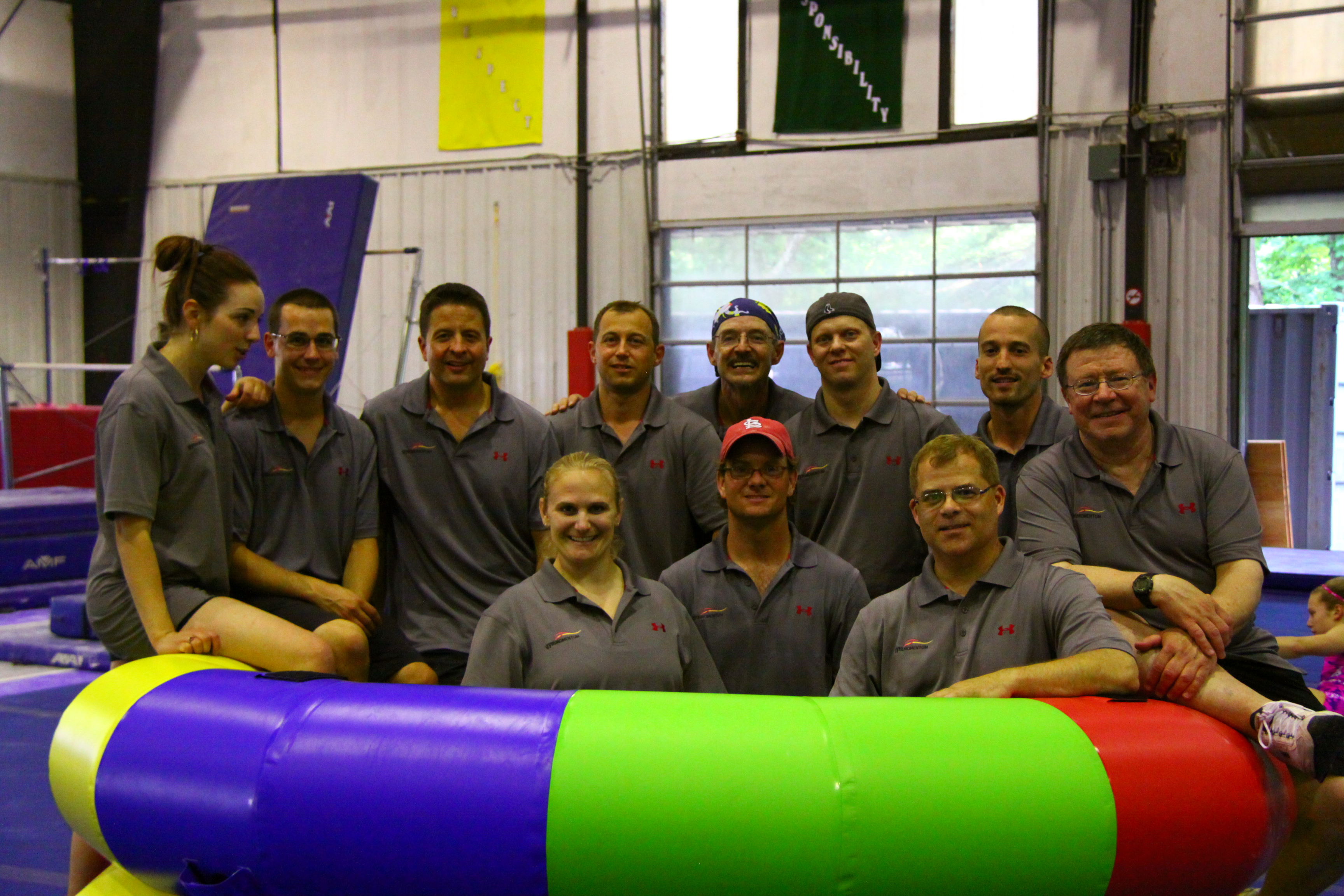
Gym Momentum Staff
One of the things I love about camps is getting together with other coaches in a social setting. Typically all conversations lead back to the gym. What we are doing with a particular group that is working and what isn’t working. Hoping for some help from some of the other coaches. This year we seemed to get a little bogged down with coaches looking for quicker ways. In the end- There are no shortcuts, crash programs or quick fixes that will get you there faster. You will always have to pay the piper whether it is sooner or later. It is better to pay up front by being very thorough in the development process with a balanced program that builds a solid foundation. All components of fitness must be trained at all times of the training year and the career, just the proportion and emphasis changes with advancing training age and proficiency. At younger training ages, especially during periods of rapid growth and development it is tempting to try to accelerate the process, because they can but they will pay for it later on. My concern today is that young athletes over compete and under prepare in terms of sound fundamental training. They can continue to advance on talent and competitiveness and then the roof caves in either with serous injuries, performance stagnation or performance decrement. Pay the piper, take care of fundamentals heed the wisdom of the body and train appropriate for the athlete’s level of development. Rome was not built in a day; training accumulates day-to-day, week-to-week, month-to-month and year-to-year. Take time and do it and teach it right the first time.
It is a given that to achieve any level of success in gymnastics demands hard work. That being said ANYONE can work hard. Champions are the ones who work smart. They know how to balance the work in order to get full benefit from the time and effort in training. Some gymnasts and coaches make the choice to try to go hard all the time with the HOPE that they will survive. It is just that hope. And hope does not win medals. In reality more often than not it is this athlete who is seldom there when it counts the most. They either get hurt or spend all their time managing nagging injuries that keep them from achieving results. The alternative is to train smart, understand their capabilities and recoverability so that they can thrive and be at their best when the stakes are highest. Smart training balances the hard with the easy, it takes into account individual differences and allows for differing adaptation times to different training demands. To train smart listen to your gymnasts and have them listen to their body. Follow what it is telling you. Training accumulates over time so recognize that you are in it for the long term.
To be a Good and effective coach – it demands a careful blend of art AND science. It is not an either or proposition. Modern coaching necessitates that the coach have a sound foundation in sports science which means the coach is educated in sports science, but is not a sport scientist (I leave it up to Dr. Sands and Dr. George!) You can learn the science in school or by reading, you can’t really learn to coach in a classroom, online or in a book. You must get out and practice coaching. Coaching is something YOU ARE not something you do. Day to day coaching demands artistry to achieve results. In today’s world, with the stress on science and technology it is too easy to forget the art and focus on the science. The words of Bill Sweetenham from the Global Coaching House last summer in London sum it all up quite nicely: “ Science is only useful if it makes the coach a better artist.”