Jason Mortimer, (JAOvideos) took the time to record how long it took a BRAND NEW White foam block to turn Yellow. (He really needs a life!)
Work Hard. Work Smart. Have a Plan.
Lets not fool ourselves to get better you have to do the work, that is a given. Make no mistake that everyone who achieves at a high level does the work. All that being said just doing the work is not enough, anyone can work it is work with direction and purpose that produces results. We have this mistaken notion more prevalent today because of the “10,000 hour” myth that all you need to do is to punch the clock, accumulate hours and somehow magically at 10,000 hours you will be a champion. No way! If that work is not mindful, done with a plan that provides specific direction then all you are doing is getting tired and getting tired does not make you better. It is not the work it is what you put into the work that counts I know that is a cliché but some clichés are truisms. I have seen nothing in my experience to disprove this. Plan your work, work the plan, evaluate the results, recalibrate and keep moving forward with direction and purpose. I had this discussion with a colleague the other day and she reminded of the words of a country western song that was popular a few years ago: “Work your fingers to the bone. What do you get? Boney fingers.”
YOUR EYES MAY BE LYING TO YOU
It is interesting to listen to coach’s talk about what they see when observing movement. Are they really seeing what they think they see? Human vision is incredibly acute and at the same time fundamentally flawed. The longer I coach the more I realize that more often than not we see what we think we see rather that exactly what is happening. Whether we recognize it or not we all have a tendency toward a confirmation bias. Consciously or subconsciously we have programmed our brain to look for certain things. In many ways viewing motion is like looking at a Rorschach inkblot test, the shape of the object does not change as much as our perception of the shape of the object. I heard a story once about three pitching coaches and three scouts watching a pitcher. Mind you six people watching the same pitcher throw the same pitch and they all saw something slightly different. Listening to them you quickly realize that what each of them had seen confirmed each of their biases in regard to pitching.
And in the world of gymnastics- Every “expert” is going to see what they want. A sport scientist will find a biomechanical solution. A strength expert will find a conditioning solution. A Psychologist will find a mental solution. What is the solution? Obviously today we have high-speed video and a myriad of analysis tools, but we still need to be able to effectively use our naked eye to provide instant feedback for correction and instruction. First recognize your confirmation bias and work to erase that mental program. Second a very simple correction that I learned from Muriel Grossfeld is to change vantage point. Instead of viewing Beam from the side watch from the end or get up in the stands and view from above. You will be surprised at how many different things you see. A third solution is to learn to use you peripheral vision. Turn sideways to the action and you will be surprised at things you see. Our peripheral vision is very acute but we don’t train ourselves to use it to its fullest extent. Just like any coaching skill training yourself to have an accurate unbiased coaching eye is part of improving your skills as a coach. In words of that sage biomechanist Yogi Berra “You can see a lot by watching.”
Communicating the Message
As I have stated in past posts, it is not just important WHAT you say but HOW you say it.
Continuing along that line, it is also important HOW LONG it takes you to say something.
As Americans it seems like BIGGER is ALWAYS better. Why should we give a correction in 5 or 6 words if we can use 50 or 60 words!
In my COACHES AS EDUCATORS lecture I talk about this being so important. Coaches are filling kids with SO much information that it is difficult for the athlete to process. They then go ON and ON and ON with a 50 second correction that could be done in 10 seconds or less. As a general rule, if you take an athletes AGE- you have that many seconds to give them a correction. I know this is an over simplification but you get the idea.
Today I was reading Functional Path Training Blog and he had a great example.
Communicating the Message
Regardless of the message you have a very small window to communicate the message in a meaningful way so that the person receiving the message with get it. I was reminded of this this morning at mass when the priest missed a golden opportunity to get his message across. His theme was love. Instead of making his point he used way too many analogies and mixed metaphors and droned on for fifteen minutes. He lost me! As I was driving home and reflecting on this I could not help but relate it to coaching. Effective coaching is all about communication. How many coaches do what the priest did this morning? How many coaches talk just to hear themselves talk? We get away with it because we have a captive audience, but is it best, is it effective? Know what you are going to say. Say it wit appropriate inflection and emotion. Get the point across. Short, sharp clear on point, don’t belabor the point. Follow the example of the great John Wooden who rarely spoke more that twenty to thirty seconds during practice. The majority of what he said was instructional. Speak in phrases, short and to the point that emphasizes instruction and action words.
Keep it Short, Keep it Simple. Your athletes want you to be quick and concise with your corrections. In Coaching Commandments, I wrote about DR. Joe and Sue Massimo research of what your gymnasts wants out of you. # 3 on the list was minimum verbiage.
Swing Half Turn Dismount Progression
With the amount of quality videos Jason Mortimer puts out, you wonder if he has a life out of the gym. LOL- who are we kidding. Of course he doesn’t have a life! You should follow him on youtube.
And if you want to see him in person- he will be at Gym Momentum week long camp this summer.
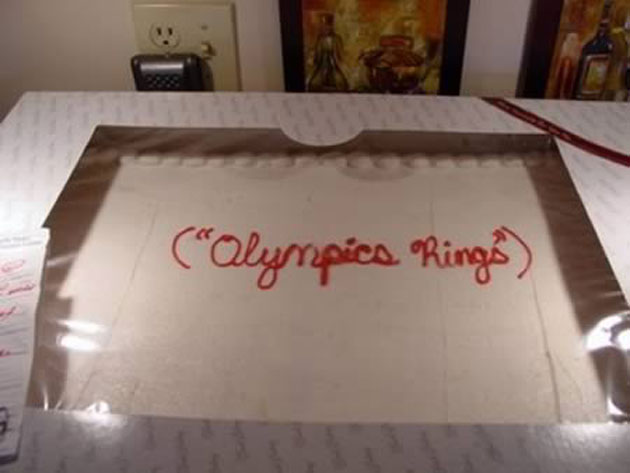
Be VERY clear when you order a cake
When you order a cake. You May want to be VERY clear with your order. Someone really just needs to try harder.
What I think about when I can not sleep
7 Steps to Handling an Injury
Sunday’s NCAA Tournament saw one of the most stomach-turning injuries ever televised live when University of Louisville sophomore Kevin Ware landed awkwardly after jumping to block a shot, breaking his right leg so severely that several inches of bone protruded from the skin. Unfortunately, most of us in the gymnastics world have seen injuries like this.
As gruesome as the injury was, Ware benefited from medical staff being on hand. In fact, within hours he had completed surgery to repair the bone and punctured skin, and by Monday the university distributed photos of Ware already on crutches. While he faces a long road back, the 20-year-old may play again.
Aside from Ware’s injury, it raises a broader questions: While such injuries are rare, what if it happens where there isn’t medical staff nearby— I have some great doctors and hospitals near by, but other than coaches with first aid training, I really do not have medial staff on site.
Here are 7 things to do if a gymnast or coach suffers a compound fracture, dislocated joint, or other serious injury in the gym:
1. Call 911. This should be obvious, right? But people often skip this step, thinking that it might be faster to drive someone to the hospital themselves. “The dispatchers are trained to talk you through first aid,” says Jeffrey Rabrich, D.O., medical director of the emergency room at St. Luke’s-Roosevelt Hospital in New York. Keep the line open, even if you have to set your cell phone down, until the paramedics show up.
2. Check for breathing. Horrific, bloody injuries sometimes make you miss even more critical problems. “Someone who hits the ground from an injury like Kevin Ware’s could hit their head at the same time and stop breathing,” says David Forsh, M.D., chief of orthopedic trauma at Mount Sinai Hospital. If he’s awake and talking—or howling from the pain—that’s good. If not, look to make sure his chest is rising and falling evenly. Tilt his head back and look to make sure his tongue isn’t blocking his throat. If it is, gently turn his head to the side and push the tongue out of the way to open the airway.
3. Immobilize the injury. Even if the bone is clearly bent at an unnatural angle, don’t try to move it back into place yourself. “You can turn a dislocation into a fracture, or make any fracture worse,” Dr. Rabrich says. Use whatever is handy to make a splint—a thick magazine and strips of cloth, for example, can splint a wrist. If it’s a leg injury, you’ll want to immobilize the entire leg. With an arm injury, you can also make an over-the-shoulder sling.
4. Cover the wound and slow the bleeding. When a broken bone tears through skin, both skin and bone are going to bleed. Applying gentle pressure with a cloth to the wound should be enough to slow blood loss. “Even if all you have are sweaty shirts and your gym towels, it’s better to prevent bleeding than worry about infection at that point,” Dr. Forsh says. If you see a lot of blood spurting out in time with the heartbeat, that’s a sign the bone may have nicked an artery. Use a belt or whatever else is at hand to tie off tightly, along the limb between the bleeding and his heart, to stop the bleeding.
5. Treat for shock. Shock can be even more life-threatening than the actual injury. If blood pressure drops dramatically from loss of fluids, the heart must go into overdrive to deliver oxygen to the brain and vital organs. Your plan: Have them lay down, and elevate one or both legs slightly (if the legs aren’t injured) so his feet are higher than his heart and head. “That will help the blood flow back to the heart so it doesn’t have to work as hard,” says Dr. Forsh. If he starts vomiting, help him roll to the side so he doesn’t choke.
6. Make sure blood is still flowing below the injury. In rare cases, a dislocation or bone break can twist the limb enough that it cuts off blood flow. You’ll see his hand or leg start to turn blue, and it will feel cold to the touch. “This is the only time where you may want to try to gently straighten the limb to a more natural position, just to get blood moving again,” Dr. Forsh says.
7. Don’t do anything else. Don’t give someone who has a traumatic injury food, pain relievers, or even water. “Chances are he’s going to need surgery, and if that’s the case he has to go in with an empty stomach,” says Dr. Rabrich. You’ve done all you can. Stay with them until medical professionals arrive.
Underswing Dismount
Jason Mortimer from Bounce Gymnastics in Michigan shares a great video and drill for undershoot dismount. You should really follow him on youtube.
The undershoot is a very important step in a clear hip progression.
Jason will be working at my gymnastics camp this summer! I am very excited to have him on staff.
What Message Are You Sending Your Gymnasts
I was at a competition last week and I was speaking with a group of coaches about motivation in the gym. Summing things up- In my gym, Atlantic Gymnastics, I only have a few rules. I feel that if you have some basic rules, nothing complicated, people will follow them. [Read more…]
TESTING
With the JO season winding down people are thinking about TOPS. I found these articles on Vern Gambetta’s Functional Path Training Blog.
Testing – A Perspective
It is important to remember that testing is the highest form of training stress outside of the actual Competition. Testing is important to determine the individual athlete’s athletic qualities relative to the demands of their position/event and the sport. I am not interested in comparing an athlete against some arbitrary norms, but I am interested in intra individual comparison, comparing them against themselves. We must be careful not to draw too many conclusions from a one off series of tests. Only after several tests are conducted periodically throughout the training year can an in depth profile of each athlete be determined. In most instances the test will indicate deficiencies that were already identified through observation of training and game performance. They will serve to further highlight those deficiencies and provide direction to address those deficiencies in training. The tests give specific numbers to compare for improvement and motivation, but remember the ultimate test is the competition itself.
Thoughts on Testing
When you are testing it is important to consider all of the following:
Know what you are looking for, there are periods of training where you should see marked improvement and other times when you should see stabilization or even slight regression on certain tests. Remember the tests should reflect the training.
Know what you are going to do when you find it. If you see regression then what adjustments will you make, conversely if you see unexpected improvement what will you do?
Regular monitoring is necessary to determine strength and weaknesses and progress of training. The goal in training is minimize weaknesses and to maximize training, testing can be a valuable guide to this process.
Testing helps to individualize training. There is much individual variability in adaptive responses to various training stimuli. Two individuals could have the opposite response to the same training session or training cycle. Testing can identify how each individual will respond and allow training adjustments to be made accordingly.
Testing will give constant feedback to the athletes and coaches as to the effects of training. Do not wait until competition to ascertain training response, use testing to be proactive. Testing must dovetail into training. It is an integral part of the whole training spectrum.
Do not use testing to:
Select a team; team selection should be based on results in the competitive arena of the actual sport. Tests can verify what you see or do not see in the competitive arena, but they should not be the sole criteria for team selection.
Predict performance. However it can give a statutes report as to progress toward a goal. Actual competition in the game, match or meet performance is dependent on so much more than the physical capacities identified through testing.