Gym Momentum Entry Europe
Gym Momentum 2026 Entry North America
The Dangers of Digital Distraction: Protecting Our Future Generations
Beyond the Gift: Why I Shared “The Anxious Generation” With My Management Team and My Children
Last year I handed out copies of Jonathan Haidt’s book, The Anxious Generation, to two of the most important groups in my life: my management team at ATLANTIC GYMNASTICS and my own children, who are teachers. I didn’t do this just to share a “good read.” I did it because we are facing a cognitive emergency that is dismantling human potential in the gym, the office and the classroom alike. I want to believe that my kids and staff are not spending hours doomscrolling, but the reality is that many (most?) of their students do.
While the term “brain rot” began as Gen Z slang for the mental fog of doomscrolling, the science shows it is a legitimate deterioration of our intellectual state. We are currently witnessing a “sociological apocalypse” where short-form digital stimulation is rewiring our brains for the worse.
To My Management Team: Reclaiming Our Professional Depth
In the corporate world, they often talk about “agility,” but we’ve accidentally traded it for attention fragmentation. But even in the GYM WORLD I see the effects of “brain rot” in our staff meetings, our classes, our output every day and even our interaction with parents.
• The Productivity Drain: Research shows that the average worker is interrupted every three minutes. Crucially, it takes 23 minutes to return to a state of deep focus after one of these distractions. If we are constantly checking Slack or scrolling through “ultra-processed” digital content, we aren’t actually working—we are merely rehearsing distraction. I do NOT want my kids, my coaches, my friends working 24 hours a day, 7 days a week. Everyone needs a break. Work should be done at work. I would rather see my staff interrupted at work with an issue from home than the other way around. BUT, just taking a look at the numbers. As of early 2025, the average person spends approximately 2 hours and 21 minutes (141 minutes) per day on social media. While this figure marks a slight decrease from 2024, it still represents over 30 days per year spent on social platforms. Has any of that time contributed to your life in a positive way?!
• Reward Deficit Disorder: Internal documents from tech companies admit they have turned their apps into “slot machines”. This creates “reward deficit disorder,” where our brains become so binned on instant dopamine hits that we lose the ability to feel satisfied by long-term professional achievements.
• The “CEO” of the Brain: Biologically, constant digital stimulation hyperactivates the amygdala (our threat detector), which increases irritability and stress. Meanwhile, it “downregulates” the prefrontal cortex—the part of the brain responsible for the strategic thinking and impulse control that I rely on you for as leaders.
To My Children (The Teachers): Protecting the Next Generation
As teachers, you are on the front lines of what Haidt calls the “Great Rewiring of Childhood”. You see students who can’t read a single sentence without getting bored.
• The EdTech Blunder: We made a colossal mistake by putting “multi-function play devices” (laptops and tablets) on every student’s desk. Since 2012, global test scores have been in a steady decline because these devices act as “attention fracking” tools.
• The Sensitive Period: Puberty is a critical “sensitive period” where the brain locks down its permanent wiring. By allowing kids to spend 8 to 10 hours a day on screens, we are preventing them from learning the vital connection between hard work and reward.
• Popcorn Brain: You are teaching a generation with “popcorn brain”—a sensation where the mind is so used to the fast-paced “pop” of digital novelty that the “slow” pace of a classroom feels like torture.
The Common Thread: A Sense of “Horizonlessness”
Whether in the office or the schoolyard, “brain rot” is fueling a mental health crisis. Adults and teens alike are reporting a sense of “horizonlessness”—a feeling that there is nothing to look forward to and no point in working hard because the future feels invisible. We have become our own “night watchmen,” scanning for danger 24/7 through our feeds, which keeps us in a state of chronic hyper-vigilance that prevents true happiness.
Horizonlessness is a psychological state increasingly reported by adults where they feel they have nothing to look forward to, a feeling that directly sabotages human potential by stripping away the motivation to work toward a future. The human brain is evolutionarily wired for progress; when that sense of a future disappears, individuals often fall into a “what’s the point?” mentality regarding hard work, personal development, or professional effort. This state prevents adults from reaching their potential in several ways:
• Dismantling Motivation and Purpose: Reaching one’s capacity requires a meaningful relationship between oneself and their work, where they feel productive and useful to others. When the future feels invisible, adults may feel “useless,” leading to a destruction of human capital and a loss of the sense of meaning required to achieve long-term goals.
• Chronic Stress and Cognitive Drain: Horizonlessness is often exacerbated by a digital diet of “poly-crisis” information—constant real-time updates on global disasters—that keeps the brain in a state of chronic hyper-vigilance. This state triggers the amygdala (the brain’s threat detector), which in turn “downregulates” or quiets the prefrontal cortex.
• Impairment of Executive Function: Because the prefrontal cortex is responsible for executive functions like planning, strategic thinking, organization, and impulse control, its suppression makes it physically and mentally difficult for an adult to execute the steps necessary to fulfill their potential.
• Stifling Creativity and Reflection: Reaching one’s potential often requires “brain breaks” and boredom to activate the default mode network, which handles self-reflection and the generation of new ideas. Horizonlessness, combined with the “primal urge to scroll” to manage the resulting stress, prevents this network from working, meaning true ideas never have the “soil” they need to bloom.
Ultimately, horizonlessness traps adults in a defensive, short-term posture that prioritizes immediate dopamine hits over the sustained attention and effort required for mastery and success.
Reclaiming the “Quiet” Where Greatness is Born
This struggle is about more than just productivity; it is about being fully engaged in your life and the real world. Consider why we often have our best ideas in the shower: it is one of the few remaining places where we are not scrolling. As a society, we used to build and do great things, but human potential is now being diverted into a world where people merely try to “influence” others with curated photos.
We must rediscover that there is beauty in a bored brain. Boredom is not an empty space to be filled with “digital slop”; it is the “soil” in which resilience grows. When we allow ourselves to be bored, the “default mode network” in our brain kicks in, fostering the self-reflection and creative thinking where true ideas bloom.
How We Reclaim Our Humanity
The brain is elastic, but recovery requires intentional “digital hygiene”. I’m asking the managers at my gyms and my family and friends to join me in these changes:
1. Delete the “Slot Machines”: Remove addictive apps like TikTok, Instagram and Reels from your phone to break the dopamine loop.
2. Establish Geographical Boundaries: “Where you put your phone at night may be the most important decision you make”. Keep devices out of the bedroom to stop “revenge bedtime procrastination”—the habit of stealing your own sleep to scroll, which ruins your health and clarity the next day.
3. Grayscale Your Device: Turning your phone to black-and-white removes the “technicolor” appeal that triggers compulsive checking.
4. The Rule of Two: Your brain can only handle a couple of changes at a time. Pick two of these habits, stick with them for eight weeks to allow for neural rewiring, and then add more.
Attention is not something you have; it is something you train. Every scroll is a vote for the brain you are becoming—it’s time to start voting for the one that can think, create, and contribute to the real world.
Gym Momentum International E.U. Entry
3 Keys To Being a GREAT Coach
As the New Year approaches, it is time to look back AND look forward. My goal for the new year has been the same for many years. BE A BETTER COACH. Doc Massimo always told me that I had to focus on the things I could control. Being a better coach is something I can always work on.
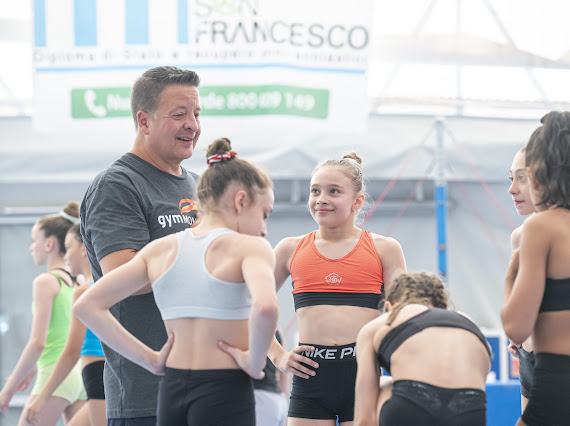
I have always felt that a good coach is simply a good teacher. I have written and lectured on COACHES as EDUCATORS many times. Maybe it’s time I dust off that lecture and start doing it again.
Through out my career (35+ years) I have been able to meet some truly great coaches. Some I visited in their gyms. Some I met at conferences or competitions and some have become friends. Watching them interact with the gymnasts and other coaches is a thing a beauty. Here are my takeaways.
One: Relationships with the gymnasts. Great teachers truly care about their students as people. Great coaches need to do the same. We need to build relationships with the athletes. We may not be close to all of them but we need to try to build relationships with as many as possible. We need to listen to the gymnasts. It’s not just about the struggles the gymnast is having in the gym, thought that is important. We need to be available to hear about their struggles with life, with school, and with what happens today. We must respect the gymnasts as people. This is how we build a relationship.
Two: We must be enthusiastic about coaching gymnastics, working with gymnasts and the event we are on. This can be difficult at the younger levels where coaches have to “do it all”. Great coaches can fake it to some extent because they are passionate about enough of what they are teaching to know what that feels like. Passion is contagious. It also means that one wants to share that passion as well as the specific knowledge they are trying to share. Gymnasts who have a relationship with a coach will naturally want to learn what is being taught so enthusiastically.
Three: Innovation. I would rather have one coach with 20 years experience than 20 coaches with one year of experience. The great coaches I have met are constantly innovating. They may start with a canned program. One they have taught many times before. Then they add, subtract, and move things around. More often though, they make their own. Individual to the current group and athletes they are working with. Oh, sure, they abide by necessary standards but they teach their own way. They are rarely satisfied. At this point in my career, I very rarely use notes to teach off of. I have been down this broad countless times. Then I pick up on a cue and I start modifying the plan to fit the kids. When we get a new piece of equipment in the gym I try to see how many different ways I can use it. When I am lecturing you’ll often find me modifying my presentation, before teaching that material again. I write down what worked and what didn’t work and then I go on.
The other day my friend is WENDY BRUCE-MARTIN sent me a drill she saw on instagram. It was a drill that she and I did years ago when we were coaching in Switzerland. The person was presenting this as something NEW. I wasn’t bothered. A great coach will borrow from other great coaches and teachers (although it would have been nice to have been given the credit). A great coach is not afraid to find ideas from others and fit them into how and where they teach. I have lectured often throughout the world on gymnastics and education and one thing I almost always see is that the coaches who are giving the lectures can often be found sitting in on other lectures. They are always learning. Always looking for a better, more efficient way. They are talking to others in the hallway, sharing meals and activities outside the conference. They are always listening and learning.
Bonus: The great teachers and coaches share their knowledge with others. They will share their plan and philosophy. They share not for ego but because there is something about being a coach that just makes one want to help everyone become better. Better about teaching. Better at knowing things. In the end, If I teach you something and your gymnasts get better- I need to innovate and up my game to be better.
Seek out the great teachers. Become a great teacher. Make the world a better place. Make that part of your New Year’s Resolution.
Mobilità dell’anca, della schiena, della spalla
Although the video titles and some of the speaking is in Italian- the video is self explanatory on some exercises and stretches for Hips, Back and Shoulder mobility.
Minnesota and Wisconsin High School Workshop
In order to provide you with the MOST amount of information I will add links to other lectures and articles. Even if I am unable to have the time to answer all your questions there will still be answers below.
VAULT
Success in Vaulting requires the “skills” of an advanced tumbler as well as the “running speed” of a champion sprinter.
Like Beam, Vaulting also has an unforgiving nature. Vault involves one element and the gymnast has precious little, if any, time to make a correction.
So many times it comes down to the run.
run fast, hit the board, shut your eyes.
Goals pre-season.
- develop a steady accelerating run.
- consistent board contact
- maintain straight body through out.
- Air awareness every day
Goals During season
- Don’t get hurt
A few of my favorite Yurchenko Vaulting Drills
Where to go from the handspring vault? (Notes from a lecture)
UNEVEN BARS
Bars is about repetition and combinations. (and repetition OF combinations)
It tends to be the most difficult event because of the strength necessary and that you can’t fake it.
Pre-season goals
- develop the grip strength necessary to make it through the routine
- develop core strength
- develop swing
Teach the dismount first! If they are comfortable with the END of their routine they will be able to concentrate on the skills leading up to it.
Like an airplane pilot performing complex aerial maneuvers, the gymnast should focus intermittently on fixed frames of reference
Drills for Giants (as I put this in I noticed that some of the YouTube links are bad and need updated. I will work on that.
Front Giants and Blind Changes
5 Things every Gymnast needs on Bars
TUMBLING
Tumbling is where it all begins (or ends). If they cannot do it on floor it is highly unlikely and probably dangerous for them to try it at other events. Most coaches would agree that a gymnasts competency in tumbling serves as the great separator between champions and would be champions.
Body Shaping Drills for Tumbling
Developmental Twisting Part 8 (this is the last of an 8 part series. The first 7 have links at the bottom)
BEAM
Beam skills MUST be mastered on the ground, then a line, low beam, medium beam, etc. The more steps you have in your progression the more sound the skill will be. The actor balancing ANYWHERE, let alone on a beam going into or out of a skill is about core strength. A gymnast must maintain the effective weight of the body directly over the base of support.
- stack the vertebrae
- strong ankles/feet
- strong wrists/ hands
- Focus on the target
Drills for arms on Jumps and Leaps
Planning workouts during the season
STRENGTH
USECA SURVEY
As chairman of the USECA I take my responsibility to the coaches I represent very seriously. I have an Advisory Council Meeting at National Congress. Please take the time to fill out this survey.
https://forms.gle/7EnJJtzNDAcNfA5z6
An Offer to Help Ukrainian Gymnasts
The Swiss Gymnastics Federation (STV) has sent a letter to Oleksandr Sukhomlyn the President of the Ukrainian Gymnastics Federation stating that If the Ukrainian Gymnastics Federation wishes, we can arrange accommodation, meals and training facilities in Switzerland for Ukrainian gymnasts and their support team and coaches.
I am so proud to be part of this organization that searches for solutions and takes action. This is what leadership looks like.