If You Can’t Explain It in a Few Words, You Don’t Understand It
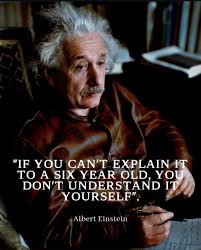
“If you can’t explain it to a 6-year-old, you probably don’t understand it yourself.”
— Albert Einstein
I’ve always loved that quote. Because gymnastics is not a lecture hall.
It’s a laboratory.
And clarity wins in the lab.
⸻
Coaches Talk Too Much
Let’s be honest. Gymnastics coaches talk too much. Especially when we don’t fully understand the issue.
- We see a bent arms on a giant.
- We see a low chest on a Yurchenko.
- We see a short landing on a double back.
And instead of identifying the root cause, we start narrating everything we know about shoulders, hips, tap swings, block angles, and center of mass.
Meanwhile, the gymnast just wants to know:
“What do I change?”
Most athletes don’t want the dissertation.
They want the direction.
⸻
The Real Skill: Communicating the Correction
What makes a good coach great isn’t the ability to see the correction.
Plenty of coaches can spot errors. Great coaches can communicate the correction efficiently. In a few words.
Clear. Direct. Actionable.
The correction not being complicated does not mean the skill is simple.
- “Stay tight.”
- “Finish tall.”
- “See your hands.”
- “Open later.”
- “Push through your shoulders.”
Those cues are not complicated. But executing them at speed, upside down, under pressure? That’s extremely difficult.
Coaches often confuse the two.
They think because the correction is hard to execute, it must require a complicated explanation.
It doesn’t.
⸻
Simple Is Not Easy
- A full twisting back tuck on beam is not simple.
- A Yurchenko double twist is not simple.
But the cue often is.
- “Lift up your chest”
- “Close your round off faster.”
- “Spot the take off”
Simple cue.
Difficult execution.
When coaches give complicated answers, it’s often because they haven’t truly identified the primary cause.
Clarity requires confidence.
And confidence comes from understanding.
⸻
This Doesn’t Mean You Talk a Lot
Let me be clear.
Efficiency is not about silence. And it’s not about being cold.
This doesn’t mean you talk a lot. It means that every word you say has weight and meaning.
Great coaches are not quiet.
They are precise. They don’t waste words.
When they speak, the athlete listens—because the words matter.
⸻
The Mechanic Analogy
When I take my car to the shop, I say:
“It’s making a weird noise when I slow down.”
They fix it.
Then they tell me:
“You needed new brake pads.”
That’s it.
- I don’t need the metallurgy lesson.
- I don’t need the physics of friction.
- I don’t need to know about the tiny metal tab that makes the squeal.
I just need the problem fixed.
Most gymnasts are the same.
They don’t need to understand the molecular structure of the spring floor.
They need to know what to change on the next turn.
⸻
Lessons from Coaching Abroad
This lesson became crystal clear during my years coaching internationally—and it is reinforced right now.
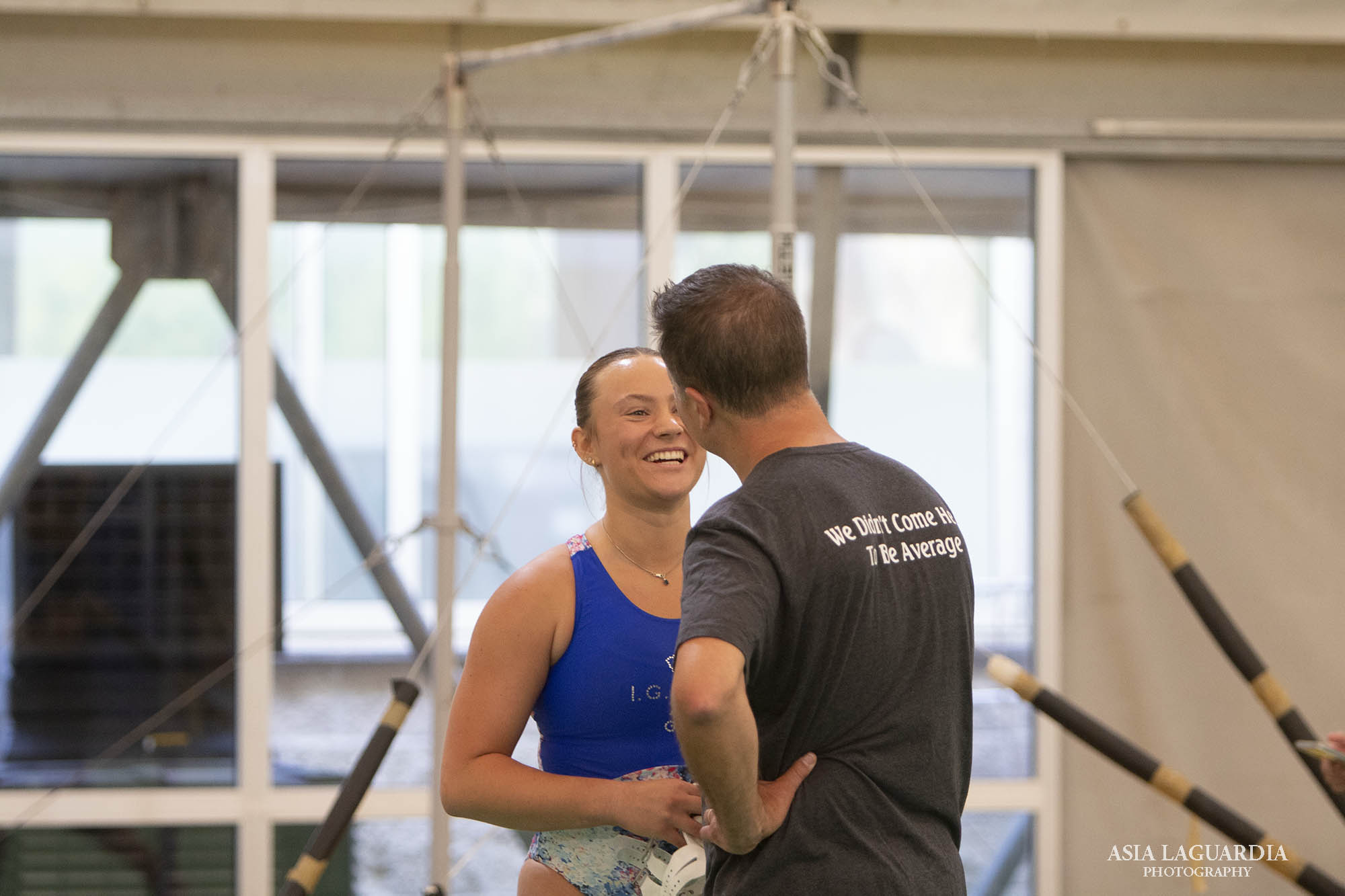
I am currently coaching in Italy.In the gym, I must speak Italian.
My Italian is… basic. (Il mio italiano è… semplice.)
So how can I be effective? How can foreign coaches in the United States be wildly successful when their English is basic?
The answer is simple:
We deliver the necessary information without fluff.
I know how to say:
• “Straighten your arms.”
• “Push here.”
• “A little longer.”
• “Open your chest.”
What I cannot do is launch into a five-minute explanation of scapular engagement and angular momentum.
I don’t have the language capacity. But you know what?
It works.
The girls understand. They adjust. They improve.
And they appreciate it. Because they don’t need complexity. They need clarity.
In fact, the language barrier forces better coaching. It forces you to strip the correction down to its essence.
And when you do that, you realize how much unnecessary talking you used to do.
⸻
Over-Explaining Is Often a Symptom
When coaches over-explain, it usually means one of three things:
1. They don’t fully understand the root cause.
2. They are trying to sound knowledgeable.
3. They are uncomfortable with silence.
But athletes don’t perform better because we sound intelligent.
They perform better because they know what to do.
And in a sport where hesitation can mean injury, overload is dangerous.
Clarity builds confidence.
Overload builds doubt.
⸻
Coaches as Educators
In my upcoming book Coaches as Educators (It’s More Than Just a Cartwheel), this principle is foundational:
Your job is not to showcase knowledge.
Your job is to transfer understanding.
And understanding shows up in action.
If you can’t explain the correction in a few words, you probably haven’t identified the true error.
When you see the real cause, it becomes simple.
Not easy.
But simple.
And when it’s simple, athletes attack it.
⸻
A Practical Challenge
At your next practice, try this:
Limit every correction to five words.
Five.
If you need more than five words, pause.
Ask yourself:
• What is the real issue?
• What is the single biggest fix?
• What do they need to feel or change right now?
Then say it.
And stop talking.
Let the athlete work.
Let the rep teach.
Let the simplicity do its job.
⸻
Because if you can’t explain it simply, you don’t understand it deeply enough.
And in gymnastics—where milliseconds matter and fear lives in small spaces—clarity isn’t just good education.
It’s great coaching.
Looking for a great place to learn along side your gymnasts? Try Gym Momentum Italia 2026.