Press Handstand Drill submitted by Ashley Lamborn from Don and Terry’s Gymnastics in Myrtle Beach.
Have a drill you ant to share? Send it to Gym Momentum!
Podcast: Play in new window | Download
Press Handstand Drill submitted by Ashley Lamborn from Don and Terry’s Gymnastics in Myrtle Beach.
Have a drill you ant to share? Send it to Gym Momentum!
Podcast: Play in new window | Download
In Developing A Plan For Bars I wrote about the importance of having a plan to teach skills in the right order. There are few skills that are more important (or more deducted) than the Cast Handstand.
I had a coach ask me, “is there a way to teach cast handstands WITHOUT spotting?” In short. NO. Or at least not that I have found.
I am not a proponent of mindlessly spotting casts over and over and HOPING that a gymnast can figure it out. Like everything, you need a plan.
Reasons for spotting:
MUSCLE MEMORY through repetition of the correct BODY POSITION
Alleviate Fear. Most have hear of falling over. That is why in the process I teach a 1/2 pirouette. They will know what their body has to do if/when they fall over. I also make sure I spot cast handstands on the high bar as well.
Cast Handstand Progression
Handstand Shape.
Strength Exercises
Spotted Exercises
Here are a few of the drills I use that do not need spot. I do believe you need to monitor everything to ensure correct body positions.
Some Spotted Drills
Straddle Cast Handstand Drills
I am sure I will be adding to this.
Send me YOUR IDEAS!
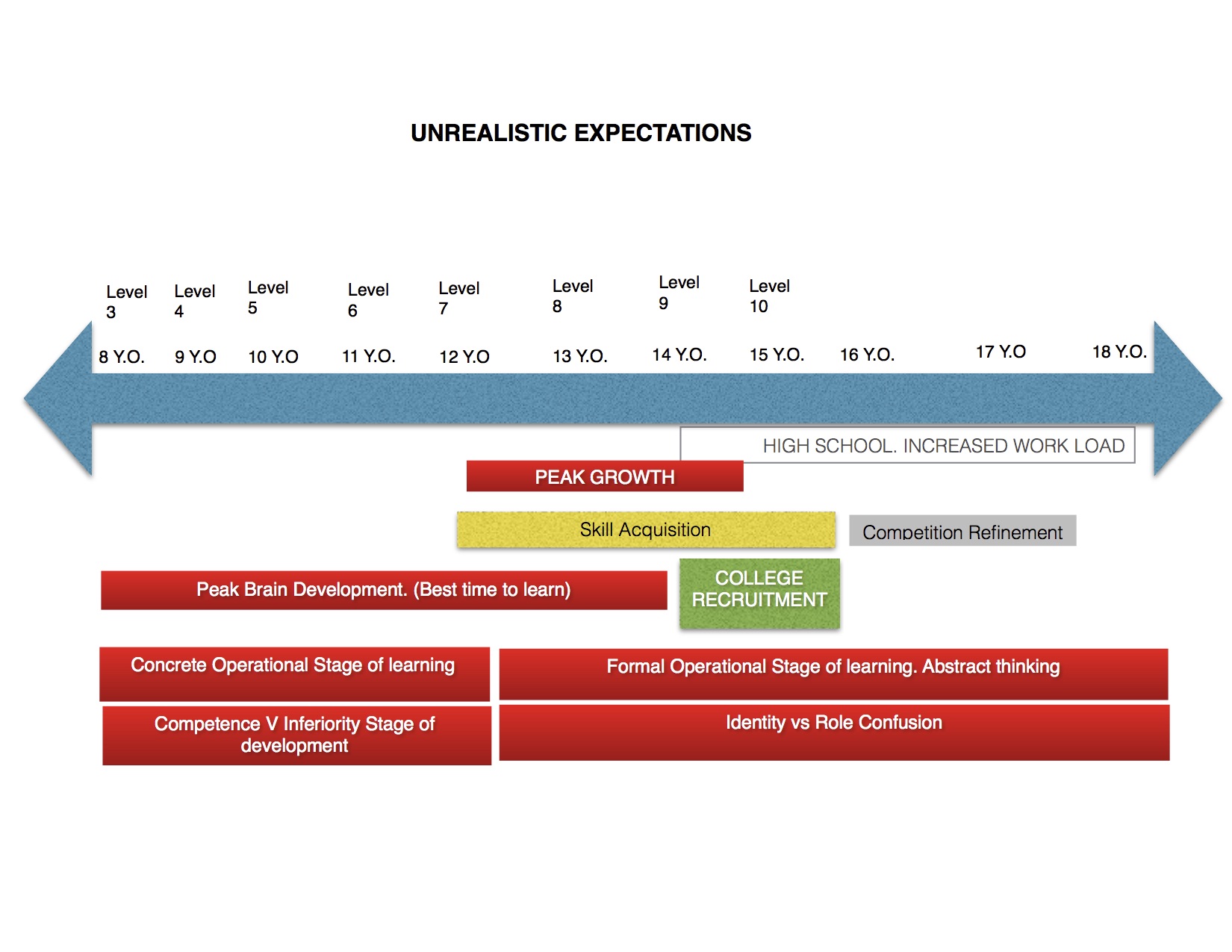
Problems with Linear Gymnastics
All too often coaches get stuck in a linear thought process with the gymnasts.
Level 3, then Level 4, 5 etc.
Reality is that with this system- you will run out of time.
It has been noted by coaches much smarter than me that you need to introduce every skill a gymnast is going to have by they time they are 13 if they are realistically going to get the skills into a routine.
Take any advanced skill. For example a double back on floor. Although the skill is quite common these days, the technical demands are essentially the same as when it was first competed and thought to be too dangerous! What we have now is smarter coaches, more training devices, springier floors and softer landings.
If you first introduce a double back to a child at 13 years old (meaning the gymnast has NEVER flipped over twice anywhere) you will have approximately a year of drill work where they are being heavily spotted, tumbling up to mats, a lot of time on trampoline, many turns into foam pits before they are able to consistently do this skill alone. This time could certainly be MUCH, MUCH longer depending on the amount of time that can be spent tumbling, how much time spent on current skills and routines. Time loss due to injury or illness.
Now at 14 the gymnast is able to perform a double back alone.
At 14.5 years she may have the skill in her routine although it is possibly still inconsistent.
14.5 is also the age where many gymnasts experience an increased workload in school and will therefore be missing more training sessions.
Also take into account that between the ages of 11 and 14 females experience (on average) the most rapid period of growth. Through adolescence the increased mass a female gymnast adds can also slow things down.
15 years (Prime college recruitment age) a gymnast now has the skill (hopefully) consistently.
You can see the pitfalls of delaying the learning process by not introducing the skill at a young enough age. The gymnast will simply run out of time to have the skill in a routine.
Taking this back into the USAG compulsory program. The average age of the Level 3’s in most gyms is 8 years old.
If they do 1 level per year
Level 4 – 9
Level 5 – 10
Level 6 – 11
Level 7 – 12
Level 8 – 13
Level 9 – 14
Level 10- 15
You are simply going to run out of time. How can you take the USAG system and use it to the benefit of most gymnasts and certainly for the more talented gymnasts?
In order for us, as gymnastics professionals, to become more efficient, we need to understand growth and development of the gymnasts we work with.
Children are not just smaller versions of adults. They have very particular needs and capabilities. One of the major issues in gymnastics is a lack of knowledge on the part of coaches and parents about how children grow and develop. This ignorance places unrealistic expectations on the child and often causes them to give up the sport. Good coaches know and understand the many changes that take place from child to adult and structure their coaching to best suit the needs of the young athlete.
Some general rules:
● Think about growth stages rather than ages. Kids develop at different times.
● Think how changes in physical proportions will affect performance with certain skills
● Encourage skill learning at a younger age for all your athletes, late developers could be very successful later.
● Don’t use exercises which place excessive force on bone growth regions during periods of maximum growth (growth spurts)
Given the formula which many clubs use, you can see that we have set out unrealistic expectation on a great many of out gymnasts.
A more realistic timeline for long term development would have the gymnasts being introduced to most of their skills by the age of 13.
My reasoning is that developmentally it seems the best time to learn. They generally have not hit their growth spurt where you may end up having to scrap some skills that are no longer practical. They do not have a huge amount of school work and have the least amount of FEAR.
When ever I do a congress I always hear about this great 10 year old back in the gym. This gymnast is learning so fast she is going to be the next Olympic Champion. Then what happens? They grow, become afraid, have too much school work to train enough hours to finish the skills. My experience has shown me that you simply do not have enough time to introduce a skill , refine the skill and compete the skill after 13.5 years old.
In order to have program wide success you need to have a plan. A plan for each group and each individual. If you are doing 1 level per year. You are simply going to run out of time.
Questions to ask yourself-
What age will this group start competing?
Will they be skipping a level or at some point do 2 levels in 1 year?
What did I learn from the LAST GROUP that I will do differently?
What will I do the same?
What competitions do we NEED to be at (Large invitationals to see how you stand up on a Regional or National level)?
Should we get involved in USAG Developmental Camps or TOPs?
Are we looking at collegiate gymnastics or potential National Team?
What skills will these gymnasts need in 3 years?
In 5 years?
In 8 years?
With every group you need a plan. Ask these questions so that you have direction.
 WHAT ARE YOUR THOUGHTS?
“With confidence, you have won before you have started.” — Marcus Garvey
THE 3 C’S OF BEING A CHAMPION ARE COURAGE, CONFIDENCE AND COMPOSURE
Confidence is often the single differentiator between people who are successful at competitions and those who are not. Those who think and believe they can do something — (as a coach) qualify your gymnasts to Nationals or (as an athlete) Stick your beam routine…. they do it.
Our mind is a very powerful tool, and the impact of our thoughts and words cannot be underestimated. Our thoughts create our emotions. Our emotions create our actions. Our actions create our life. Confident people have greater control over their minds and have tuned their mental station to one of “I can.”
You can’t wait until everything is just right. It will never be perfect. There will always be challenges, obstacles, and less than perfect conditions. So what? Get started now. With each step you take, you will grow stronger and stronger, more and more skilled, more and more self-confident, and more and more successful.
Here things that confident people do that you can apply:
Do not overcomplicate. You want something? Great! Create a plan to make it yours. Keep your eye on the prize and do not get distracted by other peoples noise or by your own ability to over-think.
Focus on what you want. Confident people keep a positive vision in mind of the future. They expect good things to happen to them, and as a result they do, as expectation is a very powerful force.
Act as if it’s already yours. People who are self-assured allow their language and actions to be in line with their outcome. This inspires confidence in others.
Use words with intention. Consider the difference with two people discussing their new routines. One could be, “Yes, I am a level 10. You are too? What’s your favorite tumbling pass? Good luck today! I can’t wait to see your new routine. Let me know what you think of mine! ” vs. “Well, I am trying to be a level 10 but I don’t know if I’m going to make it through my routine. (nervous laugh).” Who do you think is going to do better?
Listen but don’t pay heed to others’ opinions. Other people are well meaning and sometimes err on the side of caution. Confident people listen to other people but do not let their difference of perspective take them off track. It’s your life!
Dedicate time to what matters. Confident people are happy to say NO to things to make sure they have time and energy for their priorities. Funnily enough, people treat them with more respect as a result. As a coach, you have a JOB to do. What is getting in your way?
Act humble. Confident types don’t talk endlessly about their successes. At a gymnastics camp I was working at I was speaking to an outgoing and likable parent who said she “worked with athletes” I found out later that evening that she was the founder of Shade Global, a strategic brand marketing and consulting firm based in New York and Florida. She manages MOST of our Olympic team. (As well as being the parent to a pretty good gymnast). Confident people let their success speak for itself and don’t need to vocalize it.
Know failure is sometimes inevitable and don’t fear it. Worrying about failure can keep us from doing anything at all. Confident people know that failure is part of the process. When the chips are down they know it will pass.
Repeat all of the above! Confidence building takes a lifetime. The more we practice confidence as an attitude, the easier it becomes.
The most successful and happy people are not born the most rich, beautiful or talented. They just believe in themselves and go for what they want. Confidence is also a highly attractive quality in others. You need to try to hang out with confident people as well as be a confident person.

This is a bit of an inside joke to those who have seen my release move lecture.
Developing a Plan for Uneven Bars
If you are going to be successful at coaching bars, you need a plan. Every gymnast is going to be a little different, every group of gymnasts you have will be different from past groups. Knowing this, when you create your plan keep it general. You will fill in the specifics later based on the needs of individuals. There can be no generic plan. I think the best way to get an idea for YOUR plan is an example of what goes in to mine.
I will be posting a few of my favorite drills for all of these skills in the near future BUT It must start with a plan.
Let me know your thoughts and share your favorite drills
The 18 Month Rule.
Once you get past Level 3, you need to make sure that your gymnasts stay about 18 months ahead with the skills they need for the future. (They should be about twice that on floor!). I have been in gyms where it took nearly the entire bar workout to get the gymnasts through their routines. Dividing my bar workouts into thirds.
I like to make sure is that the gymnast gets their dismount first. They should have a dismount that they can compete and a dismount that is in their training routine. My reasoning is that if they are comfortable with their dismount, they can focus on the other elements in their routines. As they go into competitions their routine will be newest skills to oldest skill.
Fly Away
I teach fly aways with little kids (level 3) on low bar. Why? Because they are little and light! I do NOT teach tuck flyaways. I go right to layouts. My theory is that a body will follow its feet. If they tuck their feet are CLOSER to the bar. Most kids are afraid of kicking the bar. You might as well teach them to swing up and away in a layout.
A gymnast should be able to do a fly away from all 4. You never know when or how they will need it in the future.
Front Fly away
I teach this and let them do it alone over the pit pretty young. Reality is that when they are learning this they are falling faster than flipping. They are getting comfortable with a front flip. Most gymnasts do not swing hard enough so many will do a pike or ugly tuck. This doesn’t make me happy but I do not worry about it too much.

Cast Handstands
We all agree that cast handstands take a HUGE amount of time. We spot these (or should) everyday. Hundreds if not thousands of repetitions. I like to introduce the cast to handstand as early as level 3. While I am teaching cast handstands I teach a 1/2 pirouette at the same time. Many beginner optional gymnasts have a lot of fear with falling over the bar on cast handstands. So I teach a pirouette at the same time. If they are comfortable with falling (and turning) they will go for it harder. It takes countless repetitions. Be patient.
Inbar skills
The next thing we spend a lot of time coaching and spotting on bars are inbar skills. For most of the gymnasts that is clear hip circles and toe on handstands. I start every gymnast with clear hip circles but move to toe on handstand pretty quick. I feel that I can spend 80 hours working with a group of 10 gymnasts and get 1 really good clear hip circle (but still with some inconsistency) and maybe 2 other with reasonable clear hip circles. 2 more that occasionally make it to handstand and the rest really struggle with form, handstands etc. Spending the same amount of time on Toe on Handstands I have found more success and those gymnasts transition more easily into stalders.

Giants
This skill is often looked at as the make or break skill for many beginner optional gymnasts. You need it to be competitive at Level 7 and it really is a must for all advanced skills that come after that. I have always tried to teach front and back giants at the same time. Many of the drills are the same. It is important with front giants to also teach a “beat tap” as opposed to an uprise tap. With out this tap the gymnast will struggle with Jaegers or double fronts. If a gymnast does not front giant they will never be totally comfortable with pirouettes.
When learning giants I want the gymnasts to be comfortable swinging in all grips (over grip for back giant. Under grip and “L” (eagle) grip for front giants) and facing both directions.
Turning Giants
Once a gymnast can front giant (with spot) I want them to begin to pirouette (blind changes and higgens). This is nearly simultaneous. I want the gymnasts to be relatively free from fear swinging in under grip before they blind change. If they know what is going to happen going over the bar when they pirouette and what their body is going to do under the bar, they will be more comfortable in doing the pirouette. REMEMBER to teach a gymnast how to pirouette OUT of their front giant and how to FAIL. The more comfortable they are, the more aggressive they will be in their tap and the more willing they will be to experiment (play) with new skills.
Release Moves The Big 3. Jaeger, Tkatchev, Gienger.
I start everyone with drills for Jaeger and Tkatchev. Those 2 share a lot of the same drills and the hecht action is necessary for the toe on “hic-cup” to high bar.
The Jaeger is my current preference to push early because I think it may be the most difficult and therefore takes the longest to learn. If a gymnast has a blind change to Jaeger they have at least +.2 in bonus and fulfill 3 special requirements in that they turn, they have a release move, they are in under grip.

The Tkatchev as I stated shares many of the same drills as Jaeger and helps in other skills. This needs to be viewed as a BASE in that there are SO MANY skills that use that action (Hic-cup, Tkatchev, Maloney, Ray, Shaposhnikova, Hindorf, Kim, etc). A Tkatchev also has a fairly large margin of error and still be able to catch.
Gienger- I have been pretty successful teaching kids this skill but I view it more as a skill for the right gymnast. One who has a big “floaty” flyaway.
PAK/ OVERSHOOT
At the JO level I think many gymnasts have an easier time with a Pak because they can set the bars WIDE and have the low bar higher than FIG which helps hide some of the common problems. Although I do NOT think the skill itself is that complicated, keep in mind that most gymnasts are going to need to Kip cast 1/2 pirouette out of it. If you have a gymnast who struggles with pirouettes, you may want to teach an over shoot.

I teach overshoots and Paks at the same time and then see which is best for which gymnasts based on their fear and potential.

This is the first in a series of posts. I will be breaking down and posting drills for each skill.
Presentation
Recently I did a clinic at Central Vermont Gymnastics Academy. The owner of the gym, Anissa, has faced many difficulties opening up her gym. I want to share her story. Through adversity we find our strength.

For the past 32 years I have been involved in gymnastics as either a competitor or coach. My love for gymnastics all began at age 7 when I started competitive training at the original Green Mountain Gymnastics in Waterbury Center and performed exhibition routines at Harwood Union High School. I moved on to train at Champlain Valley Gymnastics (originally Dunkley’s Gymnastics) in South Burlington in 1984. Subsequently, I competed for Harwood on their junior high and varsity teams.
Wanting to continue my passion for the sport into adulthood, I turned to coaching the Harwood Union Middle School team right out of high school and worked in recreational gymnastics programs. Since 2002, I have taken on the role of head coach of the Harwood Union High School, Harwood Union Middle School and Crossett Brook Middle School teams. I am currently the Director of Gymnastics Programs at Harwood and have been for the last 13 years.
In 2006, I started Anissa’s Acrobats with a mission toward making gymnastics instruction more accessible to children in the Central Vermont area by offering classes and open gym sessions to children ages 2-12 at Thatcher Brook Primary School, Stowe Elementary, Waitsfield Elementary School and Harwood with whatever mats I could fit in the back of my car. It is my hope that the future of gymnastics in Vermont will continue to grow and enhance the lives of children throughout the State. In October 2010 I started Central Vermont Gymnastics Academy in the hopes that space would be found to call home to CVGA. Doors to Central Vermont Gymnastics Academy opened June 19th 2011.
August 29th 2011 just a little over 2 months after opening its doors, CVGA was under three and half feet of water and sludge from hurricane Irene. It was my first day off in 6 weeks and I was sleeping in. I got a phone call from my brother who was doing the morning milking at the farm he worked at and was listening to the news on the radio in the barn when he heard of the devastation in Waterbury. The first thing he asked me was, “Are you okay?” I was very confused, then it hit me, the storm. Oh yes, I had been out the night before stocking up on easy to eat food in case we lost power. Power loss was the only thing I knew to be worried about. While I was at it, I stocked up on supplies for the gym; a ton of toilet paper, arts and crafts, ink for the printer, you name it, if it was an office supply I bought it because the back to school sales are fantastic in August! Then my brother spoke again, “Your gym Anissa, is it okay?” What was he talking about? I was working so many hours at that time I had no cable or internet at home, no land line, just my cell phone. We were never home so why did we need those things? My three kids (15, 12 and 9) did not complain because they spent the summer helping me at the gym. That’s when he told me, downtown Waterbury was under water! I was still in denial, no way, my gym must be okay… it’s on the other side of the bridge, the bridge that goes over the river, to my gym, which is right next to the river! It slowly dawned on me that maybe I was in fact, NOT okay!
I threw on my mud boots, told my kids I would be back and had to go check on the gym. As I got down into town, traffic was stopped. They were not letting cars across the bridge to my gym because the river was still over the bridge. I sat stuck in traffic for what felt like forever… Noticing the awful smell… it was overwhelming! Finally traffic started moving and as I pulled into my parking lot, I realized I was pulling into sludge. The smell was even stronger now. My business neighbors were at my doors peering in. I got the doors unlocked and that is when the devastation hit. What had I done wrong? I remember clear as day that was the first thought that went through my mind. I don’t know why, just, what had I done, did I do something wrong?
There was no power in my building, it was dark and all not firmly planted items had been thrown to one back corner of my gym. I am pretty sure I was in shock. I don’t know where they came from but someone brought me a giant squeegee. I worked until I could not see any longer hauling out water and muck from the gym. I had been alone for hours in my gym, I had one girl friend who came and helped me in my struggle to remove all water and muck, because really, what else could I do. I felt so helpless, I needed to have some action I could do. As I drove back through town that night heading home, my only thoughts were, Thank God it was just my business! So may people I knew had just lost their home, their cars, their family photos, their everything!!! I only lost my business.
Insurance sent an adjuster. They told me I had a total loss. Hurry and get as many of my receipts in as soon as possible and they would get me a check. My only internet access was at the gym. I had to go to friend’s houses to work because there was no power at the gym, no internet, no phone. Weeks of going back and forth with the adjuster trying to get a straight answer, I finally went up the chain of command where I was informed that I would not be receiving any insurance money. I was devastated! What now… quitting was not an option!
FEMA – If you are a business, they send you to Small Business Association (SBA). If you tell them you have been open for two months they very politely try not to laugh as they tell you there is nothing they can do for you. So now, all the equipment I had been buying piece by piece since my travelling program, that I paid cash for up front to build my business literally from the ground up is gone and no way to replace it. I had a goal of reopening in one month! Everyone told me I was crazy and could not do it. These were also the same people who told me I could never open a gym in the first place. Finally, I found a small Vermont program that would give me a small loan. The money would not even begin to replace everything, but it was a start.
I am a very visual person. Hearing dimensions of mats was not working for me. So, I called John Deary of Deary’s Gym Supply and told him what was going on and could I take a road trip to his business to see what he had. John was wonderful and worked with getting me the best deals he could find. I ended up doing quite well and was now on my way to having equipment and mats delivered to the gym. I was very excited to have a “real spring floor” the one I had previously was hand built from plywood picked up at home depot and springs from another gyms old floor. I had less than a week left until my opening date. I had a few parents and their kids helping with the rebuild process, because, most people were still trying to rebuild their home.
We pulled a few all nighters. I had one dad tell me, he was glad to be there to help me because I had coached his daughter from 7th-12th grade and what I did was more than just coach gymnastics, and it was time someone gave back. I tried very hard not to cry in that moment! In the first days after, my then 9 year old son asked my “first friend on scene” if she would help him clean the bathrooms for me. He told her he thought I cried a little every time I walked by them. Not sure if I did, but I wouldn’t be surprised, they were disgusting!
Finally, October 10, 2011 CVGA opened it’s doors again after many people said it could not be done! We had to start over again with advertising and getting recreational kids back into the program. A lot of them had moved on to other sports by then because they needed something to keep their kids active. Slowly, our numbers started to grow again.
On March 18th 2013 Once again CVGA had water damage. This time it was seeping water from snow being plowed to the side of building and the building sitting below the ground. One third of all flooring, carpet bonded foam and mats were under water again! We had State Championships coming up in just two weeks, I could not lose anytime to this. I started checking in with other gyms about practicing at their space. I then realized what a hardship it would be to get my gymnasts there and that I could not keep cancelling classes and this needed to be fixed right way. Again, everyone said it could not be done that quickly. I had a goal of being up and running in two days, we did it. I ran to home depot at 8:00pm and bought carpet on the spot until I could figure out how to get better padding back. I had a crew of 3 people helping me. One owned the fitness gym next door. We had to move all the beams, bars, vaulting area, mats and mats and mats!!! We decided it would be easiest to lay the carpet over a barrier over the whole space of the gym minus the spring floor. This was a huge under taking for four people. But we did it!
March 31st, we were at our State Championships. My daughter came to watch and had my phone. She got a message that my gym had flooded again. The water had come in the same place again because the original problem was never fixed. My boyfriend and son had stopped at the gym to check on something else when they noticed the water damage. They immediately started grabbing all the chairs they could find to get the carpet up off the floor and moved all the mats. I got back about 9:00pm that night to see devastation again! Once again we were on a mission to have the gym back up and running as soon as possible because I could not afford to keep closing and offering make up classes and trying to get everything in. We were able to hold recreational classes utilizing just the floor space and doing vault and beam on floor. Only half of our gym was open but we made it work.
Our lease is up the end of May 2016. We cannot renew our lease and need to move out the flood plain. We need to stay in the area as we are serving a previously underserved region. Unfortunately there are no properties in our town or neighboring towns that are big enough or even have high enough ceilings. At this point our only option is to build. We have found were we want our new home to be, now it is just about coming up with the money to help with the building cost. I have already been told, “You can’t do it” enough to last a life-time. How about a few people start saying, “You can do it!”
UPDATE: After the outpouring of support and a suggestion by a reader Anissa has set up a GO FUND ME Site.
https://www.gofundme.com/ff75hjck
Source: 12 Things Albert Einstein Taught Me About Coaching | The Elite Gymnastics Journal
12 Things Albert Einstein Taught Me About Coaching
By: Anne Josephson
Albert Einstein was a genius. Sure given that the word “Einstein” is synonymous with “genius” this could be the opening sentence to The Book of the Obvious. But I mean it sincerely: aside from being a brilliant scientist, the man was an incredible philosopher.
While I wouldn’t go so far as to call it PTSD, let’s suffice it to say that neither I nor the poor guy who taught me 12th grade physics were quite the same after that challenging year. I never did solve the rate of velocity with which Superman flew to rescue Lois Lane; and, I am fairly certain my teacher didn’t need to calculate the rate at which he pounded his head against the blackboard over and over in trying to explain it to me as he experienced it daily.
So while the significance and value of Einstein’s theory of relativity and his enormous influence on theoretical physics, quantum theory and the photon theory of light remain as inaccessible to me today as they did then, I do appreciate this brilliant man’s words.
Here are 12 things Albert Einstein taught me about coaching:
“Everybody is a genius. But if you judge a fish by its ability to climb a tree, it will live its whole life believing that it is stupid.”
I love this quote so much that it hangs in my dining room. Every child we work with has something that they are good at. Our job as coaches and teachers is to help them discover and develop that not to repeatedly remind them of what it is that they are unable to do.
“Insanity: doing the same thing over and over again and expecting different results.”
And yet, too often I am guilty of this. If something didn’t work last season or last workout, simply repeating it over and over is probably not the best course of action. You need to change things up to get different results.
“If you can’t explain it simply, you don’t understand it well enough.”
A Ph.D. in mechanics should not be required to understand you explanation of how to hit a springboard correctly. That is, not if you actually want to teach a child how to do it.
“A person who never made a mistake never tried anything new.”
Athletes will makes mistakes, but so will coaches. It’s part of learning. And we all need to be constantly learning, so logic follows that we all need constantly be making mistakes.
“Any man who can drive safely while kissing a pretty girl is simply not giving the kiss the attention it deserves.”
If something matters to you and you going to do something well, pay attention to one thing at a time. You cannot multitask while you teach. Teaching is multitasking enough!
“Most people say that it is the intellect which makes a great scientist. They are wrong: it is character.”
Substitute scientist for coach, teacher, whatever. Intellect is nice but it’s character that counts.
“Strive not to be a success, but rather to be of value.”
Instead of focusing on winning or making yourself look like a brilliant teacher, concentrate on the development of your students. The rest will follow
“We cannot solve our problems with the same thinking we used when we created them.”
We have to change our mindset to change our circumstances. For instance, when we are angry or frustrated with an athlete, we are not going to find a solution to her mental block. Instead we need to think about the good qualities of the athlete in question and see how that changes how we approach the situation.
“It’s not that I’m so smart, it’s just that I stay with problems longer.”
Like most things in life, persistence is the key. Teaching is no different.
“The measure of intelligence is the ability to change.”
Smart coaches continually learn and innovate.
“I never teach my pupils. I only attempt to provide the conditions in which they can learn.”
Good coaching is not just the imparting of knowledge and the reinforcing of corrections on to an athlete. It is so much more. It involves crafting an environment and a plan in which athletes rise to challenges and discover that they are capable of more than they might have believed they were.
“Not everything that can be counted counts, and not everything that counts can be counted.”
Coaching isn’t just about reps or championships, it’s about the stuff you can’t measure or even see: passion and character
There are three things that, if I had waited until I was completely ready, I never would have done. Get married, have kids, and open my gym. And yet, when I think where I get the most enjoyment and satisfaction in my life right now, it’s those exact three things – my wife, my kids and my business.
That is why it was so difficult to no longer coach in my gym on a daily basis and start GYM MOMENTUM. To share my knowledge and experience.
I’d wanted to take “my show” on the road for a while, but always had excuses. Finally, four years ago, conditions were “perfect”. And by perfect, I mean I had just had my hip replaced, So what better time to forego a regular paycheck and jump off the deep end? What could be better to rehab my hip than set up lectures and clinics through out the country and now the world.
In retrospect, I’m not completely sure what I was thinking. But I can’t imagine doing anything else. In fact, I might be downright unemployable now. I absolutely love what I do, not only because I love the work but because it enables me to meet some truly amazing people.
My goal in life has been to make a positive difference in the life of others in (and out) of the gym. Gymnastics is such a great sport. I am truly lucky to do what I do. In the last 12 months I have taught and lectured at gymnastics conferences and training camps through out all of North America (Let’s see if I can remember where I have been with out checking credit card receipts)
New Hampshire, Massachusetts, Connecticut, New York, Vermont, New Jersey, Pennsylvania, Rhode Island, North Carolina, South Carolina, Florida, Oregon, Indiana, Ohio, Minnesota, Iowa, Nevada, Newfoundland and Labrador, New Brunswick, Quebec, Alberta, Ontario, Yukon (in February- WTH was I thinking?)
Outside of North America I’ve taught in
Australia, Iceland, Italy
As this year finishes off, I will be headed back to Canada, then Brazil, Mexico and Hopefully Italy.
(BTW- If You are interested, I still have some open weekends)
Here is a small sample of some of the notes from gymnasts and parents I have received. I treasure each note.
Tony,
I just had to write again and say a huge thank you from all our gymnasts and staff, and from me personally. Not only did we all enjoy every minute of the time with you in so many different dimensions, the doors that you opened for us will have a lasting impact on the direction and success or our program and gymnasts. I had been concerned and nervous that we would have a fun and exciting weekend and then get back into our normal routine and not be able to use the information within our program. I’m incredibly impressed at how you were able to touch on so many facets of what we need, and do it in such a positive and encouraging way. I had told you beforehand that I probably needed some encouragement- I never would have been able to guess at the way in which you were able to offer it to me and us.
The reason people email you after you have left is that it takes time to digest and try out what we have taken from the weekend. This week I have discovered a lot more of what you said or were giving us that I didn’t realize at the time. Probably the biggest one happened 5 minutes before the clinic ended and you were showing progressions for yurchenko drills adding the flip from the mat stack. You mentioned putting it all behind the table and I asked if we had room. Your nonchalant response was “I don’t know- we’ll find out”. Throughout the week I’ve realized that one of the biggest points of the weekend was you giving us tools to launch from and think for ourselves. It is not about following the exact warmup or exact drills, but taking the tools and applying them to our program to discover the best formula that works here- for us. That will be what we work to put together in our coaches meeting today, and something I’m already working to instill in the girls. It has been refreshing this week to see our staff having fun trying out new drills even for classes and applying concepts. Kat’s preschool circuits were much more creative and applicable this week because of the inspiration you gave.
In ways this week was hard for the girls because everyone wants to continue the high of the weekend, and the reality is that we still have season just around the corner. However, I feel like I have a new level of communication with the girls, and they definitely have a new perspective of themselves and the sport that I think will really last.
What this weekend opened for the girls is possibilities in the sport that they never knew existed. What it did for me is show me how I have slowly over time limited my expectations and what our program can accomplish so as to avoid disappointment. This created a ceiling for the girls and for my staff that you showed us doesn’t have to be there. Every coach and parent and gymnast had their expectations exceeded for the weekend and can see it carrying forward.
Everyone is already asking when you are coming back, and some have even asked for specific dates. Once you catch your breath, we would love to to start talking in that direction.One more quick story- sorry to be long when I know you are at training camp. On Wednesday Mary was at the grocery store. An employee passed out and stopped breathing. Mary- 16 years old, performed CPR and recussitated and saved the man’s life. Doesn’t necessarily directly relate to gymnastics but you did work with her this weekend and I wanted to share and brag- I am so impressed with her…
Have a great weekend- Lillian says hi!


Gym Momentum Training Camps
July 14-17 in Boston, MA USA
July 28-31 in Edmonton, Alberta Canada
I will be a featured coach at Thomas Gymnastics’ Camp in Rock Hill SC July 21-25
Source: Analyzing the U.S. gymnastics men’s World Championships team | OlympicTalk
INDIANAPOLIS — The U.S. men’s team for the World Gymnastics Championships includes two Olympians, and five of six members have World Championships experience.
Sam Mikulak, who captured his third straight U.S. all-around title Sunday, leads the team. He’s joined by Donnell Whittenburg, Alex Naddour, Danell Leyva, Paul Ruggeri III and Brandon Wynn. The alternates are Chris Brooks and Marvin Kimble.
The World Championships are the last week of October in Glasgow, Scotland.
The U.S. took bronze medals at the last two World Championships with team competitions in 2011 and 2014. It has never earned team medals at three straight World Championships.
China has won every Olympic/Worlds gold medal since 2007. Japan has won every Olympic/Worlds silver medal since 2007. The U.S. could contend with host Great Britain for at least a bronze in Glasgow, should the Americans clean up mistakes from an error-filled Sunday at the P&G Championships.
Japan’s Kohei Uchimura has dominated the individual all-around competition, winning every Olympic and World title since 2009. Mikulak was a medal threat in 2013 before a mistake on his last routine on high bar dropped him to sixth. He was 12th behind Uchimura in 2014.
The last American man to earn a Worlds all-around medal was Jonathan Horton, who captured bronze in 2010. Horton, 29, competed at the P&G Championships in Indianapolis, but he placed ninth in the all-around and did not make the Worlds team.
Neither did Olympian Jacob Dalton, a four-time Worlds veteran who withdrew before the P&G Championships with a small shoulder labrum tear but hoped for a spot on the Worlds team.
Here’s a look at the men who did make the Worlds team with each gymnast’s credentials:
Sam Mikulak: 2012 Olympian, 2013/2014 Worlds veteran. Mikulak is the three-time reigning U.S. all-around champion, but his résumé is missing an individual Olympic or Worlds medal. He finished fourth in the 2013 Worlds high bar final, fifth in the 2012 Olympic vault final and sixth in the 2013 Worlds all-around.
Donnell Whittenburg: 2014 Worlds veteran. Whittenburg qualified fourth into the Worlds all-around final in his debut last year but struggled under the bright lights of the final and finished 17th. He was seventh in the parallel bars final and is also strong on floor exercise, still rings and vault.
Danell Leyva: 2012 Olympian, 2009/2010/2011/2014 Worlds veteran. The Olympic all-around bronze medalist is a two-time Worlds medalist on parallel bars. He was also used on pommel horse and high bar in the 2012 Olympic and 2014 Worlds team finals.
Alex Naddour: 2011/2013/2014 Worlds veteran. Naddour has finished first or second on pommel horse at the U.S. Championships each of the last five years. He could also be used on still rings, as he was at the 2014 Worlds.
Brandon Wynn: 2010/2013 Worlds veteran. Wynn took bronze on still rings and seventh on parallel bars in his last Worlds appearance. He was second on rings at the P&G Championships and no better than ninth in the other five events.
Paul Ruggeri III: Ruggeri was an alternate for the 2010, 2013 and 2014 Worlds teams. He is the lone Worlds rookie this year. Ruggeri was second on high bar and vault and fifth on floor exercise at the P&G Championships.
How do YOU think the MEN from USA will do?
For my International Readers- How does YOUR team look? Any insight?