Christian Gallardo
Owner/Head Coach – Future Gymnastics Academy
Owner/Consultant – Gymnastics CCC2016 Olympic Gold Medal Coach (Gabby Douglas)
2016 Olympic Bar Finals Coach
2015 World Championship Gold Medal Coach
2015 World Championship Silver AA Coach (Gabby Douglas)
3 Time USA National Team Member Coach
USAG Master of Sport
Coach of Numerous State, Regional and National JO Champions
I am honored to be part of the Gym Momentum Camp because Tony Retrosi inspired the turning point in my coaching career. He made me believe that I could go from a common coach to one who was capable of coaching greatness. I look forward to the opportunity to share and spread that same passion with others!

Meet the Staff at Gym Momentum Camp: Wendy Bruce
Wendy Bruce Martin was a member of the 1992 Olympic team and 5x national team member. She has been involved in gymnastics for 37 years. She received her degree in psychology and is a certified mental toughness coach. Wendy owns the Mental Toughness Company, GET PSYCHED! is co-owner of Gold Medal Moms, and Author of the book, Breaking Through a Mental Block.
You can visit Wendy at www.Psyched4sports.com www.WendyBruceMartin.com or www.GoldMedalMoms.com email at gymnasticsmentalcoach@gmail.com.
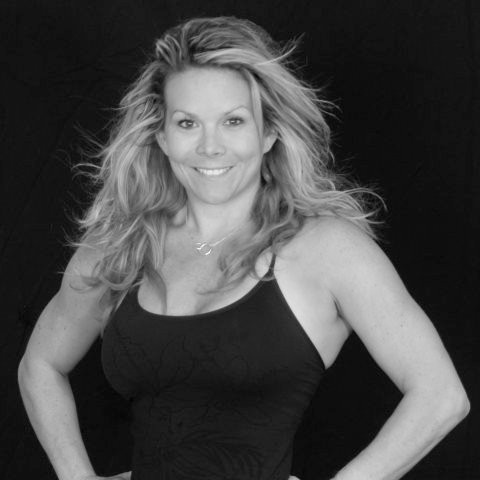
Last year Wendy and I lectured and coached together at least 6 different times. Every time we get together I learn something and I am very happy to have her back another year.
Meet the Staff at Gym Momentum Camp: James Parent
James Parent is the Vice President of Tumbl Trak and has been present on one way or another at Gym Momentum events since the beginning.
His ability to communicate with both the gymnasts and coaches makes him everyones favorite.
I’ve been involved in gymnastics my whole life, whether it be as an athlete, coach, or manufacturing equipment. I’ve coached for over 15 years ranging all levels and both men’s and women’s gymnastics. I was a level 10 gymnast for 5 years who cared more about doing the crazy skills than doing the skills well. However, as a coach I appreciate the basics done to perfection. I’ve spent a lot of time touring the country talking with the most accomplished coaches in our nation. I love being a constant student and always learning from the best.
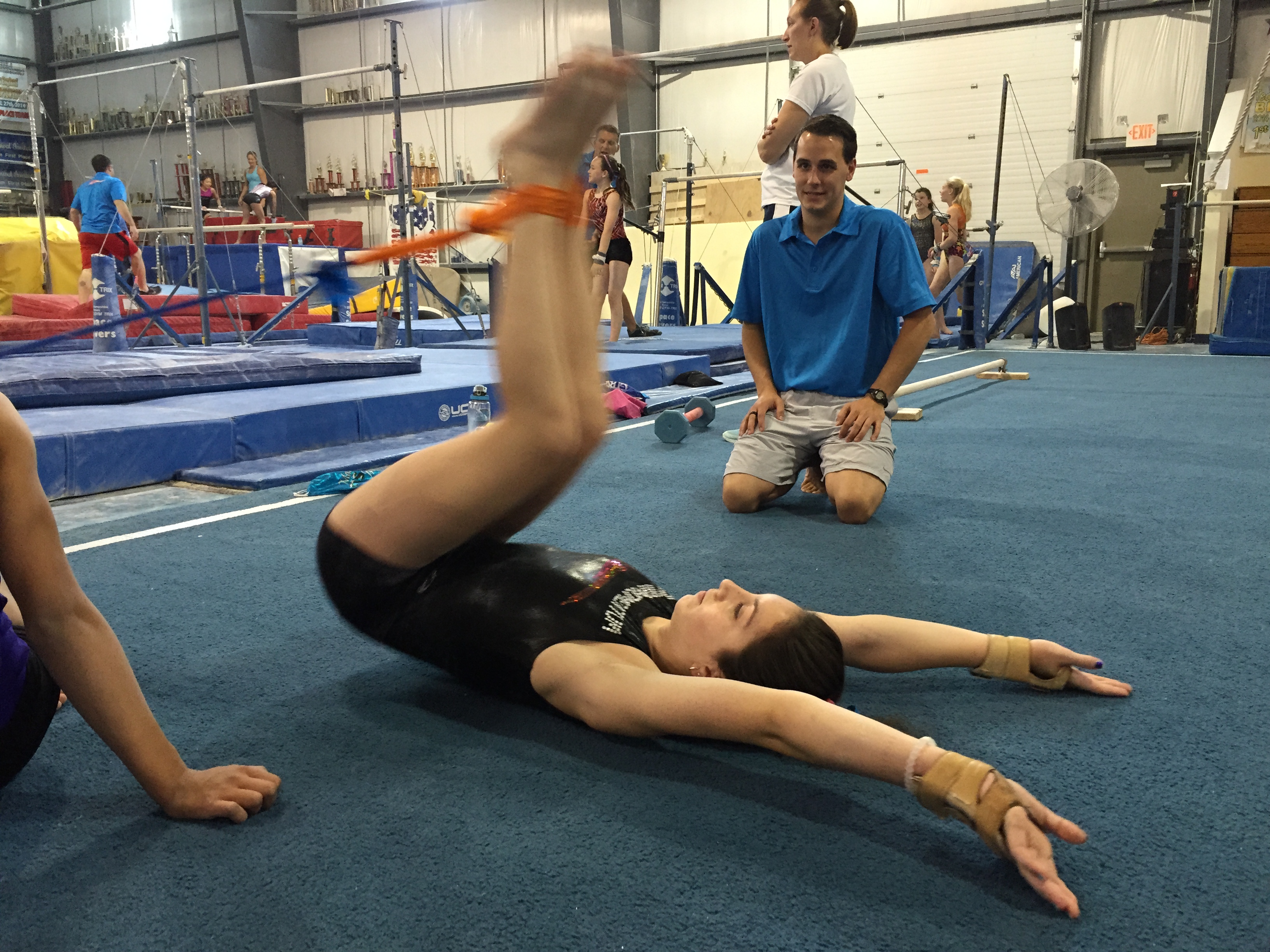
Meet the Staff at Gym Momentum Camp: Jody Nichols
Jody attended both the University of Massachusetts and Boston Conservatory as a
dance major. She has been teaching dance and acting to children, as well as
adults, at various dance companies for the past 29 years. She has
choreographed major productions for local theater companies such as Fiddler
on the Roof, Hairspray, and Chitty Chitty Bang Bang as well, as local high
school productions such as Grease, and Anything Goes. She has helped cast and
choreograph a national commercial for Shiki Emoji wrist bands. Many of her
students have been cast in local and national commercials.
Jody created the Broadway Kids program nine years ago, to introduce young
students to singing, acting, dance, improvisation, and get them comfortable
performing on a stage. In 2016 they received the Bons Award for “Best Kids
Program“, readers’ choice from Northshore Magazine.
Currently, A Broadway Kids Company (ABC) is in its fourth year and offers a
variety of classes for kids ranging in ages from 1.5 to 18 years, with no
experience necessary. At ABC, my students learn about music, dance, and
acting in a fun and nurturing environment. ABC is a well-rounded educational
center for the Arts. Along with our weekly classes we also bring in guest
teachers from all over New England, and New York giving students an
opportunity to take classes with professional industry teachers, an
opportunity that they might not have otherwise. Miss Jody says, “I am thrilled to be back
for my fourth summer with Gym Momentum.”

4 R’s of Training
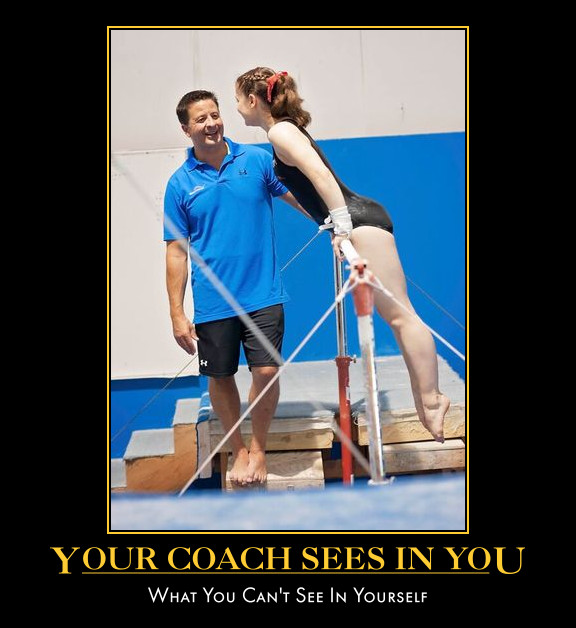
Vern Gambetta shared this basic concept to give a context to debrief of training or performance.
Reason
Why are you doing what you are doing?
Reality
What exactly are you doing? Is that reconciled with the reason?
Reflection
What did you learn from what you did? Be as specific as possible here.
Response
What are you going to do differently? This should consist of specific actions based on the reflection.
This is a simple process that can be used to make your daily coaching more effective
UNEVEN BAR RAILS- What to do with old ones?
I recently had to replace some rails in my gym. I set the old rail to the side.
I notice I have NO LESS than 8 old rails over there. What do I do with all of these.
NO- I do not need any more floor bars
NO- I do not need any more leg lift bars or stall bars.
Give me some ideas before I throw these out! Serious, humorous All ideas accepted!
There has to be something I haven’t thought of.
Contact me: or e-mail me at tony AT gym Momentum.com
Who knows- best idea may get a prize.
Don’t Turn Your Back: Let Your Gymnasts Watch Beam. – Get Psyched!
My friend met me for lunch today, and we shared stories about our weekend. She watched her first live gymnastics competition, and was not happy about what she witnessed. She showed me a video of a …
Source: Don’t Turn Your Back: Let Your Gymnasts Watch Beam. – Get Psyched!
My friend met me for lunch today, and we shared stories about our weekend. She watched her first live gymnastics competition, and was not happy about what she witnessed. She showed me a video of a gymnast’s beam routine and said she was stunned that not one of the teammates watched her compete. She was appalled that the entire team turned their backs on during each beam routine and refused to watch each other compete.
I told her it wasn’t that the kids were rude, it was that their coach made them turn their backs. I went on to explain that beam was a very Mental event and the girls don’t watch so they don’t get psyched out by seeing someone fall or make a mistake. They turn their backs because they are supposed to be thinking about their routines, visualizing, and preparing for their turn.
As I continued to explain to her why coaches used this technique, I began to remember why I don’t like this type of beam training at all.
The idea of not watching is so:
The gymnast won’t see their teammate fall and start to doubt in their own performance.
The gymnast can focus and prepare for their own routine.
This idea may seem like a great plan, but it may not be the best way to prepare the gymnasts and teach mental toughness on beam.
Not letting a gymnast watch (because the coach is worried they will see a teammate fall and start to doubt their own performance) doesn’t teach the gymnast how to overcome distractions, refocus after they see a fall, or deal with negative thoughts.
Avoiding a problem doesn’t teach the gymnast how to overcome the problem.
They must learn how to be prepared for every situation. The gymnast must learn how to watch someone fall and not lose confidence in their own performance.
They are smart and will know when their teammate falls, they can hear them fall, and everyone in the crowd moans, but they won’t know why or how, so it may worry them even more.
By not letting them watch, it also sends the message that the coach doesn’t think they are Mentally strong enough to handle distractions. It also teaches the gymnasts that beam is too difficult to watch and very intimidating. This is not a good message for the coach to send the gymnasts.
Standing in a line does not prepare the gymnast for their routine.
The best way for a gymnast to prepare for their routines is to move around, run through their routines in their heads, do arms sets with their Mental Choreography, and to stay relaxed.
Standing in one spot is not good, especially for the last gymnast in line.
Coaching techniques that try to avoid situations miss out on great opportunities to teach the gymnast more important lessons.
Teach the gymnasts why to focus, what to focus, when to focus, and how to focus.
Teach them to recognize distractions and how to refocus.
Teach them how to remain focused before, during, and after performances.
Don’t teach them to avoid situations, avoiding situations never makes the situations go away. Don’t teach them to pretend they aren’t paying attention to the girl on the beam, they know whats going on, they can hear her fall. Don’t make them stand in line having to turn their backs on their teammates and away from the beam with fear.
Teach them to face beam with the tools they will need. Beam is not something to run and hide from, so teach the gymnasts how to look at the beam with confidence and strength. Attack the beam with a fierce knowledge that they can and will make that beam fear them.
Watching Your kid Sit the Bench is NOT easy. – Get Psyched!
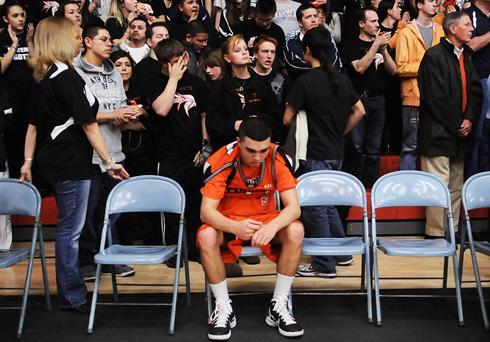
Here is a wonderful story from a friend. She tells her story about when her daughter had to sit the bench. Her honesty helps us all, because we all go through these situations. By Cayce Broker telling her story, she lets us see that we are all trying to do our best.
Source: Watching Your kid Sit the Bench is NOT easy. – Get Psyched!
“Had an emotional event with my daughter this weekend….
She had a basketball 🏀 game Saturday night. She was so excited!!! We had friends and family come to see her play and she was so proud!! The game begins and our team was amazing right out of the gate! The first turns quarter turns into the second and the second into the third. With every passing second she didn’t play, I became emotional. She was the VERY LAST girl to be put in and my heart sank. She’s not in the group of the best players and that’s ok with me…. but to go so long without play time was hard to watch. She did play some of the third and most of the fourth quarter and played well.
Once we got home, I could not hold back my tears any longer. I was upset for her, and worried that she was embarrassed. Let’s be honest… no one wants to watch their kid sit on the bench. I began to cry even more which lead to some texting of dear friends and some soul searching on my end.
Does this REALLY matter? Should it REALLY matter? I got caught up in a STUPID basketball 🏀 game. I’m human after all and let Satan really get it my head…. but there has to be a reason it happened.
I needed a good swift kick in the pants … I already have an AMAZING child with or without basketball 🏀. My job is teach her that there is MORE to life than this particular situation. My job is that she knows Jesus and she is already on an amazing path with her Savior. Once that reminder came over me I was at peace. I talked with Cylin about it and we prayed. She was upset but said she had a good time at her game. At the end of it all she said… “Mom…some popcorn 🍿 would really make it all better.”
That’s my girl.”
Handstand Drill
“The very symbol of the sport, the handstand, is indeed one of the most important fundamental elements in gymnastics. Although often viewed as an individual skill, the handstand shape is repeatedly seen in every event, every exercise, and virtually every movement sequence.” Dr Gerald S. George, Ph.D. “Championship Gymnastics. Biomechanical Techniques For Shaping Winners” 2010 [Read more…]
NCAA Gymnastics for Beginners | The Balance Beam Situation
PUBLIC SERVICE ANNOUNCEMENT: You can now also listen to me read this post to you on GymCastic! NCAA Gymnastics for Beginners Move along, haggard old jaded NCAA fans. Nothing for you to see here. In…
Source: NCAA Gymnastics for Beginners | The Balance Beam Situation
Move along, haggard old jaded NCAA fans. Nothing for you to see here. Instead, take this time to write a polemic against the aerial-to-back-handspring acro series on beam.
If, however, you watch elite gymnastics and have finally become fed up with nothing interesting happening 11.975 months out of the year—or you were introduced to the WEARETHEFINALFIVEAHHH during the Olympics and thought, “This sport is a ludicrous sparkleburger that seems to be based entirely on critically assigning numerical ratings to people’s every action, so it’s my life and I’m in love now”—then settle in. NCAA gymnastics is here to soar to your rescue, here to save you from a wretched winter of non-gymnastics discontent by bringing its beautiful qualities like an actual season with weekly meets, stuck dismounts, and legitimately close and exciting team competitions. (I know, right?!?!?!)
So, welcome. Make yourself comfortable. And by that, I mean stay quiet and do exactly as you’re told.
But it’s only fair that I warn you. NCAA gymnastics will change you. By the time you’ve watched a full season, the phrase “like a jank-ass rudi dismount” will be your go-to burn, you’ll be telling toddlers that they really need to display more calm confidence, and you’ll be greeting new acquaintances with pieces of paper reading “9.825” to inform them that they’re just OK.
So, let’s begin. You’re in for a treat.
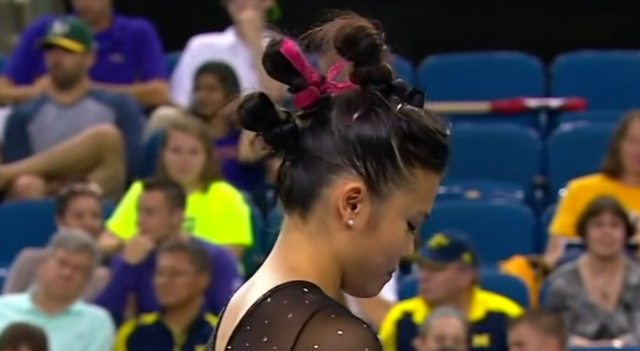
Item #1 is, of course, Ivana Hong’s triceratops hair. Just know this. If you can’t get behind the idea of Ivana Hong triceratops hair, then you are too far gone to be saved and NCAA gymnastics will never happen for you.
But now that we’ve got that out of the way, let’s begin for real.
What…is this thing?
I’m glad you asked. This thing is a big old vat of beautiful insanity called NCAA gymnastics.
Here’s what happens: Once they reach the age of 18 or 19, your favorite elite gymnasts are forced to heave themselves out of their hospital beds, start having a personality, and go to a real school for the first time (harrowing). There, they will join many of the top Level 10 gymnasts in the country to compete on a series of university gymnastics/competitive-temporary-tattoos-on-the-face teams.
They get to do this on a full scholarship because athletes are more important than scientists. Also because, in the 1970s, the US government realized that women exist and told the NCAA that women must be allowed to leave the birthing hut and throw a ball sometimes, even if you can’t necessarily exploit their athletic achievements to make millions of dollars of your own while pretending like you’re doing them a favor in the process. Or something.
These teams spend four months each year competing against other schools—under a code of points that most closely resembles elite competitions of the early 1990s—in the hope of screaming, chanting, sticking, hugging, teamworking, and life-lessoning their way to the annual national championship.
How does the season work?
Beginning the first Friday in January and ending in the middle of April, the NCAA gymnastics season takes over all of your weekends and whole life (as if you had one…) and sees the nation’s 82 teams compete against each other approximately once a week, usually in dual meets against one other school, though occasionally in tri- or quad-meets as well. The main point of dual meets is to make fun of the people who write “duel meets,” as though Florida has challenged Alabama to pistols at high noon.
Also, can Florida please challenge Alabama to pistols at high noon?
With the number of big-reputation, competitive teams going up against each other each weekend, it’s basically like every Friday night is the worlds team final.
At the end of March, the top 36 teams in the country are allowed to continue on to the regional championships, from which 12 teams advance to the national semifinals, from which 6 teams advance to the Super Six Team Final, where the national champion is crowned.
What about individual titles?
HOW DARE YOU, SHUT YOUR FILTHY MOUTH. It’s all about the team. In NCAA, any acknowledgement of individual goals or the desire to win an individual title—or any honest assessment of your own individual gymnastic abilities—is tantamount to treason and will see you drawn and quartered in the town square. On an NCAA team, you are the closest group of sisters, and no sister is more sisterly than any other sister. SISTERS.
Maggie Nichols already gets it. Like an old pro. She just wants to help the team anywhere she might possibly maybe be able to contribute, you guys.
[Whispering] There actually are national all-around and event titles awarded based on performance in the national semifinals, but ssssh. You’re not allowed to talk about them because you might seem selfish or come across like you think you’re more important than the team manager. [/Whispering]
What are the teams?
NCAA gymnastics is infinitely more entertaining if you have a specific team to root for. And, consequently, rival teams to root against. (You’re allowed to do that, like a real sport, just don’t tell the gymternet.)
Before January, I highly recommend picking a team and then getting instantly and aggressively obsessed with it for little reason other than it’s fun. Pick any team. There are no wrong choices. That’s obviously a lie, but I don’t want to discourage you right away.
The most common (and crudest) ways of picking a team are 1) by simple geographical proximity to yourself or 2) by which team’s former elites you like the most.
For reference, here are the former elites (with the awareness that I left out some people who were junior elite for one second) currently on some of the top teams:
Oklahoma – Maggie Nichols, Brenna Dowell, McKenzie Wofford
LSU – Lexie Priessman, Sarah Finnegan, Ruby Harrold (GBR), Erin Macadaeg, Shae Zamardi (CAN)
Alabama – Maddie Desch, Amanda Jetter, Mackenzie Brannan, Ari Guerra, Kiana Winston
Florida – Amelia Hundley, Rachel Gowey, Kennedy Baker, Grace McLaughlin, Ericha Fassbender, Claire Boyce, Maegan Chant (CAN)
UCLA – Kyla Ross, Madison Kocian, Katelyn Ohashi, Felicia Hano, Macy Toronjo, Peng Peng Lee (CAN), Mikaela Gerber (CAN), Hallie Mossett, Stella Savvidou (CYP)
Stanford – Elizabeth Price, Dare Maxwell, Rachel Daum, Kaylee Cole (BOL), Aleeza Yu (CAN)
Georgia – Sabrina Vega, Natalie Vaculik (CAN), Vivi Babalis (CAN), Jordyn Pedersen (CAN)
Utah – MyKayla Skinner, Missy Reinstadtler, Shannon McNatt
Auburn – Abby Milliet
Cal – Toni-Ann Williams (JAM), Jessica Howe
Michigan – Brianna Brown, Talia Chiarelli (CAN), Polina Shchennikova
Oregon State – Maddie Gardiner (CAN), Sabrina Gill (CAN), Silvia Colussi-Pelaez (ESP)
A more advanced way of picking a side is actually watching the different teams and then deciding which style, mood, history, level of dominance/underdogginess, and attitude connects with you the most, but that sounds far too reasonable.
Or, you can just read my season previews here throughout October-December to see which team sounds like it strikes your fancy.
Or just base it on which coach seems the most like a cartoon drag queen like the rest of us did.
How do the meets go?
On each event, six gymnasts compete for each team with the five highest scores counting. At the end of four events, the team with the highest score wins. You know, like a gymnastics competition.
Please note that winning a meet is entirely meaningless (apart from Super Six). Qualification to the regional championships is based on scores, not wins, so the focus is on getting a high team score more than beating an opponent. Still, winning things is fun. Or so I’m told.
How do I watch?
Because NCAA gymnastics is amazing and super popular, TV coverage on the SEC Network, Pac-12 Network, and Big Ten Network has grown dramatically in recent years, meaning the majority of major meets are now broadcast live on TV or streamed through those networks’ online platforms with commentary predominately from people who aren’t terrible. Oklahoma meets are also randomly available sometimes on weird channel numbers, and a great proportion of the smaller teams will have online streams, sometimes even free.
If you don’t have a TV subscription and login ID for the SEC, Pac-12, and Big Ten channels, then you can also build a magical screen out of clouds and dreams and just imagine what facial expression Miss Val is making right then. It’s like the same.
Why is there a lowercase l next to that egg?
Common misconception. That’s not an l next to an egg. It’s actually a 10, which is a score that you can still get in women’s college gymnastics.
WHAT? Then, wait…how does the scoring system work?
That’s an excellent question. I’ll let you know when we find out.
I’m only kind of kidding.
NCAA gymnastics uses a modified version of the JO code of points, only with softer deductions and more overall judging subjectivity and crack smoking. Particularly the crack. I cannot overemphasize how critical crack smoking is to the judging process in NCAA women’s gymnastics.
These days, you will see about one or two 10s awarded each weekend, and for the strongest gymnasts/teams, a score of 9.900-9.950 is considered excellent, 9.850 is fine/solid, 9.825 is OK, and anything lower than that is unlikely to be satisfying or good enough. Once you head into the teams ranked 20-40, 9.850 is considered a much stronger score, and they’re usually happy to count anything 9.750 or above.
For the overall meet scores, the best teams will be expecting to hit 197 regularly. That’s the rule of thumb for a strong score. Anything in the 196s, especially earlier in the season, is not disastrous. Anything in the 195s is.
One of the beauties of NCAA gymnastics, and what makes it ideal for new or non-gymnerd fans, however, is that you don’t have to know anything about the intricacies of the scoring system to understand what’s going on. You can safely assume most routines you see will start from 10.0 (except for Yurchenko fulls on vault which are now 9.950), and the deductions taken from 10.0 are minimal and reserved primarily for the most obvious errors (steps, wobbles, short handstands, etc). That’s why we get scores in the 9.8s and 9.9s. And also why you actually have to be able to hit your skills and have them look good. NCAA gymnastics replaces difficulty with mastery and as a result keeps many teams in contention for wins.
At the top of the rankings, there will be about 8 or 9 teams within a few tenths of each other with a realistic shot to do damage in the postseason, and at last year’s team final, the top four teams were ultimately separated by just three tenths. Small mistakes matter. Wobbles are everything. You don’t know who is going to win before the championship starts.
But what if I actually want to know more about the scoring system?
I’m also here for you. As in Level 10, NCAA routines that meet the element requirements (minimum 3 As, 3 Bs, 2 Cs) automatically start from 9.500, with five tenths of bonus available to be earned in order to get up to that 10.0 start value.
Bonus can be earned by skill difficulty—with D skills garnering 0.1 bonus and E skills garnering 0.2 (E is the highest skill value)—and by connection bonus. A maximum of 0.4 bonus can be earned from either category, so to get a full 10.0 start, some of the bonus must be from skill difficulty and some must be from connections.
The connection bonuses are as follows:
BARS
C+C (both skills include flight or 1/2 turn) – 0.1
C+D – 0.1
D+D – 0.2
BEAM
Dance/mixed
A+D – 0.1
B+C – 0.1
B+D – 0.2
C+C – 0.2
Acro
B+D – 0.2
C+C – 0.2
B+B+C – 0.1
B+B+D – 0.2
B+C+C – 0.2
Turns
C+A – 0.1
(Three-element series on the beam itself that include a C element get an extra 0.1 series bonus.)
(The layout stepout is considered C for the purposes of awarding connection value but a D for the purposes of difficulty. Because…remember that thing I said about crack?)
FLOOR
Dance/mixed
C+C – 0.1
B+D – 0.1
D salto + A dance – 0.1
C salto + A dance + A salto – 0.1
C+D – 0.2
Acro direct
A+C – 0.1
B+B (different elements) – 0.1
B+C – 0.2
A+D – 0.2
Acro indirect
A+A+C – 0.1
C+C – 0.1
A+D – 0.1
C+D – 0.2
Many elements (though far from all) share difficulty values with elite, but there are some important exceptions. Of note, bars dismounts like the double layout and full-twisting double back are Es in NCAA, which makes it very easy for NCAA gymnasts with those dismounts to get their 0.5 in bonus.
For execution deductions, take a look at the judges’ cheat sheet included here and then ignore all of that information because 1% of those deductions actually get taken.
NCAA rules — Judges’ cheat sheet
But what if I’m put off by the level of enthusiasm and screaming?
This is normal. There’s a lot of screaming and smiling and cheering and entirely unfounded joy in NCAA gymnastics, and it can be extraordinarily upsetting to those who have not gone through a process of exposure therapy to adapt to this strange world in which RBF and sass-eye are not the primary form of communication.
The important thing to remember is that you can always make fun of it. And should forever.
There is a place for sarcasm, disapproval, honesty, and side-eye in NCAA gymnastics as well. I think it’s here.
What are…10 hands?
10 hands (alternatively 10HANDS) is a phenomenon in NCAA gymnastics in which a gymnast will perform a languid beige drape of a routine and her coach and teammates will attempt to trick the judges into thinking it was rainbows by holding up all 10 fingers and shouting, “10! 10! 10!” It is horrible and works sometimes.
As a member of the NCAA gymnastics community, it is now your responsibility to quash it at every turn.
Why are people in NCAA gymnastics constantly trying to tell me that it’s better than elite?
Because in the upcoming war between the worlds, you must pick a side. And our side has a lot more stiletto heels to be used as weapons.
What else should I do?
EVERYTHING.
Play fantasy gymnastics
It doesn’t matter if you don’t know anything and just pick the names of a few gymnasts that you’ve heard of. You’ll probably still do better than us experts who are always like, “I’m going to pick this obscure Lindenwood gymnast because based on my research…oh, she’s dead.” It’s probably the best way to get yourself excited about the sport, especially teams and gymnasts you wouldn’t care about otherwise.
Scour the rankings
A great way to learn about the teams to follow, scores, gymnasts, and what expectations you should have for the upcoming season is by running through the rankings and meet results from previous years and getting lost in a wikipedia-style information hole.
Watch These Routines as a starter
https://www.youtube.com/watch?v=4e0gPtPtuas
https://www.youtube.com/watch?v=efttzj5VtXE
https://www.youtube.com/watch?v=cpLVOIHc7CU
https://www.youtube.com/watch?v=8TlR51SuTuA
Balance Beam Situation– A MUST READ