Wendy Bruce Martin & Dennis (Trucky) Martin
I AM USA GYMNASTICS #IamUSAGymnastics
I AM USA Gymnastics
Last week I was speaking with my “gym sister” Wendy Bruce-Martin. We both are proud of the work that we do in gymnastics and in the community. We were relating stories of some of the great things we have heard over the summer. Coaches and club owners going out of their way to help families in need. Gymnastics professionals rallying around a coach who was stuck with sudden illness. Coaches going into the “rival” clubs gym to help out when their “rival” had a death in the family. We all know great stories like these.
Wendy had the brilliant idea that we should start a hashtag showing positive things that we do in our communities, in our gyms, at camps etc and be proud that we are part of USA Gymnastics.
#IamUSAGymnastics
#WeareUSAGymnastics
I posted a couple of tweets last week and a few photos on Instagram using these hashtags. I believe this is something we all can get behind. Let’s carry this through Championships and National Congress.
We each see things we are proud of. We each do things that is WAY MORE than just teaching gymnastics. It is time to tell the world!
Hiring New Staff: Questions to ask in the Interview
My gyms have steadily grown and I’ve been fortunate to have had little turnover with my staff. I have coaches who have been with me for 20+ years and coaches who were former athletes here who after college came back to coach. That being said, you still need to reach out and hire coaches from outside to keep you fresh.
I’ve interviewed a few hundred people in the last 20+ years in business. Some were college students looking to teach a few hours a week. Some were coaches with many years experience looking for a change.
In general I am never looking for a certain position to fill. I am looking for a certain personality. I really believe that the gym is just an extension of my family and I am looking for someone that is a compliment to the talent I already have.
Hiring the best talent is a massive and never-ending challenge. It was hard to hire our first employee, it’s hard to hire our 50th employee, and it’s still going to be hard when we hire our 100th employee.
While every company has a different culture, there are few questions that I like to ask to help me identify if a candidate is a good fit.
There is no such thing as batting a thousand with hiring. You’re going to make mistakes no matter how good you are at it. That said, in my personal experience I’ve found these questions to be hugely helpful in determining culture fit.
1. How did the culture at your last job empower or disempower you?
This is a really interesting question, because it will get candidates talking about their previous gym through the lens of how they were affected by my gym’s culture. Getting candidates to talk about their past employer can be very telling. Do they openly throw the gym under the bus? Do they recognize the positives even though it ultimately didn’t work out?
Asking specifically about the culture of their last gym also tells you a lot about how they view the importance of culture. Their response will tell you if they’ve thought a lot about “company culture” or if they don’t really know what it is. The question will also reveal how they think they are empowered or disempowered, which will give you a look into their motivations.
2. What were the characteristics of the best boss or teacher you’ve ever had?
I like this question as a follow-up to the culture question, because it’s somewhat similar but from a different angle. If you didn’t get a sense for a candidate’s view on culture and what motivates him or her, you likely will from this question.
Did the candidate thrive under a boss who was extremely direct and valued performance above all else? Did he or she thrive under a boss that put as much emphasis on communication and interpersonal skills as results within the role? Did they have a teacher who made a lasting impact on their lives? Those who did will most likely want to pass on that message to the children they coach.
3. Describe how you handled a conflict with one of your co-workers or a parent in the last gym?
It’s always helpful to ask candidates about how they dealt with a conflict. As people, we tend to be more open and honest when recalling a specific event versus describing characteristics about ourselves. Understanding what the candidate perceives as a “conflict with a co-worker” will likely reveal information about the person’s level of self-awareness.
Understanding how someone dealt with a conflict will also give you insights into what he or she perceives as a reasonable and positive response to a conflict. No matter how wonderful your culture is, conflicts will arise. How your coaches and front desk people deal with conflicts is the true test of YOUR culture.
4. What kind of feedback do you expect to receive in this role and how often do you expect to receive it?
Understanding a candidate’s desire or hesitation to receive feedback tells you a lot about the person’s expectations. The frequency and type of feedback that is shared within a gym tends to be highly correlated to culture.
Does the candidate expect feedback to be tied to core values? Does the person think feedback is only about performance in the role? Does he or she see feedback as a once-a-year formality or as part of a constant process of growth and improvement?
At Atlantic Gymnastics, we value feedback and continuing education. You cannot have one without the other. I get a feeling I will be writing more about feedback in an upcoming article.
The previous questions I may not ask everyone. I do have some prospective employees who are still in school and have little experience in which to answer those question. I do ask everyone the next 2 questions. It helps me get to know them and their thought process as well as set the tone for their possible employment.
5. What will you do to make those around you better?
At time I have to explain that I mean their coworkers but I need them to realize that we are a TEAM. We must not just do our job, we must help others do their job. I expect to get a variety of answers depending on their age and experience. The other day a relatively young (college student) candidate said, “I am really a happy and energetic person. With me in the gym I think I will bring everyone UP. I will keep the energy high. You can’t really teach gymnastics in a low energy environment, can you?”
6. How do you take your coffee?
Drinking coffee is not a prerequisite for the job but everyone has a reason for how they take their coffee or why they don’t drink coffee. This has started some great conversations and helped me get to know a prospective employee.
A constant word of caution- if you are in a position to hire it is your duty to also do your research. Call previous employees, call other coaches in their area who may know them.
USA Gymnastics. Rules vs Culture.
This was originally published by me for the US Elite Coaches Association. Given current recommendations I thought it would be timely to repost.
At the highpoint of the USA Gymnastics crisis I read many editorials and social media posts calling for change. There are multiple ways you can manage an organization to make sure that the right decisions get made when change is in order. One way is to be rules-based and the other is culture-based. You might also choose an option somewhere in between.
Rules-based organizations are those that try to plan for pre-determined scenarios by creating processes and procedures. A great example of a rules-based organization is McDonalds. Every situation you can think of has been documented and scripted, from how to cook French fries and burgers, to how to clean the bathrooms and repair the HVAC unit. This approach works well in organizations that have a lot of structure and a defined hierarchy where everyone knows their role down to a tee. If a customer makes a complaint, for example, the process begins with an assistant manager and then gets pushed up the ladder to the manager, the district manager and on up the chain as needed.
On the flip side is what you might call a culture-based organization, where it is the cultural values of the organization that drive actions and decisions rather than rules. As an example, consider a YMCA or Church based group.
They are both global organizations that gives autonomy to each individual mission or center throughout the world. Unlike a McDonalds franchise, which follows the same set of rules as every other franchise, YMCA’s and churches rely on their strong cultural values to make decisions.
While this might seem like it borders on anarchy to some, it’s actually quite effective because the organization’s values and culture are so powerful that they force everyone to be accountable to them.
As USAG looks to replace it’s CEO/President we need to find someone whose long-term goals are compatible with that of the base.
When it comes to USA Gymnastics, what kind of system would you prefer? A Rules based organization or a Culture based? How about with your club?
I think a hybrid solution that combines the best of a rules-based and culture-based system like we see in the U.S. military. The military, as we know, is very hierarchical and rules-based to the point where no one jumps ranks or disobeys orders at the risk of being severely punished. And yet, when it comes time for a unit to enter combat, the military’s system allows for much more creativity and decentralized decision making once shots are fired.
Should it be all about rules or all about culture, or possible somewhere in between?
In the gymnastics community there are some things which need to happen for us to have REAL change.
• Leading by doing: Our best clubs, coaches and administrators must lead by example.
• Engaging all levels: Driving change too much from the top can actually be counterproductive. For change to occur all levels of the gymnastics community must be involved.
• Showing, not saying: Everyone needs to know what the new behaviors will look and feel like, so they can be brought to life for everyone. In essence, the desired behaviors must be embedded into every aspect of the organization, so they will eventually become hardwired into what gymnastics professionals do and how they act.
UPDATED (on an airplane on my way back from Calgary. Sorry for any typos)
My goal for gymnastics is to leave a legacy- not just a financial legacy for my children and possibly in the form of scholarships but a more lasting legacy might be a cultural legacy.
When my children were younger and we went camping often our motto was to leave the site better than we found it. Picking up the trash left by others. I want to do the same thing for our sport. When it is time to sell my clubs and move on to retirement I want the sport to be better than I found it. A sport known for excellence and safety. Something we can all be proud of.
My gyms are successful but I certainly am not a business genius. My success comes from being a principled person and surrounding myself with smart people, principled people and staying loyal to them. In return I earn their loyalty.
I judge my success not in how many gymnasts made nationals or won states but by how many graduations and weddings I get invited to. There is nothing more important to me and my organization than having happy well adjusted athletes. AND FOR THE RECORD- WE WON STATES AT A NUMBER OF LEVELS AND HAVE CONSISTANTLY QUALIFIES ATHLETES TO JO NATIONALS. It is possible.
For the long-term viability of the sport you need a viable corporate culture. It, too, had to be long-term. We need to cultivate good people and kept them. From these modest principles we can grow an empire.
Tony’s Rules for creating the right culture.
1. Hire the right people
Hire for passion and commitment first, experience second, and credentials third. There is no shortage of impressive CVs out there, but you should try to find people who are interested in the same things you are. I have always tried to hire people that share our philosophy. I can teach the the rest. I don’t want to be simply a stepping stone on a coaches journey. Asking the right questions is key: What do you love about coaching? What inspires you? What are you going to do that makes those around you better?
2. Communicate
Once you have the right people, you need to sit down regularly with them and discuss what is going well and what isn’t. It’s critical to take note of our victories, but it’s just as important to analyze where we messed up. We need a culture that recognizes when things don’t work and make adjustments to fix them to.
Listening is probably more important than talking. Great cultures grow around people who listen. It’s also important to listen to what’s happening outside the sport. What developments, trends, and calamities are going on?
3. Tend to the weeds
It is easier to plow a garden under than to plant and tend to it. USA Gymnastics has to be passionate about growth and we cannot grow with out pulling some weeds. One of the most destructive weeds in a gym is the whiner. Whiners aren’t necessarily public with their complaints. They don’t stand up in meetings and articulate everything they think is wrong with the gym. Instead, they move through the organization, speaking privately, sowing doubt, strangling passion. Constructive criticism is healthy, but relentless complaining is toxic. One of my rules for my business and my team is “Do not come to me with a problem without a potential solution”.
4. Work hard, play hard
It’s easy to do what you love. In the gym we can measure who has a superior work ethic, who is getting the most turns. Not many gyms these days thrive on a forty-hour work week. A culture where everyone understands that long hours are sometimes required will work if this sacrifice is recognized and rewarded.
5. Be ambitious
“Make no little plans: they have no magic to stir men’s blood.” These words were uttered by Daniel Burnham, the Chicago architect whose vision recreated the city after the great fire of 1871. The result of his ambition is an extraordinary American city that still has the magic to stir men’s blood. Ambition is sometimes seen as a negative these days, but without it we would stagnate. We need a culture that supports big steps and powerful beliefs. Cities are the most visible examples of successful and failed cultures. Bilbao and Barcelona did so and became the envy of the world and prime tourist destinations. Pittsburgh reinvented itself when the steel industry withered. But Detroit wasn’t able to do the same when the auto industry took a dive.
6. Celebrate differences
When choosing gymnasts for out team program, we consider more than just their strength and flexibility. If you had a dozen strong and flexible gymnasts who were from the same socio-economic background you might not get much in the way of interesting skills or routines. Great cultures are built on a diversity of background, experience, and interests. These differences generate energy, which is critical to any enterprise.
7. Create the space
Years ago, scientists working in laboratories were often in underground bunkers and rarely saw their colleagues; secrecy was prized. Now innovation is prized. When we first started using the Ranch it was barely inhabitable. Now the gym and motels are much better. I am not trying to incite debate as to whether we need to stay at the Ranch (I do not have any inside information) but MAYBE it is time we build something we can all be proud of. A state of the art facility for all disciplines, A brick and mortar gymnastics university. Where we can innovate. Where we can share knowledge. In cutting-edge research and academic buildings, architects try to promote as much interaction as possible. Design a space that encourages interaction between the disciplines.
8. Take the long view
What is success? I think some of our recent issues occurred because we sacrificed long term stability for short term wins. The Women’s Developmental Camps and TOPS are focused on long term success. If our culture is dependent on this quarter’s earnings or World Championships in October, then it is handicapped by short-term thinking. We tend to overestimate what we can do in a year, but underestimate what we can do in five years. The culture needs to look ahead, not just in months but in years and even decades.
Success Isn’t Easy
Wouldn’t it be great if success was simple?
But it isn’t.
There is no one-size-fits-all answer for success in the gym and in life, but I will do my best to steer you in the right direction.
GET UP INSANELY EARLY
It sounds scary, but consider what would happen if instead of watching reruns of bad movies at night, you went to bed at a reasonable hour, thus allowing yourself to wake up early and super productive? Through the Gym Momentum community I get 10-15 e-mails each night and another 20-30 things on Facebook. Looking at the time stamps I know that many of you post and e-mail late at night when your time would be better spent sleeping.
Waking up before anybody else allows you to work out the logistics of the day to come , track your time, and (most importantly) UNPLUG FOR A FEW HOURS. Turn off your cell phone at night, If you wake up in the middle of the night, don’t check your e-mail or text messages. They will all still be there in the morning.
I hear people all the time say, “I just need a few more hours in the day to get everything done” . Often these are the same people who waste their mornings.
KEEP PROMISES, NO MATTER HOW SMALL
Talk is cheap and meaningful customer relationships are built on promises. Same goes for your personal life, right?
Well, Maybe.
Success is built on mutually trusting relationships with just about everybody. If you say you’re going to walk the gym dog, well, you’d best walk the gym dog.
LEARN HOW TO TELL STORIES.
You want to be successful in life, but you don’t have the job you want or your team isn’t as successful as you’d like them to be this year. The first step to nail that dream job or dream team? Learn how to tell a great story- Starting with your interview.
Sometimes you need to CREATE your history. Create YOUR story. WHY you are who you are. WHY are you destined for greatness.
LEAD, DON’T DICTATE.
There is a big difference between being a leader and being a boss. A great leader leads by example and sets the tone. You want a team of hard working individuals. Be the hardest working one out there.
DON’T BE AFRAID- OR EMBARRASSED- OF YOUR FAILURES
We all know many stories of those who have failed in order to succeed. I have posted many BLOGS on why Failure is a necessary step t success. BUT how do you fail constructively?
Not all failures lead to solutions, though. How do you fail constructively?
We’re taught to do things the right way. But if you want to discover something that other people haven’t, you may need to do things the wrong way. Initiate a failure by doing something that’s very silly, unthinkable, naughty, dangerous. Watching why that fails can take you on a completely different path. It’s exciting, actually. To me, solving problems is a bit like a drug. You’re on it, and you can’t get off
It’s also OK to QUIT something when your heart isn’t into it or when you see the writing on the wall.
ASK QUESTIONS. A LOT OF THEM
Albert Einstein, obviously a great thinker, would have been a great coach and entrepreneur.
To raise new questions, new possibilities, to regard old problems from a new angle, requires creative imagination and marks real advances in science.
EVERYONE needs to pause occasionally for self reflection.
What is your purpose on earth?
What should you stop doing?
What is your “lab” or “petri dish”?
BE HONEST WITH YOURSELF and OTHERS
Remember when I said about asking questions ? Here is a hard one-
ARE YOU PASSIONATE or DELUSIONAL?
Delusion is a double-edged sword. When it comes to productivity, tricking yourself can be your best move, but if your career is hurting other (more important) aspects of your life it might be time to re-evaluate your priorities.
Truth be told, I think the difference between passion and delusion isn’t even very distinguishable. I suspect many a coach has fallen too far down the rabbit hole without even realizing it. It happens to me. I convince myself my gym and my team is on the right track and then I get to a big competition and we blow it. Upset parents, upset gymnasts and upset coaches.That is my reality check. I was laser-focused on the belief I had to succeed no matter what, which led me to lose sight of reality. My story has a happy ending because I was able to wake up and get back on track.
TAKE BREAKS
Go for a walk, go surfing, go camping. Get your ass out of the gym . Unplug for a few days. Spend sometime with friends. It will keep you from going insane and help you refocus when you are back.
TAKE NOTES and STAY ORGANIZED.
If you are trying to delve deeper than surface level engagement, try taking notes.
I have always been a journal keeper. It might sound silly but putting some genuine effort into it- note taking, list making and reflection- it helps me stay organized and keep my focus onto what I am after. If we want to get focused, one old and obvious hack isto first go analog. What’s nice about a notebook and a pen is that your friends and colleagues can’t assault you with cat videos and humblebrags as you organize your day, unlike anything connected to the Internet.
Lessons from the past
There aren’t a lot of business books from a half-century ago that are helpful to gymnastics professionals today or have stood the test of time. Peter Drucker’s The Effective Executive , now available in a spiffy new 50th Anniversary edition, is one of the select few. In 1967, back before Millennials were a gleam in their parents’ eyes, Drucker declared, “The executive is, first of all, expected to get the right things done. And this is simply saying that he is expected to be effective.” That statement is obviously true for coaches as well.
Drucker is as relevant for coaches today as he was for business leaders the year after I was born (now you know my relative age). He approaches the study of business like a surgeon. His clarity of thought and language were a scalpel, which he used to dissect every aspect of management until he had revealed its essence. In The Effective Executive, Drucker applied that scalpel to leadership.
Drucker was convinced that leaders are made, not born. As a gymnastics professional there are five practices that can make you a more effective leader in your gym:
1. Manage your time
“Time is the scarcest resource,” wrote Drucker, “and unless it is managed, nothing else can be managed.” Successful coaches know how they need to spend their day. They dismiss or delegate any activity that doesn’t require their direct attention. If you really need something done- asks a busy person.
To identify the unnecessary time-sucks in your day, Drucker suggested jotting down everything you do in real time. Even better, these days you could get a time management app. Then, examine your activity entries and, for each one, ask yourself, “What would happen if this were not done at all?” If the answer is nothing (and it often will be, according to Drucker), stop doing it. If the task needs to be done, ask yourself if it could be done by somebody else. If so, delegate it. Repeat every few months to make sure you’re still spending your time wisely.
2. Focus on contribution
Effective coaches hold themselves “accountable for the performance of the whole,” wrote Drucker. By that he meant that they weren’t solely focused on their job performance or their own careers. Instead, the most effective leaders are team players who work hard to realize the strategic goals of their clubs or organizations.
Direct your focus to what you can do to maximize your contribution to the gym. Ask other people in the gym, [your] superiors, [your] subordinates, but above all, [your] colleagues : “What can I do to help you do a better job and make the gym better?”
3. Build on strengths
Drucker preached a strength-based approach to talent decades before it became a corporate buzzword. This was possibly a lesson he could have learned FROM US! Effective coaches drive team productivity and results, by building on available strengths–the strengths of other coaches, the strengths of the facility, and one’s own strength.
Train yourself to focus on strengths instead of weaknesses by concentrating on what coaches can do rather than what they can’t do. Seek out only the best-qualified people, instead of those who play well with others or who appear to have no flaws (we ALL have flaws). And don’t forget to apply this practice to yourself–identify your own strengths and use them to improve your performance.
4. Prioritize and concentrate
Long before we were all tethered to our smartphones, Drucker was warning leaders about the dangers of multitasking. He said that effective executives focus all their faculties on one achievement at a time. Why? “The more one can concentrate time, effort, and resources,” Drucker wrote, “the greater the number and diversity of tasks one can actually perform.”
To make the most of your concentrated effort, first prioritize your tasks. Prioritization is key. If you’re only working on one thing, you must make sure it’s the right thing. Effective coaches do first things first and they do one thing at a time.
5. Make decisions systematically
Finally, Drucker said that effective leaders make sound decisions–that means no on-the-fly calls or going with your gut. Sound decisions, he said, come from using a repeatable, consistent process with clearly defined elements executed in a distinct sequence.
How should you approach decision making?
- Determine what kind of decision is required. If the issue is ongoing, you’ll need to develop a policy; if it’s a one-off situation, make the call and move on.
- Define the decision’s “boundary conditions”–that is, its objectives, minimum goals, and the conditions it must meet–before you make it.
- Shoot for the ideal outcome to start. Save the inevitable compromises for later, when it’s time to implement the decision.
- Define the actions necessary to implement the decision in the decision.
- Don’t chisel your decisions in stone. Allow for post-implementation feedback and adapt the decision when needed.
And a #1 song from 1967 for no reason at all:
https://www.youtube.com/watch?v=vw40NMa_0RM
Finding and BUILDING Leaders
This post started as an internal memo from me to my managers at my gyms. We are getting to the end of a year where we have had a lot of changes. We have been successful despite some serious obstacles and are now looking forward to the next stage.
Some people are natural leaders, but the best leaders don’t always wear it on their sleeves. I take hiring decisions seriously, and I’ve always strongly believed in hiring from the inside. Someone once told me (it was probably my mom!)
“If you have to hire from the outside- hire the personality and philosophy. You can teach them the rest.”
Bringing someone new into a group that works like a well-oiled machine is always a risk. Plus, I know that the quality of the services my gym delivers is based, at least partly, on the strong and long-lasting relationships our team has built. I love the people I work with. I do not ever want to make their job harder.
Since I value loyalty within Atlantic, it’s always been important for me to find leaders among people who weren’t originally hired into leadership positions. I don’t necessarily want to hire someone from the outside for leadership roles; I want the experience from someone who has already worked for us for a long time. Look at Dina our General Manager, she started as part time office help! We are going through a lot of changes right now and I have given a great deal of thought into techniques that I have used in the past that have put people in a position where they can step up. As much as I’d like, I cannot be everywhere at once and YOU cannot be either.
Here are my words of wisdom on a steamy Thursday in May. (written on a 90+ degree day after nearly a month of cold and rain)
Encourage them to fly early and often.
Give our employees opportunities to exercise leadership skills before they take on formal leadership roles. For example, certain projects, like arts and crafts for summer camp or developmental team/ Tops may be better led by the person with the most directly related experience, rather than the person who has a management title. This gives “non-managerial” employees the chance to step up and lead. You or another manager should still set goals and expectation for these projects and groups but you’ll have the chance to examine how this employee handles new tasks, authority over others, and the responsibility of delivering a finished project.
One of the best signs an employee is ready for leadership is a desire for more responsibility. Make sure you are providing guidance to employees who are coming to you looking for the chance to take on more work. You should consider them first when you’re looking for leaders for your next project. You can bolster their abilities in the meantime by sending them to training camps, congresses or conferences.
word of caution- when they volunteer, you are still going to need to supervise, encourage and guide. I have gotten myself into trouble in the past when someone steps up I give them responsibility but I didn’t offer enough guidance and encouragement only to find out too late that they were over their heads. Even when they say, “I’ve got this”.
Be their confidence until they have their own.
Not everyone feels like a natural leader, but some who possess the necessary skills may simply be suffering from a crisis of confidence. If one doesn’t have past experience with leadership, it can be an incredibly intimidating proposition to try to get others rallying around a common goal. However, when given the chance, employees who have never been in such a position can suddenly shine. They just need some support from you first.
If you’re trying to transition a coach/teacher into a leadership role, make sure that you’re serving as their confidence until they can develop their own. There are several ways you can do this.
First, let them know that you believe in them when they’re handling tough projects. Make sure you mark their successes with positive reinforcement and praise. Just like you would with a gymnast learning a new skill.
Then, when they experience setbacks, help them understand their failures by discussing the failures you experienced when you were just starting out. Fail forward. Failure is a prerequisite to success.
Let them know that the most important thing is to be constantly moving forward; the only answer to failure is to immediately start working on the solution and not let disappointment affect you.
Invest directly in the skills you want to refine.
Even coaches you identify as strong potential leaders will not come with all the necessary skills attached. Sometimes, you need to invest in these individuals after they arrive to help mold them into the kind of leaders you need them to be. One great way to do this is by encouraging continuing education. You can do this by recommending books, classes or conferences going on in the area. Attending congress or other educational opportunities. Take the time to discuss each of these with your coaches.
You know that I find continuing education to be one of the most important things a coach can do. I have been at training camps with literally the BEST COACHES IN THE WORLD and they have each shared things which they have learned in the last few months. If your coaches are not continuing to learn and move forward- they are probably in the wrong sport.
Scout a new leader today.
You may never know what leadership potential already exists among our coaches and teachers until you present them with chances to develop and hone their skills. Not all strong, natural leaders know how to present their strengths. To do so, they may need your help.
By looking within Atlantic for potential leaders, and giving these individuals the support they need to grow and thrive, you can build leaders who know the gym(s) inside and out, and care about loyalty just as much as you do.
We strive to make the gyms not just a great place for the athletes and parents but a great place to work. A place where our employees know that we want them to continue to move forward.
Gymnastics Prepares You For Life.
Why Gymnastics Prepares You For Life.
They had the AC cranked and it was uncomfortably cold in the conference room at the hotel so I ran up in between lectures to put on long pants and shirt.

I’d been introduced, I knew this lecture back to front, I had polished the PowerPoint presentation and the opening video was being projected on the screen. I welcome the audience, thank them for coming to this regions mini-congress. I get about 6 slides in and THE ROOM GOES BLACK. The emergency lights flicker on, there is enough light to keep going but there is no power to the projector.
I wait 1 or 2 minutes, someone from the hotel says that there is no power on the entire block. We are safe to keep going. No AC, a room filled with 200+ people. I start to sweat. I unplug the projector spin my laptop around and put it up on chair on top of the table and keep going. Showing every slide twice. First to the left side or the room, then to the right side.
Practice Your Mistakes: Know How to Fall
The idea of practicing mistakes is something I do quite often. Very rarely (if ever?) does anyone in the gym complete a skill or exercise without room for improvement. In a routine a pirouette is missed or a turn goes too far.
What do you do, Stop? Try again?
When I speak at congresses or seminars I rely on many pieces of technology to execute “flawless” performances. It’s rare when not at least one thing goes wrong. It be could be as small as forgetting to put batteries in the microphone, to something big like a hard drive crash (please knock on wood that this never happens to me).
But when things do go wrong, it’s usually an operator error (me, myself and I).Things usually do not go terribly wrong, because I’ve likely practiced the mistake ahead of time. Just like what we do in the gym every day.
Falls are common in every gym. Equipment failure can occur. A grip can break, a mat can slip. When you walk into anyone’s gym you will see quality gymnasts take missteps and have GRACEFUL FALLS. It’s as if they anticipated their fall, readied their body and as best they could do, gently fall to the floor below.
Almost like they practiced it and I’ll bet you they did. For every great flight series we see, how many falls do you see to get there?
Perfect Mistake Practice Makes Perfect
It’s been said that practice makes perfect. Or perfect practice makes perfect. But the reality is, rarely anything is flawlessly executed. We can train and practice. We can study and go through scenarios over and over inside our head, but there is nothing that can actually simulate for “showtime.” There is nothing that can emulate the nerves, the environmental conditions, a mat deciding to slip, and a host of other issues that all tend to rear their heads at the wrong time.
This isn’t about having a backup plan, which you should also have. Backup plans and encountering mistakes are two different things.
A back-up plan is having another PowerPoint remote, or an extra set of grips. But could your really prepare for a TOTAL POWER OUTAGE? The only way you can be prepared is to practice our mistakes. Practice our falls. The better you get at that, the better you will get at making on the fly adjustments and continuing.
In the gym it seems we are always practicing routines. Once one season ends we have a few short weeks before we are already trying to put new skills into next seasons routines. We practice when things go right and we practice when things go wrong.
In the business world you must also practice when things go right and when things go wrong. I do NOT believe is rising to the occasion. I believe in sinking to the level of training.
In the business world I’m an advocate for practicing our mistakes, or running through those catastrophic scenarios that make you think, “I’m dead, there’s nothing I can do, show’s over.”
But if you’ve gone through those scenarios before, then it’s not a catastrophe, it’s a slight detour from the original plan. You know exactly what to do to fix the problem because you’ve practiced this before.
AND- IF YOU ARE IN THE HIRING DEPARTMENT OF A COMPANY, HIRE A GYMNAST. WE KNOW HOW TO STUMBLE AND POSSIBLY FALL, MAKE ADJUSTMENTS AND KEEP GOING.
My Gymnastics Philosophy Part 2
Finding your philosophy.
I had someone tell me once that if I were hiring someone I needed to hire someone with a philosophy that I could work with. I could teach them the rest. In our business, that is often an overlooked quality. A gym owner will look at someone’s accomplishments, their ability to spot. They (hopefully!) will do some investigating into their background, make some phone calls to past employers and maybe call some parents or former gymnasts. All of that is a good start but as gym owners or managers interviewing a potential employee you need to LISTEN. You need to have some in-depth conversations to find out if their philosophy in and out of the gym is compatible with yours.
Teaching them your system won’t take long. Educating them to be a BETTER coach should be an ongoing process. You are probably not going to change their philosophy. They can change their mind on whether to teach a yurchenko or tsuk first but their core values will remain the same.
In my professional career there were 2 books that helped me form my overall philosophy. Recently I was flying through Heathrow Airport in London and had some time to kill. I was walking by a book store and they had both of “my books” displayed in front. Don Quixote and The Prince. One is my HEART, the other is my HEAD. One is my coaching philosophy, the dreamer. The other is my business side. I bought both.
THE PRINCE
Over Christmas break my son and I were talking about The Prince. Few historical figures are as divisive and polarizing as Niccolo Machiavelli. The fact that this Renaissance philosophers works date back 500 years hasn’t blunted its impact or controversy one bit. Some view him as the father of modern materialism, inspiring people to do or say anything to achieve personal gain, i.e. the ends justify the means. Indeed, the word Machiavellian – derived from his most famous work, The Prince – has come to mean cunning, deceit, and manipulation.
I, however, see him as the world’s first great realist and a positive influence on modern politics and business. Machiavelli may even have been the first to apply empirical scientific methods to human behavior by making innovative generalizations based on experience, observation, and history. Many of his ideas for achieving long-term political success and power translate extraordinarily well into the business world.
I never realized how closely my own ideas on business and leadership resonated with his. It turns out that I’ve more or less been quoting the guy for years without even realizing it. Coincidence? Hmm.
Some Business Lessons:
Either treat people well… or completely destroy them.
Men ought either to be well-treated or crushed, because they can avenge themselves of lighter injuries, of more serious ones they cannot; therefore the injury that is to be done to a man ought to be of such a kind that one does not stand in fear of revenge
None of our businesses are islands. We are part of the communities we are in. You will have interactions with other businesses and other gyms. When we go to competitions you have the same 2 choices. Treat other coaches well. Or completely destroy them.
I prefer to treat all with respect. It is just the way I was brought up.
If you suspect someone could pose a future threat, deal with them now.
The Romans never allowed a trouble spot to remain simply to avoid going to war over it, because they knew that wars don’t just go away, they are only postponed to someone else’s advantage.
By nature I am a pretty non confrontation person. When confrontation is unavoidable, I’d rather face it now. Sometimes it is an angry parent, disgruntled employee or even another coach in the community.
Study the greats. That way, even if you fall short, you’ll end up good.
A prudent man should always follow in the path trodden by great men and imitate those who are most excellent, so that if he does not attain to their greatness, at any rate he will get some tinge of it.
A lesson that carries over from Don Quixote. I aim for great.
It’s safer to be feared than loved. But don’t go overboard with the fear thing.
From this arises the question whether it is better to be loved rather than feared, or feared rather than loved. It might perhaps be answered that we should wish to be both: but since love and fear can hardly exist together, if we must choose between them, it is far safer to be feared than loved.
A prince should make himself feared in such a way that if he does not gain love, he at any rate avoids hatred.
I think FEAR is too big of a concept. It is more about respect. I want my gymnasts and my employees to be afraid to disappoint me.
Perception is reality.
Every one sees what you appear to be, few really know what you are.
The vulgar crowd always is taken by appearances, and the world consists chiefly of the vulgar.
Whether we want to or not, we are role models for our gymnasts and employees. How they perceive us is very important.
Smart people hire other smart people.
The first method for estimating the intelligence of a ruler is to look at the men he has around him.
If I ever find myself the smartest person in the room, I am in the WRONG room. I want to be surrounded by the best and the brightest. I give them actual responsibilities and hold the accountable. If they are successful- I want everyone to know it. If they are struggling, we will handle that behind a closed door.
Just do it.
It is better to be rash than timid, for Fortune is a woman, and the man who wants to hold her down must beat and bully her. We see that she yields more often to men of this stripe than to those who come coldly toward her.“All courses of action are risky, so prudence is not in avoiding danger (it’s impossible), but calculating risk and acting decisively.”
When it is time to make a decision, MAKE IT.
A few of my other favorite quotes
“It is not titles that honor men, but men that honor titles.”
“It is essential that in entering a new province you should have the good will of its inhabitants.”
“He who is highly esteemed is not easily conspired against;”
“Therefore the best fortress is to be found in the love of the people, for although you may have fortresses they will not save you if you are hated by the people.”
My Gymnastics Philosophy Part 1
Finding your philosophy.
I had someone tell me once that if I were hiring someone I needed to hire someone with a philosophy that I could work with. I could teach them the rest. In our business, that is often an overlooked quality. A gym owner will look at someone’s accomplishments, their ability to spot. They (hopefully!) will do some investigating into their background, make some phone calls to past employers and maybe call some parents or former gymnasts. All of that is a good start but as gym owners or managers interviewing a potential employee you need to LISTEN. You need to have some in-depth conversations to find out if their philosophy in and out of the gym is compatible with yours.
Teaching them your system won’t take long. Educating them to be a BETTER coach should be an ongoing process. You are probably NOT going to change their philosophy. They can change their mind on whether to teach a yurchenko or tsuk first but their core values will remain the same.
In my professional career there were 2 books that helped me form my overall philosophy. Recently I was flying through Heathrow Airport in London and had some time to kill. I was walking by a book store and they had both of “my books” displayed in front. Don Quixote and The Prince. One is my HEART, the other is my HEAD. One is my coaching philosophy, the dreamer. The other is my business side. I bought both.
Don Quixote
You need to find balance between being the GREATER FOOL and being the LESSER FOOL. You need to be able to dream and to sometimes NOT see things like they are but as they should, or could, be.
The Greater Fool: Observation that any price (no matter how unrealistic) can be justified if a buyer believes that there is another buyer who will pay an even-higher price for the same item. This line of thinking causes and fuels stockmarket and commodity market booms and manias which, in due course, lead to busts and paranoias.
In fiction, the most celebrated Greater Fool is Cervantes’ great mock-hero Don Quixote, the delusional knight-errant who tilted against windmills which in his crazed imagination were evil giants which it was his duty to slay. Don Quixote is a figure of ridicule. In his futile foolishness he assumes heroic stature, for he persists, against all reason, to see the world not as it is but as it ought to be.
In marketing terms, the Greater Fool is the ultimate disruptive innovator, the greatest risk-taking venture capitalist who dares to bet against overwhelming odds and in doing so extends the boundaries of what convention has established as the realm of the possible.
In the gym the Greater Fool is the one with the ability to carry on down a failed (or failing) path taking it further than the ordinary fool. I would rather just be an ordinary fool. No one is perfect we make mistake but at some point we should be smart enough to learn from the success and failures of others.
“The greater fool is someone with the perfect blend of self delusion and ego to think that he can succeed where others have failed.” – Sloan Sabbith to Will McAvoy in “The Newsroom”
We have all seen coaches and programs that are headed down a failing path. Coaches who think that they can get gymnasts to the top level “their way”. They constantly are trying to reinvent the wheel. There is probably less than .001% of the coaching population who are actually innovative. We just collect drills and ideas from coaches who have been down this path before and add our own spice.
Maybe it is the Italian in me but I relate to COACHING a lot like I do to COOKING. Everyone in my family has a their own recipe for tomato sauce. Some are spicy, some add meat, some add a pinch of sugar. They are all good in their own way. As different as they are- They all start with tomatoes.
When you are teaching a new skill, remember to make sure that the basics are great. Add enough spice to hide any weakness and bring out the best.
I have great faith in fools — self-confidence my friends will call it. ~ Edgar Allen Poe
I will continue to be the lesser fool. I have always had the curse of seeing gymnasts not as they are but as they should be. I do not see a Level 3 or 4. I see a potential Level 9 or 10. Then I coach the child that way. Thinking past the current set of routines, focusing on the basics that are going to help them succeed long term. Sometimes this backfires, sometimes I put too much pressure on the gymnasts and sometimes I cannot hide my disappointment when we fall short. In the end, my feeling is that if I aim high and set my goal at being GREAT, if I fall short, we are still GOOD.
Poets and artists are Greater Fools, as are spiritual masters, scientists and philanthropists. They can afford to be the greater fool. As gymnastics professionals you cannot.
What then are Don Quixote’s three lessons in leadership that you can use?
#1 Imagination
Don Quixote did not just dream about those characters. He firmly believed in them, visualized them to be so, and acted with all his heart according to his beliefs.
In his mind, the reality was less what others thought they were, but what he himself imagined and believe them to be.
In the same way, good coaches need to go beyond the ordinary. They must have the vision and moral courage to pursue something that could be viewed as bold, daring and unconventional.
Good coaches must also hold on clearly to that Big Goal. They need to stick to it despite what naysayers may be saying, and brush off those negative voices.
Imagination is the first step to greatness.
#2 Commitment
A great coach must have the resilience and determination to be committed to his or her own goals, or committed to the cause which is pursued.
Commitment can come in the form of a strong stick-to-itiveness to whatever one believes strongly in. To become a master of the mundane. Or, It could also mean that you have a road map that you stick to, even when times were hard.
#3 Joy
Finally, and probably most importantly, it is vital to have Joy in one’s pursuit. It is impossible to be perfect in the gym. You are going to make mistakes. A sense of humor and an ability to laugh off life’s failures and get over them is always needed in any leadership role. You gotta love what you do and do what you love.
Like Don Quixote, coaches (and leaders) need to have a constant sense of affirmation and true enjoyment in what they do. Only when the pursuit of excellence is aligned with the desires of one’s heart would there be true resonance.
You need to have Passion with Perspective. You need to be all in. To make BIG changes you need to have BIG ideas. You do need something, or someone, to temper your ideas. You need to keep perspective. There are times we all get so lost in the IDEA and the DREAM that we lose perspective.
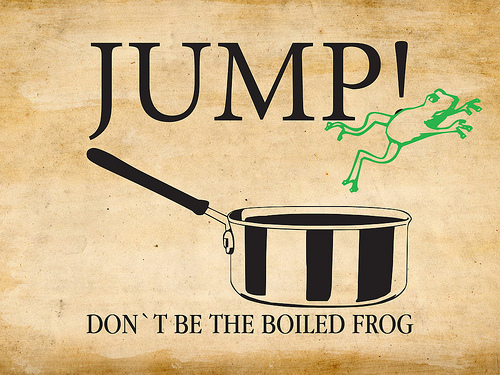
In times of crisis we can continue to make adjustments only to realize too late that it is TOO LATE. We become a Boiled Frog
Put a frog in a pot of water and turn the burner on. As the temperature of the water rises, the frog will adjust its body temperature accordingly. The frog continues adjusting with the increase in temperature. When the water is about to reach a boiling point, the frog is no longer able to adjust anymore and tries to jump out. TOO LATE. The frog tries to jump but is unable to do so, it has lost all its strength in adjusting with the rising water temperature…
Very soon the frog dies.
What killed the frog?
Many would say the boiling water. The truth is the frog was killed by it’s own inability to decide when it had to jump out
Every organization needs to adjust to events and to those unavoidable crises. The difficult part is knowing when to adjust and when to confront and face the situation. Too often club owners, managers or administrators adjust, adjust, adjust- only to realize too late that the water is going to boil.
We have to decide when to jump.
And jump while we still have the strength.