Winter Weight Gain. Nature or Nachos?
Everything about summer supports my bodily ideal: the salads, the swimming, the sunlight. It’s easy to feel the “Whee!” when your spirit, calorie burn and healthy glow are free, free, free. I dive in, a middle-aged gymnastics coach counting my play days until September and falling, giddy and exhausted, into bed each night, windows open and alarm clock set.
And then it’s over, gone, both the season and the body reduced to a shiver, stilled by gray skies, oppressed under the blanket of seasonal fact. I’ll be honest: A tiny part of me welcomes the pause, the dawn-to-dusk debauchery having left me tired and hungry. Largely, though, I manage to cling to my summer me until November, when early darkness drives me toward a different light, one whose radiance is contained only by a door. Opening the refrigerator, I reach for comfort foods to assuage my discomfort with the calendar before crawling under the comforter, the fridge door open all this uncomfortable time, my weight shifting from foot to foot and season to season.
The light takes me to a dark place. I skip first one and then another workout, my cold-weather athletic wear still in storage, see, and my son needing help with algebra homework. (And we all know what a big help I am with algebra homework!) Day three’s dodge ensures that my return to the pool/road/class/weight room will hurt, the dread of which extends my rest and recovery “day,” singular, to four days.
My body genetically knows to add padding for protection against winter’s cold. The fall harvest is aptly timed so animals and humans can fatten up for winter. Early spring food stocks, after all, will be low when we lumber out of hibernation. So there! Winter weight gain isn’t my doing; it’s programmed into my being.
Trouble is, this anthropological cream pie exists only in my head and is whipped together independent of any proven science. Our ancestors didn’t have light bulbs to extend daytime. Their heat sources didn’t come with programmable thermostats. Bears can’t go to grocery stores, which are now stocked year-round with fresh and processed foods.
My case crumbling, I pull out the big guns: the Old Testament, whose Book of Ecclesiastes assures that “To every thing there is a season, and a time to every purpose under heaven.” Enough said?
Ah, but righteousness is a mental exercise. My body is still heavy and my spirit heavier still. Making healthy choices is a breeze in the summer, but he who’s doing the choosing remains the same. I’m the one making the choices that determine my weight, I mean, fate.
And so I hereby choose to honor the restorative gift that is winter; to rest well, eat wisely and read books by the fire. I WILL hit the gym daily.
And I did! I survived the winter. Bring on spring!
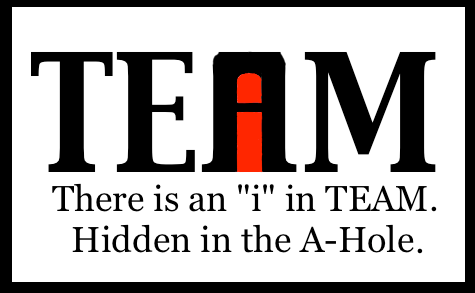
Being a TEAM
* When I first posted this- the last line was inadvertently left out after the photo. This was pointed out by a reader. SINCERE Thanks.
The last line SHOULD HAVE read- THIS WAS A REPOST from Tom Burdorf’s great blog. If you do not follow his blog- you should. He has a lot of great things to say.
When I was in High School (a fairly long time ago) I was often frustrated by the learning process. Each teacher viewed their class as THE MOST IMPORTANT THING. They did not work together. I had a 10 page term paper due in History and a 10 page term paper due in English. Could I use the same paper in both? NOPE.
I never understood the reasoning behind this. Why not have one, 15 page paper due. With the History teacher working in conjunction with the English teacher.
I see many gyms that work like that. The Vault Coach has a certain set of drills and conditioning that they insist MUST be done. The Floor coach has a certain set they feel, of course, must be done. The same is true for every event.
The beauty of gymnastics is that certain movements are shared at each event. As coaches we need to consciously make connections to make training more effective and efficient. We need to understand that that although we may target a particular event or muscle group they are all affected regardless of the emphasis. Ultimately the most important connection we must make is to connect the training to the competition. Never lose sight of the fact that the goal of training is to prepare the athlete for competition, therefore all training must connect to competition by thoroughly preparing the athlete for the demands of the competition.
Now although I am a HUGE advocate of working together. I also believe that there can only be one leader. Pick your cliche’
- a team with 2 starting quarterbacks is a team with out a quarterback. (ask the NY Jets)
- Too many cooks ruin the soup
- Too many Chiefs, not enough indians.
Work as a TEAM to come up with THE PLAN. F
ollow through by Implementing the PLAN. There will be a time when you will be the leader. There will be a time for you follow. When you lead- lead by example. When you follow, follow with gusto. I have seen too many gyms brought down by dissension. Work Together towards that common goal of gymnastics greatness.

THIS WAS A REPOST from Tom Burdorf’s blog (on Facebook) . If you do not follow his blog- you should. He has a lot of great things to say.
HAVE SOMETHING TO SHARE? Keep the momentum going!
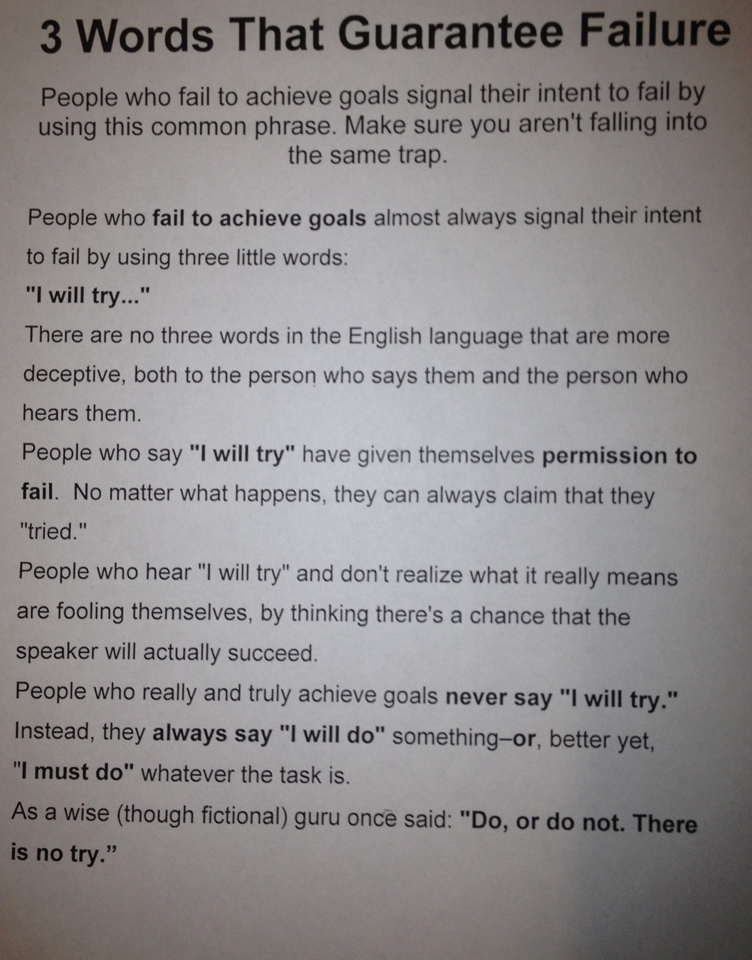
3 Words that Guarantee Failure
Dallas Gust from 10.0 Gymnastics Academy in Ft Worth sent me this photo! He has it up on the wall of his gym. A great reminder what it takes to be successful

Is it possible to, without a doubt, predict failure? Can you know, prior to even beginning a task that you will fail at it? I believe that just three words will ensure your failure even before you begin a task. What are those three words?
“I will try.”
It doesn’t matter the circumstance. If your boss asks, “Will this be done by Friday?” what do you really mean when you say, “I will try.” When your Mom says, “Will you be home for Thanksgiving this year?” what do you really mean when you say, “I will try.” Though we may not realize it or intentionally strive for failure, saying we’ll try is a far cry from saying we’ll do something.
Last night while watching the NE Patriots football game against Houston. Matt Schaub, the Texans QB jogged off the field and was given instructions by one of the coaches. Reading his lips, “I’ll Try”.
Game Over.
People who fail to achieve goals signal their intent
to fail by using this common phrase.
Make sure you aren’t falling into the same trap.
People who fail to achieve goals almost always signal
their intent to fail by using three little words:
“I will try…”
There are no three words in the English language that
are more deceptive, both to the person who says them
and the person who hears them.
People who say “I will try” have given themselves
permission to fail. No matter what happens, they can
always claim that they “tried.”
People who hear “I will try” and don’t realize what it
really means are fooling themselves,
by thinking there’s a chance that the speaker will actually succeed.
People who really and truly achieve goals never say “I will try.”
Instead, they always say “I will do” something–or, better yet,
“I must do” whatever the task is.
As a wise (though fictional) guru once said: “Do, or do not. There is no ‘try.'”
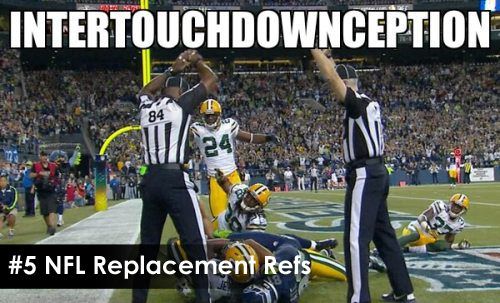
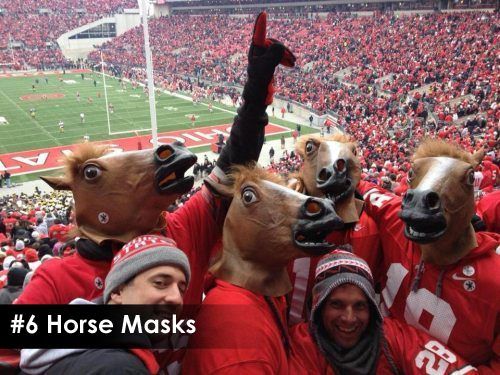
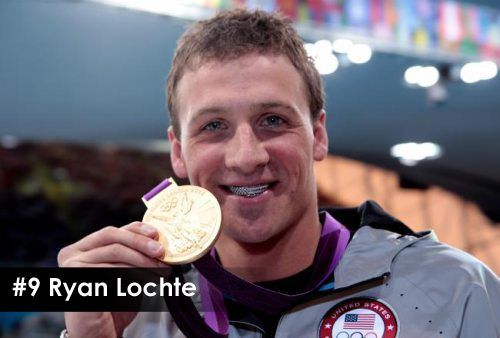
Things I will NOT miss from 2012 (and NEVER want to hear about again)
Things I Will Not Miss About 2012 (and never want to hear about ever again)
We had to endure the Electric Slide, the Hustle and, the Macarena. 2012 brought us, direct from South Korea, Gangnam Style. I don’t get it. Still it received over one billion views on Google’s You Tube. Frankly it is stupid. It has replaced YMCA and the Conga as the most embarrassing dance at weddings and celebrations – unless of course you are eight years old. Enough is enough.



TwilightYes, Robert Pattinson and Kristen Stewart might be easy on the eye but that’s the only appeal of Twilight, whose lovesick melodrama is surely only acceptable if you’re 15 years old and full of hormones. You like vampires? Watch The Lost Boys – in a battle for King of the Vamps, Kiefer Sutherland’s David Van Etten would beat Edward Cullen hands down.


MORE THINGS ON MY LIST
THE KARDASHIANS AND OTHER REALITY PSEUDO CELEBRITIES
FISCAL CLIFF – C’mon Congress. Do your job! And you wonder why your approval rating is lower than Nixon during the height of Watergate.
THE 1 PERCENTERS – I don’t know about you, but I am sick and tired of hearing about the “1 percenters.” Why does our society insist on the one hand deifying the rich and famous actors and athletes who are overpaid far more than bankers yet at the same time demonize successful entrepreneurs? Why can’t we think about the 100 percenters, that is everybody as a society in its entirety? Remember that more one percenters live in the “Sandy” states of New York, New Jersey and Connecticut than anywhere else. They are people too. Instead, politicians have to pit segments of society against each other. It is so counterproductive. We made it through World War II by being a nation of 100 percenters. We fought epidemics like AIDs as a nation of 100 percenters. Why change our strategy now?
STATES TALKING ABOUT SECEDING- Just stop it. You really aren’t going anywhere. Be part of the solution not part of the problem.
Gifts For Your Coach: 10 Gifts For Your Coach Under $50
Coaches are nearly impossible to shop for. They give you so much (and we’re not talking about presents!), how can you find the perfect gift in return? Even though you may wish you could splurge on a nice Corvette or a tropical vacation to show how much you love them, there are awesome, affordable alternatives that are even more thoughtful.
Calendar
A wall calendar with black and white photography by Ansel Adams is an elegant choice. It’s almost like buying your parents art, but you don’t have to spend a fortune.
“Cloud Atlas”
Slippers
Slippers are a cozy choice and will be appreciated for winters to come.
Your parents will appreciate the retro-meets-modern feel of this iPad speaker, styled after an old-fashioned gramophone. The speaker doubles as a charger and is available in four colors.
College Sweatshirt
Seniors, if you know where you’re going to college next year, get a head start and deck out your coach in college gear! Sweatshirts, t-shirts, and car decals are all awesome choices.
Holiday Coffee Sampler
If your coaches are useless before their first cup of coffee, this set of six coffees should be at the top of your shopping list. Now you KNOW, I am huge on buying local! So first see if you can get a coffee sampler from a local cafe. It will make you, your coach AND the local economy happy!
Hulu Plus
If your coaches are TV junkies, gift them with a Hulu Plus account for unlimited access to the site’s TV and movies.
Art
Spruce up your coaches office with a piece of art from Art.com, a site that sells famous prints for as low as $25. This work is called “Long Distance Romance” by Irene Suchocki.
Head Massager
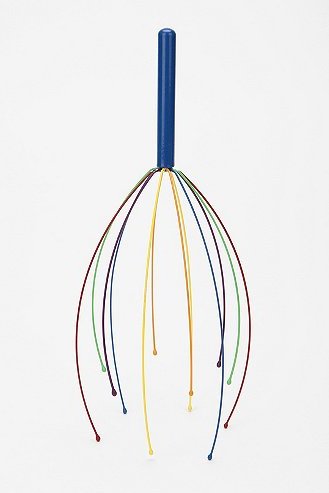
This head massager may look funny, but it brings pure bliss to your scalp. It’s perfect for a stocking stuffer. And it might help your coach relax and be in a better mood in the gym!
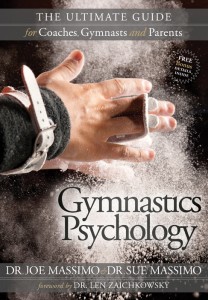
Truly a fantastic book that every coach should have.
And on the outside chance that any of my gymnasts are reading this, I’ll take the Corvette.
What’s on your Christmas list?
How to Deal with a Bad Week
According to my daughter, “This week, so far, has sucked.”
Yesterday, she cracked the screen of her phone for the third time this year. she broke her favorite sunglasses today, and a malevolent bird decided to relieve itself on the windshield of her car. Later, she decided to cheer herself up with her favorite smoothie, only to spill nearly all of it down the front or her shirt once she got home. All of these unfortunate events, compounded with the fact that she is doing much more poorly in her favorite class than I would like. This week it is enough to make her feel like a walking Murphy’s Law. While these events may not seem very significant or even that bad, they have made for an absolutely miserable week in the life of this melodramatic teenager.
Usually, if this string of events were to happen, she’d react with the typical teenage quick fix: mope and whine and make angsty tweets about her misfortune. This approach, while cathartic, is not a very healthy way to deal with the effects of a bad week. So this time, I have not let her unhappiness get the better of me, and I have come up with three key ways to help her keep her cool.
1) Gratitude. If you stop for a moment and force yourself to feel genuinely thankful for everything you DO have in your life, the small problems will seem even smaller.
2) Unwind. Cooking always helps me calm down, so I bought her a box of Ghirardelli double chocolate brownie mix today. Even if you still feel badly afterwards, at least you now have a batch of delicious brownies.
3) Laugh at yourself. I mean, it just gets comical eventually. You trip and fall on your face, realize you forgot your homework at home, spill all of your lunch on the ground, get a terrible grade on a test… After a certain point, it seems like you’re starring in a remake of “Just My Luck,” except Chris Pine isn’t your boyfriend.
The bottom line is that we all have bad days. There is always a day where everything goes completely against your will, and you can’t help it. But we all have good days as well. What makes the biggest difference is staying levelheaded and keeping perspective, so that you don’t lose sight of those good days that already happened and the ones that are to come. I’ll end with a quote from the wise Lemony Snicket, who wrote, “At times, the world may seem an unfriendly and sinister place, but believe that there is much more good in it than bad. All you have to do is look hard enough.” So look hard!
WHAT MATTERS
WHAT MATTERS
When searching for solutions to a problem It is not WHAT is the matter, that is evident, rather focus on WHAT MATTERS. In order to get meaningful results from training and competition it is imperative to focus on what matters. It is how you do what you do when you do it that counts.
Never discount passion and emotion, as they are integral parts of the human spirit.
Coach and teach with passion and emotion based on knowledge and reason that is what really matters. It is amazing how problems will then be minimized and when they do occur the solutions will be much clearer.
Short Term Thinking
If you only think of the short term and immediate results from training something will always be missing in the long term. Short-term thinking yields immediate results and long term stagnation. Always consider potential second and third order effects. What happens when the initial training effect wears off? Now what? Think process and big picture. Training is cumulative.
THE ULTIMATE “DON’T STRESS” FOR TEENS
Gymnasts are over achievers in so many areas. Sometimes, it can feel like everyone in your class has had a boyfriend or girlfriend before you have. Or everyone else is getting straight A’s while you’re stuck with a C in Math. Or, somehow, you’re not doing high school right, because your story doesn’t look anything like what you see in TV shows or movies about “the best years of your life.” You spend countless hours in the gym and you feel you may be missing something.
I’m here to tell you that it’s okay if you feel this way — and, in fact, it’s totally, utterly, and completely normal if most of your high school experience doesn’t feel like one epic “High School Musical”-worthy song and dance number. But it can be survivable (and maybe even fun, sometimes), if you can find a way to shake off the pressure you’re putting on yourself to find a prom date, or that perfect group of friends, and vow to stop being embarrassed about the things you like or do.
With this in mind, I’d like you to repeat after me,:
“It’s Okay If You…”
Haven’t had your first kiss by the time you graduate high school
Don’t have a date for prom
Don’t have a “best friend”
Have never had a “summer fling”
Don’t have straight A’s
Don’t win a senior superlative
Listening
What kept me up last night started with my frustration with a person at the gym.
The slight trick in the question is that, by asking you what you were hearing, I prompted your brain to take control of the sensory experience — and made you listen rather than just hear. That, in effect, is what happens when an event jumps out of the background enough to be perceived consciously rather than just being part of your auditory surroundings. The difference between the sense of hearing and the skill of listening is ATTENTION.
This is because hearing has evolved as our alarm system — it operates out of line of sight and works even while you are asleep. And because there is no place in the universe that is totally silent, your auditory system has evolved a complex and automatic “volume control,” fine-tuned by development and experience, to keep most sounds off your cognitive radar unless they might be of use as a signal that something dangerous or wonderful is somewhere within the kilometer or so that your ears can detect.
More complex attention kicks in when you hear your name called from across a room or hear an unexpected birdcall from inside a subway station. This stimulus-directed attention is controlled by pathways through the temporoparietal and inferior frontal cortex regions, mostly in the right hemisphere — areas that process the raw, sensory input, but don’t concern themselves with what you should make of that sound. (Neuroscientists call this a “bottom-up” response.)
But when you actually pay attention to something you’re listening to, whether it is your favorite song or the cat meowing at dinnertime, a separate “top-down” pathway comes into play. Here, the signals are conveyed through a dorsal pathway in your cortex, part of the brain that does more computation, which lets you actively focus on what you’re hearing and tune out sights and sounds that aren’t as immediately important.
In this case, your brain works like a set of noise-suppressing headphones, with the bottom-up pathways acting as a switch to interrupt if something more urgent — say, an airplane engine dropping through your bathroom ceiling — grabs your attention.
And yet we dare not lose it. Because listening tunes our brain to the patterns of our environment faster than any other sense, and paying attention to the nonvisual parts of our world feeds into everything from our intellectual sharpness to our dance skills.
Luckily, we can train our listening just as with any other skill. Listen to new music when jogging rather than familiar tunes. Listen to your dog’s whines and barks: he is trying to tell you something isn’t right. Listen to your significant other’s voice — not only to the words, which after a few years may repeat, but to the sounds under them, the emotions carried in the harmonics. You may save yourself a couple of fights.
A wise old owl lived in an oak,
The more he saw the less he spoke
The less he spoke the more he heard.
Why can’t we all be like that wise old bird? – unknown author
Yes, we were all taught (hopefully) to listen to our parents and to listen in school. However, few of us were taught good listening—the active, disciplined kind of listening that helps us examine and challenge the information we hear in order to improve its quality and quantity, and thereby improve our decision-making.
Mind Reading – Assuming you already know what the person is going to say while ignoring him/her and without bothering to ask questions to confirm your belief.
Rehearsing – No way to hear when you are practicing your next lines in your head.
Filtering – The only thing you’re going to hear is what you want to hear, nothing else.
Judging – You’ve already determined that the person speaking has no value for you, so you don’t bother to pay attention to what he/she says.
Dreaming – Something half heard sends you off into your own little world to think about a similar aspect in your own life.
Identifying – As someone shares an experience, you relate it back to your own life.
Advising – Before someone can explain, you are offering advice. You completely miss the point, the feelings and the scope, and leave the person feeling misunderstood.
Sparring – You listen, but only for something to disagree with, argue over or debate.
Being Right – You will rationalize, make excuses, shout or accuse the speaker of anything you can think of just to avoid being wrong.
Derailing – Bored or uncomfortable about what is said, you change the subject.
Placating – No matter what is said, you agree. You listen just enough to catch the places where you can agree.
Effective Listening (Do)
Now, here is a short list of tips to effective or empathic listening. You probably already do a lot of these, especially when the person and the conversation are particularly interesting to you. See if you can ‘catch’ yourself using any of these. Then, see if you can use them at will.
Acknowledge the speaker by being attentive, genuinely interested, alert and positive. Be in the moment and focused.
Show you are listening with “uh-huh”, nod your head, lean forward in a relaxed way, make frequent eye contact, and invite more to explore with open-ended questions.
Be a sounding board and a mirror by restating what is said in your own words. Let the speaker dominate the conversation.