USGCOA Charter Members

We would like to officially introduce the United States Gymnastics Club Owners Association. This is an independent organization that has been formed by US club owners to help provide guidance to USA Gymnastics in moving the sport of gymnastics in a positive direction. Our purpose is to be the trusted and unifying voice, advocate, and partner for owners of gymnastics clubs throughout the United States; and our priority is the safety and well being of all those involved in the sport of gymnastics.
We would like to publicly thank the club owners who have donated both time and money to ensure the formation of this much needed association. The following charter members donated $1,000.00 each to cover the financial and legal obligations in forming such an organization.
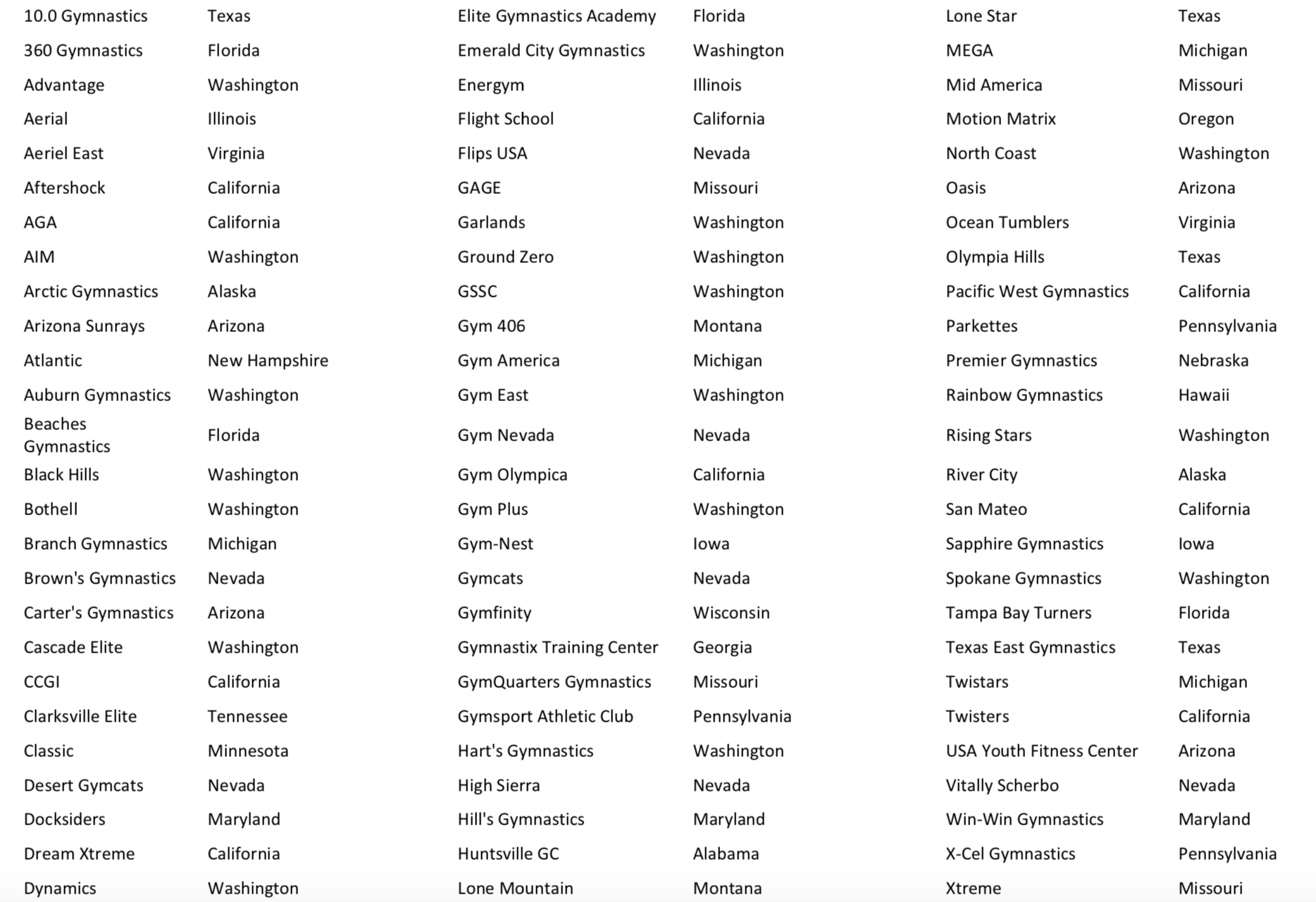
The charter members will have lifetime recognition on our website, and their donation will include their 2019 membership dues. Charter membership will close on December 31, 2018. If you are interested in getting more information, or attaining charter membership, go to our temporary website USGCOA.ORG. 2019 membership dues have been set at $350.00, and will be available for purchase within a few weeks.
Our intention is to share information as it becomes available. At this time, our branding is complete, our bylaws will be voted on very soon, and our permanent website will be live mid-December. We are beyond excited about the progress and recognition this association has already accomplished. We’ve had a very promising discussion with the current USA Gymnastics Board of Directors, and they have reached out for our opinion on more than one occasion! Together, our voices are being heard!
Wishing you all a very happy holiday season. Your support is beyond appreciated.
Sincerely,
USGCOA Board of Directors
US Gymnastics Club Owners Association. AGENDA for Upcoming Board Meeting
The USGCOA will have a Board of Directors meeting the weekend of November 30-December 2. If you have anything you would like addressed- please contact me.
Tony
USGCOA Board of Directors Meeting
Aria Hotel, Las Vegas
November 30 to December 2nd 2018
Agenda:
Greeting and Call to Order-
– Roll Call-
Announcements and recognitions-
– Approval of minutes-
Reports:
– *Finance-Kim Thomson
– *Membership-Sandy Flores
– *Website-Sandy Flores
– *Liason-Claudia Kretschmer
– *Bylaws- Brent Phelps
Business:
– mission Statement-
– *Discuss term limits and nominations to stagger term-
– *Summit- open annual meeting
– *Summit- hotel- non union hall- Cassie
– *Summit- suppliers association- vendors
Scott & Claudia
– *Summit speakers-
– *Ways to combat the negative -Partner with vendors or other org. For a positive campaign…’Got milk?’
– *Lobbying arm to talk to congress. Ie) safe sport, innocent until prover guilty.
– *Athlete wellness-Cassie
– *Note from Karen Golz
– *Note from Holcomb
– *Decertification
– *Polling membership and polling question development- Scott
Loyalty. Your staff will only be as Loyal to YOU as you are to THEM
Loyalty. Your staff will only be as Loyal to YOU as you are to THEM
We spend countless hours trying to build loyalty and trust with our gymnasts but not nearly enough time with our staff. Loyalty and trust is a priceless commodity which actually costs you little more than time. It is not based on perks or fear-driven. It is earned by creating a culture in your gym that values teamwork .
Culture exists in every workplace whether it is by design or default. An improved work culture in your gym increases engagement and productivity. It also will help get everyone on the same page. I like my gyms to be fun and I like to have contests (sometimes crazy) with my staff. BUT THAT ISN’T THE CULTURE OF THE GYM. It’s not just about fun and games and wacky perks. People want to be proud of the organization they work for. They want to feel a sense of achievement and deep fulfillment.
Make your people your top priority.
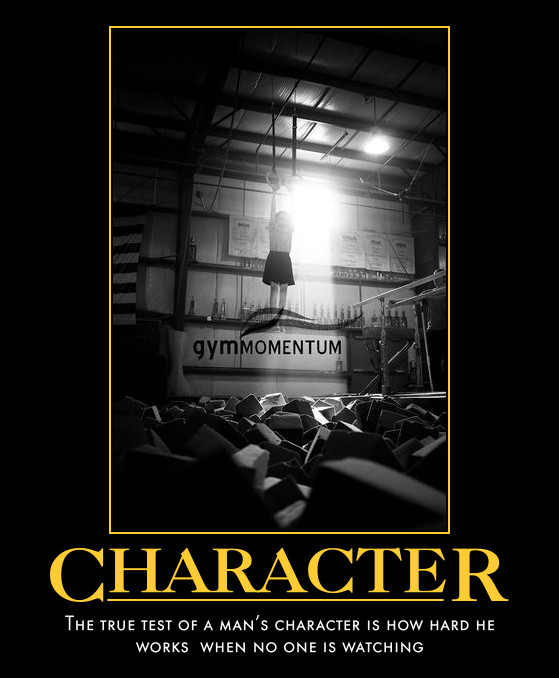
Culture is what guides your coaches when you are not around. It’s what you do when no one is looking. Loyal employees will tell everyone how great your gym is. They will uphold your brand and ensure the sustainability of your business. As Richard Branson famously said, “Train people well enough so they can leave; treat them well enough so they don’t want to.”
Coaches will be attracted to your gym if they feel they will have an opportunity to grow. To become a better coach and to have an opportunity to contribute to the organization. When you become a partner with your staff and help them build their career path instead of a BOSS- You become a leader.
Entrepreneur Magazine lists seven strategies that will help coaches feel valued and invested in and where both business and people flourish. (1)
1. Screw the performance review.
We give constant feedback to the gymnasts we work with in the gym. We tell them what they did well and what corrections they need to make. People like to receive feedback and be recognized when they get things right. Consistency is the key, not a one-off comment one time per year. Consistent communication creates a safety net where misunderstandings can be minimized and employee commitment and loyalty are celebrated.
2. Humanely wired to connect.
Strong bonds in the workplace encourage a more positive work environment, support people to step into a thriving world and enhance the overall well-being of the company. Fostering team activities provides opportunities for relationships to develop strong collaborative bonds that lift each other up in times of celebration and in times of need.
3. Plug in.
People contribute to the success of the entire business. Value is created by hungry, loyal and happy employees. A survey conducted by Korn Ferry found 33 percent of employees planned to look for a new job due to being bored and needing a new challenge. Leaders who are plugged into the organization listen with open ears and are present for improvement conversations.
4. It starts at the top.
Simply put- Lead by Example. If you want your coaches to make education a priority they need to see you make education a priority.
5. When people leave, ask why. When they stay, ask why.
Every gymnast and coach in your program is someday going to leave your program. I could be for family reasons, school or that YOU ARE A JERK. Ask the why.
6. Success leaves clues.
What we do is NOT unique. The annual list of Achievers 50 Most Engaged Workplaces is a great place to discover what other companies are doing to build employee loyalty. Be a gym dedicated to improving their culture by investing in you staff teams and fostering an environment where people work hard, care about each other, innovate and have fun. By constantly seeking progress and moving toward an environment that nurtures people and business, loyalty increases, and business success is boosted.
7. Leaders cultivate leaders.
Accenture Strategy Study showed that the class of Gen Z, the so-called “digital natives,” crave the human element. Forty-two percent show a preference for in-person meetings and seek a supervisor who will mentor and coach them as a top priority. When you feel your input is trusted, people respond positively. Trust inspires people to rise above the line. When you invest in your people, they will rise to the occasion. When you don’t, they will also rise to the occasion. Investing in leadership skills early on benefits the workforce and the business at large.
1. Angela Kambouris. 2018. Your Team Will Only Be as Loyal to You as You Are to Them. Entrepreneur Magazine. August 27, 2018
Takashi Kobayashi is dead – Gymnastics Coaching.com
Source: Takashi Kobayashi is dead – Gymnastics Coaching.com
Takashi Kobayashi is dead
 As feared, the great coach and coach educator Kobayashi sensei passed away on the evening of July 20 Japan time.
Stomach cancer.
His funeral will be held in Yokohama, his home town, on the 24th (the vigil on 23rd).
Takashi was one of the most widely admired and respected coaches worldwide. His philosophy and techniques shared through FIG coach education events greatly appreciated.
US men’s soccer team didn’t make the 2018 World Cup for this reason
I am staying at a hotel outside of Boston on the first day of GYM MOMENTUM CAMP. I enjoy watching the FIFA World Cup, I certainly had teams I was cheering for (Iceland early on, then Sweden and England. I apparently suck at this btw) and I was wondering what happened to Team USA? I spend a lot of time in Italy and EVERYONE there cantle you why they didn’t make it this year.
As I sipped my coffee I saw an editorial in USA Today on WHY Team USA didn’t make the World Cup. There are some pretty good points.
Source: US men’s soccer team didn’t make the 2018 World Cup for this reason
As soccer’s 2018 World Cup winds down, there is no American men’s team in the finals — or even the tournament. For all of America’s wealth and population, the U.S. men’s team was eliminated by … Panama. Adding insult to injury, Panama lost every game they played, including a 6-1 thrashing by England.
What happened? Why is our men’s soccer team so weak?
Pundits may place blame at the highest levels — the president of the U.S. Soccer Federation, or the coach of the national team. But maybe the problem is not at the top. Maybe it’s at a local field, where kids practice in fancy uniforms under the eyes of anxious parents, hands-on coaches and vigilant referees. Kids stand in line kicking balls through cones, listening to lectures about technique and tactics.
They are not playing soccer, they´re practicing it. But soccer is a game. To learn the beautiful game, they need to play it.
Teams that win teach their kids differently
Around the world, kids play in mixed-age pickup games, un-coached, without parents, uniforms or shin guards. They play with different-sized balls, not on grass, but on hard, fast, small courts packed with kids, where real skill is required just to control the ball, and the basic skills of the game teach themselves.
The greatest player of all time, the Brazilian legend Pele (Edson Arantes do Nascimento), learned to play soccer barefoot. The “Shoeless Ones” was the name of his first team. He had no cleats, cone drills, or heroic soccer parents carpooling to practices, games, and tournaments. His ball was a sock stuffed with rags.
In some of the countries that eliminated the U.S. from the World Cup, that same lack of equipment and organization at the grassroots results in the sort of creative and fast-paced game that American soccer has not produced.
(My cousins run a soccer team in their town in Italy. First time I went to see the boys play I noticed they didn’t have referees. They also didn’t have shin guards (or grass!). I asked about the shin guards. He said, they do not get them until they are 13 years old. This forces them to focus on how to handle the ball and control play. )

No Refs, No shin guards, No grass.
Are American kids learning to really play?
Many kids are left behind in a pay-to-play system that excludes huge swathes of America´s youth. Those who can pay find themselves in ever fancier uniforms, participating in ever-more-tightly organized practices. Our kids travel for hours, often across state lines, and even across the entire country in search of “outstanding” competition, sometimes spending more time traveling than playing. What skill are they learning?
Of course some may obtain a college scholarship, which in men´s soccer might coverthe cost of books. An even tinier sliver may make it to the pro ranks. But any fan watching our men’s national team in action can recognize that the products of America’s “soccer industrial complex” lack the creativity and skill on the ball to be world-class.
This could be the solution
Just maybe, the keys to getting a U.S. men’s team to the World Cup and a child’s happiness are the same. Perhaps the quest for perfect equipment, perfect fields and perfect competition in an adult-driven system has prevented our kids from developing the skills, instincts and creativity to master the beautiful game.
To become a soccer-playing nation, we need to rethink how the game is learned and played at the grassroots level, even if it means not playing on grass at all. Because what we´re doing right now isn’t working. No wonder participation has declined by around 24% in recent years.
With soccer, less may be more. In the early years, forget the drills, equipment and travel. Let the kids play on the speedy blacktops, concrete and hard-packed dirt abundant across the fruited plain. Let younger kids learn by copying older kids. The simple supervision of a YMCA, parks and recreation program or local club is all the organization needed.
The same countries where kids first learn a “shoeless” game have carefully controlled systems at higher levels. But at the grassroots, their kids are playing. Ours are not. Their kids are winning. Ours are not.
The solution is simple. The cost- and time-savings are staggering. And the organization and infrastructure already exist. Let’s strip off the gear, throw out the expensive system and take soccer back to the creativity of the streets. Like Pele, let’s go “shoeless.”
Carlo Celli and Nathan Richardson are professors in the Bowling Green State University Department of World Languages and Culture and authors of the book “Shoeless Soccer: Fixing the System and Winning the World Cup.”
Science: You Get 150 Friends and 25 Places (So Choose Well) | Inc.com

Source: Science: You Get 150 Friends and 25 Places (So Choose Well) | Inc.com
Germans have the concept of the stammtisch. Greeks frequent their stegi. Brits are loyal to their local. Around the world, it seems, people have a tendency to form strong attachments to a neighborhood hang-out. Just how much are we creatures of habit when it comes to where we spend our time? A new study offers a surprising answer.
You’re not as adventurous as you think.
We all like to think of ourselves as adventurers out to sample all the amazing sights, sounds, and places the world has to offer. We travel. We try new restaurants. We keep on top of the hottest new bars in town. All this activity creates the impression that we go to lots of different places, but when a team of European researchers used cell phone data to trace the life paths of 40,000 people of all ages, they discovered a very different picture.
At first, the team followed 1,000 students and found that, actually, they each went to only 25 separate locations. The students might add a new place to their repertoire, but when they did an old place would fall out of favor. Surely, this must just be just campus-bound kids, the researchers thought, so they expanded their study to tens of thousands from all walks of life around the globe. The results were the same, surprising the researchers.
The data clearly showed that while we might join a new gym, discover a new favorite bar, or start frequenting a different park for lunch, we also then stop going somewhere else. In short, there appears to a be a hard limit to how many places we keep in the rotation at any given time.
“People are constantly balancing their curiosity and laziness. We want to explore new places but also want to exploit old ones that we like,” commented Andrea Baronchelli, a researcher in the Department of Mathematics at City, University of London and study co-author. “We found that this dynamic yields an unexpected result: We visit a constant, fixed number of places–and it’s not due to lack of time.”
You become who you know… and where you go.
This isn’t the first time that scientists have uncovered a built-in limit to the number of connections in our lives. Research has established “Dunbar’s number,” which is the maximum number of social relationships any person can maintain at a given time. In short, your brain can only handle having 150 friends at once.
Something similar seems to be going on with our ties to places as well as people (though the researchers caution more study is needed). The world may be your oyster, but your brain simply can’t keep a handle on more than 25 places at once.
So what’s the take away from this study beyond the fascination factor of knowing you likely have a hard stop on the number of places you go built into your psychology? The findings definitely help explain why my husband and I always find ourselves back at the same handful of restaurants despite constantly claiming to want to try new places, but it also puts greater pressure on all of us to choose our hangouts well.
Whether you ask interior designers, real estate agents, retail entrepreneurs, or basketball stars, the evidence is clear: location matters. A lot. Where we spend our time affects our mindset, our opportunities, our serendipitous encounters, and even our physical health. Just like your friends heavily impact who you become, so do your surroundings. Knowing you only get to split your life between a couple of dozen places means you really have to choose those places well.
So get out there and make sure your portfolio of places is as exciting, inspiring, and joyful as it could be.
Podcast with Nick Ruddock
While on a trip to the UK and Germany I was able to meet up with Nick Ruddock and we recorded a Podcast.
I’m episode 006. (kind of wish I was oo7).
Let’s get back to Gymnastics. Enough of the B.S.
A bit of a rant but this is how I am feeling today.
I just read the letter from Kerry Perry. I am feeling pretty annoyed because USAG was supposed to begin a transparent future. It does not seem like they are.
They have created an information vacuum and only react to things. They seem to move from crisis to crisis. By not putting out information and still lacking transparency they leave the “news” to the trolls on twitter and FB who fill the void with insane thoughts and ideas.
I’ve said it to many of you individually but working with USAG right now is like having an alcoholic friend. You love them, but they keep making bad choices.
USA Gymnastics is in a tight spot. There is a lot of change that needs to happen. I understand that they are prevented and counseled from making statements. But please- tell us anything.
So, enough of the bullshit. We need people who will build us up not tear us down. We need critical thinkers and creative minds. Not just reactionary hacks.
We need individuals who can stand up to the media and answer questions. We need people who will not just do what is right but will surround themselves with others who want to do the same.
We need leadership.
We need someone to say, Enough of the Bullshit. Let’s go do gymnastics.
Tony
USAIGC Business Policies and Procedures
USAIGC/IAIGC
BUSINESS POLICIES & PROCEDURES
http://usaigc.com/business.cfm
http://usaigc.com/business_briefs.cfm
JUST ADDED
Writing Business Policies and Procedures helps ensure “product quality” because regardless of the business the product is only as good as the process the service delivers to the customer. In our Gymnastics World your service is the teaching of Gymnastics Skills and any other programs which have a benefit for a child/student/team member.
Writing business policies and procedures help to:
-ensure product quality
-ensures consistency in practice
-helps to maintain product quality/gymnasts learning/progress and the benefits that go with learning gymnastics.
– Your Club Owners Policies set the expectation for employee’s behaviors and the Business Proceduresoutlines the steps for it.
Reasons to Write A Business Policy and Procedure Book:
1. Articulation of Required Steps
A procedure should lay out the required steps to perform job tasks or provide a service to a customer. For example, for a waiter who serves in a restaurant, the service should be delivered by introducing themselves, making eye contact with the customer, offering the most popular menu items, ensuring all drinks are topped off when half-filled and ensuring food quality meets the customer’s expectations.
WHAT IS YOUR BUSINESS ARTICULATION OF REQUIRED STEPS? Detailing the procedure for delivering great service to customers is what contributes to a great service/learning environment.
2. Performance Measures Procedures should be used as a tool to measure an employee’s performance by determining if the process was followed appropriately. For example, a procedure for a receptionist answering the telephone should include a tracking of how often the receptionist answers the phone using a telephone script.
For Gymnastics an example of Performance would be CLASS RETENTION & GROWTH. The Goal for every club owner is to provide excellent service which should increase your bottom line.
3. Process Consistency When procedures are followed, there is consistency in practice for work processes. This helps to ensure that things are done the same way, every time and that all steps are followed. When steps get skipped it creates an inconsistent process that then creates variations in product or service quality.
4. Serve as a Training Tool: Employee Training is one of the most valuable investments any organization can make. When employees receive thorough training and detailed job descriptions, they are prepared to complete job tasks.
5 Benefits of Employee Training
1. Recruitment: When prospective employees assess an organization to determine if it is a good fit, they look at the employee benefit package.
2. Business Advantage
Employee skills current in order to be competitive.
Keeping up with changing software programs, technology changes, customer service skills or leadership trends are examples of competitive advantages organizations can have with a well trained work force.
Gymnastics: Instructor: is a professional individual, dresses appropriately, knowledge of teaching the skill level, good personality, good communication skills and an ability to teach multi-levels in the same class when necessary
3. Employee Morale: Most employees stay satisfied in a job for a period of time and then look for growth opportunities. Employee who continually develop their professional skills or pursue higher education, are hopeful that there will be career advancement opportunities in their future. This can also help employees remain positive and contribute to the vision of the organization.
4. Employee Contributions: Employees who are in school often bring back what they learn to the organization and apply learned concepts to the job. This offers value to the organization and provides for real life application for the student. It is definitely a win-win for both.
5. Employee Retention: This kind of policy should be considered carefully. Training impact has on an organization’s recruitment, retention and employee morale.
It is one of the most valuable investments any organization can make. When employees receive thorough training and detailed job descriptions, they are prepared to complete job tasks. Using policies and procedures as part of employee training helps to ensure that there is consistency in practice and reinforces global expectations. For example, a review of policy and procedures should be included in a new employee orientation process
5. Incorporates Worker Experience: Policies and procedures build off of those who have been performing the job tasks and documents work methods of experienced employees. It also incorporates lessons learned and best practices to ensure quality products and services in addition to safety and legal compliance.
6. Training Refresher Having a written policy and procedure manual can be used as a tool to help train employees and serves as a reminder of procedure steps and expectations.
7. Foundation for Process Improvement: When policies and procedures are reviewed and employees, customers and quality data is considered in the review, it can serve as a great template for improving what is done and can help to improve current processes.
Other Things to Remember:
- • Policies and procedures need to be reviewed and updated at least annually to make improvements and keep them current.
- • Employees need initial training on procedures but should have continuous refreshers to inform them of changes in practice and to remind them of expectations for following procedures.
- • Records should be kept in employee files to document training.
- • Policies and procedures should be consistently reviewed for its effectiveness and to ensure that what is being done in practice is adding value.
- • Most procedures should have checklists that simplify the process and serve as a reminder for employees.
As organizations grow it is important to put those things in writing that the organization values and deems important. Doing so in a detailed policy and procedure manual, that is shared with employees, can help to ensure that products and services maintain the high quality that customers expect.
Writing Business Policies and Procedures helps ensure “product quality” because regardless of the business the product is only as good as the process the service delivers to the customer. In our Gymnastics World your service is the teaching of Gymnastics Skills and any other programs which have a benefit for a child/student/team member.
Writing business policies and procedures help to:
-ensure product quality
-ensures consistency in practice
-helps to maintain product quality/gymnasts learning/progress and the benefits that go with learning gymnastics.
– A Club Owners Policies set the expectation for employee’s behaviors and the Business Proceduresoutlines the steps for it.
7 Reasons to Writing Business Policies and Procedures:
1. Articulation of Required Steps A procedure should lay out the required steps to perform job tasks or provide a service to a customer. For example, for a waiter who serves in a restaurant, the service should be delivered by introducing themselves, making eye contact with the customer, offering the most popular menu items, ensuring all drinks are topped off when half-filled and ensuring food quality meets the customer’s expectations.
Detailing the procedure for delivering great service to customers is what contributes to a great service/learning environment.
2. Performance Measures Procedures should be used as a tool to measure an employee’s performance by determining if the process was followed appropriately. For example, a procedure for a receptionist answering the telephone should include a tracking of how often the receptionist answers the phone using a telephone script.
For Gymnastics an example of Performance would be CLASS RETENTION & GROWTH. The Goal for every club owner is to provide excellent service which should increase your bottom line.
3. Process Consistency When procedures are followed, there is consistency in practice for work processes. This helps to ensure that things are done the same way, every time and that all steps are followed. When steps get skipped it creates an inconsistent process that then creates variations in product or service quality.
4. Serve as a Training Tool
Employee training is one of the most valuable investments any organization can make. When employees receive thorough training and detailed job descriptions, they are prepared to complete job tasks.5 Benefits of Employee Training
1. Recruitment: When prospective employees assess an organization to determine if it is a good fit, they look at the employee benefit package.
2. Business Advantage
Employee skills current in order to be competitive.
Keeping up with changing software programs, technology changes, customer service skills or leadership trends are examples of competitive advantages organizations can have with a well trained work force.
Gymnastics: a professional individual, dress appropriately, knowledge of teaching the skill level, good personality, good communication skills and an ability to teach multi-levels in the same class when necessary
3. Employee Morale: Most employees stay satisfied in a job for a period of time and then look for growth opportunities. Employee who continually develop their professional skills or pursue higher education, are hopeful that there will be career advancement opportunities in their future. This can also help employees remain positive and contribute to the vision of the organization.
4. Employee Contributions: Employees who are in school often bring back what they learn to the organization and apply learned concepts to the job. This offers value to the organization and provides for real life application for the student. It is definitely a win-win for both.
5. Employee Retention: This kind of policy should be considered carefully. Training impact has on an organization’s recruitment, retention and employee morale.
It is one of the most valuable investments any organization can make. When employees receive thorough training and detailed job descriptions, they are prepared to complete job tasks. Using policies and procedures as part of employee training helps to ensure that there is consistency in practice and reinforces global expectations. For example, a review of policy and procedures should be included in a new employee orientation process
6. Incorporates Worker Experience: Policies and procedures build off of those who have been performing the job tasks and documents work methods of experienced employees. It also incorporates lessons learned and best practices to ensure quality products and services in addition to safety and legal compliance.
7. Training Refresher Having a written policy and procedure manual can be used as a tool to help train employees and serves as a reminder of procedure steps and expectations.
8. Foundation for Process Improvement: When policies and procedures are reviewed and employees, customers and quality data is considered in the review, it can serve as a great template for improving what is done and can help to improve current processes.
Other Things to Remember:
- • Policies and procedures need to be reviewed and updated at least annually to make improvements and keep them current.
- • Employees need initial training on procedures but should have continuous refreshers to inform them of changes in practice and to remind them of expectations for following procedures.
- • Records should be kept in employee files to document training.
- • Policies and procedures should be consistently reviewed for its effectiveness and to ensure that what is being done in practice is adding value.
- • Most procedures should have checklists that simplify the process and serve as a reminder for employees.
As organizations grow it is important to put those things in writing that the organization values and deems important. Doing so in a detailed policy and procedure manual, that is shared with employees, can help to ensure that products and services maintain the high quality that customers expect.
—
Paul Spadaro – USAIGC President
450 North End Avenue – Suite 20F
New York, New York 10282
phone 212-227-9792, fax 212-227-9793
e-mail: paul.spadaro@usaigc.com
website: USAIGC.COM
450 North End Avenue – Suite 20F
New York, New York 10282
phone 212-227-9792, fax 212-227-9793
e-mail: paul.spadaro@usaigc.com
website: USAIGC.COM